The Japan Times
중도 성향
기타
Asics will spin off trendy shoe brand Onitsuka Tiger
Asics said that transitioning the 77-year-old brand to a more independent operating structure would enable faster decision-making.

"ASICS" · 총 20건
필터 보기현재 지수
49.5
0 = 부정 우세
50 = 중립
100 = 긍정 우세
최근 7일 기준 82,039건을 분석한 결과, 뉴스 심리지수는 49.5(균형)입니다. 긍정 10,216건(12.5%)·중립 59,099건(72.0%)·부정 12,724건(15.5%)이며, 중립 비중이 뚜렷하게 높습니다. 성향 지수는 종합 20.6(보수 경향)입니다.
Asics said that transitioning the 77-year-old brand to a more independent operating structure would enable faster decision-making.

“Make the color palette normal again,” one analyst said, as Lululemon’s stock sinks toward its lowest close since May 2018.
The bus lurched to a halt on the long, dry highway that takes you from Gwadar to Turbat. A clutch of men jumped out and sprinted towards the makeshift bathroom by the road. Some of them scattered into the bushes. Back in the bus, anchored to their seats, women stared out of the windows stiffly. They must have done the math before boarding: drink enough water to bear the heat, but not so much that you need to empty your bladder. Gwadar to Turbat is a short two hours. But it is eight long ones if you are heading to Karachi. A washroom on the Makran Coastal Highway between Turbat and Gwadar Balochistan’s new and smooth highways are praised as corridors of connectivity and trade and promise progress for a place that has long been politically and geographically distant from the rest of Pakistan. Motorway 8 goes from Ratodero to Gwadar, the N-10 runs along the Makran coast, the N-25 RCD Highway connects Quetta to Karachi and the N-40 that meanders towards the Iran border from Quetta to Taftan. But the praise for this network does not make up for the lack of safe and accessible public bathrooms for hundreds of kilometers. Where you do find one, it is rudimentary at best, a hole in the ground, a door that won’t close or lock and almost never any running water. To make matters worse, the women’s toilets are usually located in male-dominated spaces, such as roadside motels, dhabas, and bus stops. In Surab, washrooms are attached to the mosques and are strictly off limits for women. This neglect is now being challenged in court by Kulsoom Baloch, Fauzia Shaheen and Dr Quratulain Bakhtiari. They filed a complaint in the Balochistan High Court, arguing that the highways are deliberately designed to prioritise the cold mechanics of commerce at the expense of human safety, accessibility and equity. They said that the long stretch between Mastung and Kalat is the worst affected. There isn’t a single restroom for women when you travel from Quetta to Makran through Kalat and Mastung. The Karachi to Quetta-Chaman N-25 Highway is being widened into a double carriageway but toilets for women are missing from the plan. The government has to provide sanitation which is a constitutional right as Article 9 guarantees the right to life and dignity, 14 protects the dignity of the people and privacy at home, and 15 ensures the right to movement. “Men are socially free,” says Kulsoom. “They can go anywhere for nature’s call. Women are restricted socially and culturally, and their biological needs are different.” Unusable washrooms in Ormara and Gwadar Fatima, 46, describes one of her experiences. She was travelling from Turbat to Karachi for eye surgery with her husband and daughter. The bus had been on the road for a couple of hours until it stopped near a roadside hotel in Ormara. Ormara, located in Gwadar along the Makran Coastal Highway, is often the first and only major stop for buses travelling from Turbat and Gwadar to Karachi. During this journey, the first stop is usually this deserted hotel in Ormara, where bus drivers and conductors often receive free meals in exchange for bringing passengers. There were four bathrooms, supposedly for men and women both, and all of them were broken, dirty, and without door locks. She entered the dingy bathroom but her eyes kept darting towards the ajar door. Her daughter came to the rescue. “She held the door while I was inside … we had no other choice,” she says. “There’s a lingering fear that men nearby can see you. It feels humiliating.” At Gwadar’s Zero Point, which is about 90km from Hub town, there are two bathrooms, but both are unusable. “When the vehicle stops for security checks,” says Kulsoom, “women looking to use a bathroom are told to, ‘go as far as you can’.” The story is the same from Yousuf Goth Terminal in Karachi, used by passengers from Balochistan daily, to Khuzdar’s Chamrock Hotel and Restaurant (another bus stop). Dozens of women line up inside warehouses, waiting their turn to use the few available toilets. Women who regularly need to travel fall sick with urinary tract infections, diarrhoea and dehydration. Urologists warn that holding urine for hours on end causes bladder infections and serious kidney problems. In many parts blanket bans on night-time public transport are imposed when there is a threat of violence. Protests, road blockades, security checks and insurgent raids often leave women stranded for hours, if not days. A student, Saadia, was stuck on the M-8 Motorway for two days last year. “We did not have proper food, water or basic facilities. At one point, we walked several kilometres to a nearby bazaar just to use a bathroom,” she says. The only washroom at the Talaar Checkpost with proper signage and running water Saif owns a hotel on the Makran Coastal Highway at Ormara. He handles 15 to 20 buses daily with each bus carrying roughly 400 passengers. This means up to 800 travellers use his 19 bathrooms every single day. “Business is very weak these days, and on top of that, there is a major water issue,” he says. A broken sewerage system and chronic power failures cripple his efforts to maintain hygiene. He tried introducing a Rs10 upkeep fee to pay a dedicated cleaner but most passengers cannot afford to pay even this amount. He appealed to the transport companies to subsidise the maintenance cost as their passengers benefit from the stopovers without contributing towards sanitation. “The buses only stop for meals and then leave. We have spoken to bus operators time and again but they don’t cooperate,“ he says. It would cost around Rs300,000 to Rs400,000 to build good quality bathrooms. The local authorities hardly help small business owners like Saif who they fine instead of assisting with infrastructure grants or water tankers. “The Assistant Commissioner came once and fined me without any prior warning,” says Saif. He ordered him to build a chabutra (a raised platform) in the bathrooms but didn’t offer any financial support. The Balochistan Development Statistics report of 2018-2019 says the province has 42,911 kilometres of roads, with national and provincial highways connecting districts and towns. International highway design guidelines say that key rest areas should be constructed every 80km to 100km, with smaller stop points at every 50km. Washrooms along the route from Quetta to Makran If such designs were applied, the 653km Makran Coastal Highway for instance, would need at least seven rest stops. The 892km M-8 would need eight and the 487km N-85 Surab-Panjgur-Hoshab highway would need five. To pull this off, safe gender-segregated resting areas should be built in towns along these routes such as Awaran, Turbat, Gwadar, Chaghi, Pasni, and Ormara. In more isolated stretches, eco-friendly and water-efficient technologies could be viable alternatives to provide these spaces lighting, clear signage and proper maintenance systems. And infrastructure is only as good as the insight behind it. If women are not included in the designing, the facilities will fall short of their needs. As Kulsoom Baloch says, “True development begins with the basics. In Balochistan, it is always the opposite. Roads are constructed first, celebrated as progress.” No one even thinks of toilets.
O Jean-Talon é considerado um dos maiores mercados a céu aberto da América do Norte. Crédito: Kelly Jacob O Canadá oferece uma experiência de compras que vai das grifes internacionais com preços de outlet até produtos artesanais, passando por mercados a céu aberto, vinícolas premiadas e cidrarias familiares encravadas entre macieiras centenárias. A seguir, um roteiro detalhado para aproveitar ao máximo as compras por este país de dimensões continentais. Mercados públicos Antes de entrar em qualquer shopping, vale começar pelos mercados regionais, onde o Canadá mostra sua alma mais autêntica. St. Lawrence Market — Toronto, Ontário Localizado no centro histórico de Toronto, o St. Lawrence Market é um dos mercados públicos mais antigos da América do Norte. Sua história remonta a 1803. Em 2025, o complexo ganhou um reforço importante: o edifício norte (North Market), que havia sido demolido em 2015 para reforma, foi reinaugurado e voltou a abrigar o tradicional Mercado dos Agricultores, o Farmer’s Market, que ocorre desde 1803. No St. Lawrence Market se encontram queijos artesanais, pães de fermentação natural, cortes especiais de carnes, peixes frescos, mel de produção local, conservas, especiarias e produtos importados. O sanduíche mais famoso do local é o Peameal Bacon, famoso porque é típico canadense, com um corte magro de lombo de porco, curado em salmoura e envolto em farinha de milho. Fica ainda mais gostoso com mostarda. Mas não é só de sabores que vive o Saint Lawrence Market. É possível encontrar de camisetas temáticas canadenses a brincos, pulseiras, carteiras e outros itens pessoais. Há também utensílios domésticos. Visite os dois andares do mercado e una sabor às suas comprinhas preferidas. Durante o inverno, o mercado tem de tudo para o Natal, até pinheiros para as famílias levarem para casa! Marché Jean-Talon — Montreal, Quebec O Marché Jean-Talon reivindica o título de um dos maiores mercados a céu aberto da América do Norte. Inaugurado em maio de 1933, o mercado funciona o ano inteiro reunindo agricultores, açougueiros, padeiros, peixeiros e uma infinidade de produtores artesanais, inclusive alguns focados na diversidade de produtos fabricados a partir do xarope de bordo, ou Maple Syrup. De junho a outubro, nos fins de semana, as ruas ao redor do mercado são fechadas para pedestres. Lá se encontram produtos do terroir québécois, xarope de maple, cidras artesanais, geleias de frutos silvestres, ervas medicinais, até queijos franceses, massas italianas e temperos de todo o mundo. Os fins de semana de dezembro recebem um mercado natalino especial. Yonge Street Yonge Street — Toronto, Ontário Considerada uma das ruas mais longas do mundo, a Yonge Street é o eixo neural do comércio de Toronto. No trecho central, a rua concentra lojas de grandes marcas internacionais, butiques independentes, sebos, lojas de eletrônicos, souvenirs, bares, restaurantes, teatros e cafés. É o lugar ideal para quem quer combinar compras com um passeio a pé pela cidade. A Yonge Street, em Toronto, concentra lojas diversas e é considerada a principal rua de comércio da cidade. Crédito: Alamy Os Eaton Centres CF Toronto Eaton Centre — Toronto, Ontário Localizado no centro de Toronto, o CF Toronto Eaton Centre tem mais de 200 lojas. Em 2025 a Nike inaugurou uma loja de dois andares com mais de 2 mil metros quadrados, que inclui a primeira seção “Nike by You” do Canadá, onde é possível personalizar camisetas, moletons e tênis com estampas inspiradas na cultura de Toronto. No mesmo ano o Eataly, famosa rede italiana de gastronomia, abriu uma nova unidade de 2.300 metros quadrados no espaço. É lá também que fica a Apple, bem perto dos hotéis preferidos dos brasileiros e pronta para as comprinhas de eletrônicos. Centre Eaton de Montreal — Montreal, Quebec O Centre Eaton de Montreal é um dos principais centros comerciais e uma das atrações mais movimentadas do centro da cidade. O complexo surgiu nos anos 1970 no espaço conhecido como “Les Terrasses”. O atual Centre Eaton foi consolidado nos anos 1990 e hoje é considerado o maior centro comercial do centro de Montreal. O complexo funciona como shopping, polo gastronômico e acesso à cidade subterrânea de Montreal, o Réso. O local reúne mais de 125 lojas, restaurantes, cafés, serviços e áreas gastronômicas. Outlets e megamalls por todo o país Vaughan Mills — Vaughan, Ontário (Grande Toronto) A 32 quilômetros ao norte de Toronto, o Vaughan Mills é um megamall coberto com mais de 260 lojas. Marcas como Bass Pro Shops, H&M, Sport Chek, Winners e Tommy Hilfiger dividem espaço com outlets de moda, calçados e acessórios. Está ao lado do Canada's Wonderland, um parque de diversão da rede Six Flags e Cedar Fair, com a temática da Turma do Snoopy. Vale ir ao parque e às compras no mesmo dia. Toronto Premium Outlets — Halton Hills, Ontário Também próximo a Toronto, o Toronto Premium Outlets é o endereço certo para quem busca marcas de luxo com descontos. Com mais de 100 lojas, o complexo ao ar livre reúne Gucci, Prada, Coach, Burberry, Lululemon e outras grifes com descontos que podem chegar a 70% em relação ao preço de tabela. Yorkdale, Toronto O foco deste shopping é o luxo, das marcas esportivas ArcTeryx à Breitling, de relógios. É possível deixar as malas guardadas enquanto segue para as compras antes do embarque. É só agendar. Yorkville, Toronto As ruas do bairro de Yorkville em Toronto trazem marcas de luxo em um ambiente para compras a céu aberto. Não se espante em encontrar artistas de cinema e da música comprando, almoçando ou dando um passeio por lá. Prepare o bolso, nada ali é barato. O luxo reina nas lojas e no local! Premium Outlets de Montreal — Montreal, Quebec Montreal também conta com sua versão de outlet premium, que segue o modelo de espaço a céu aberto com marcas conhecidas a preços de fábrica. Localizado em Mirabel, o outlet é considerado o principal centro de compras outlet de Quebec. São mais de 80 lojas de marcas internacionais e canadenses com descontos que podem chegar a 65% durante as promoções. Entre as marcas mais conhecidas estão Nike, Adidas, Coach, Michael Kors, Tommy Hilfiger, Polo Ralph Lauren, Lacoste e Levi’s. McArthurGlen Designer Outlet Vancouver A poucos minutos do Aeroporto Internacional de Vancouver, este outlet traz um mix de lojas que atende os gostos do público brasileiro. Dica: leve o passaporte e vá ao concierge do shopping pedir seu cartão de descontos. O mix inclui Asics, Adidas, Armani, Coach, Jimmy Choo, entre outros, mas não tem eletrônicos. MEC: a meca dos esportes ao ar livre Fundada em 1971 em Vancouver como uma cooperativa de escaladores, a MEC (Mountain Equipment Company) é hoje a maior varejista de equipamentos ao ar livre do Canadá. Para praticantes de trilhas, esqui, camping, ciclismo, escalada ou esportes aquáticos, a MEC é parada obrigatória. A empresa vende roupas térmicas, botas, mochilas, barracas, equipamentos de camping, acessórios para hiking e roupas urbanas inspiradas no outdoor. A loja também é uma das principais referências para comprar artigos de neve como segunda pele, fleece, botas impermeáveis, luvas térmicas, roupas para neve e acessórios para frio extremo. Além de Toronto, a MEC possui lojas em várias cidades como Vancouver, Montreal, Calgary, Ottawa e Edmonton. A MEC é uma das principais referências do país para comprar, não apenas roupas esportivas, mas também artigos de neve. Crédito: Divulgação Souvenirs em Jasper Na cidade de Jasper, em Alberta, o comércio local concentra-se no centro histórico. Na Our Native Land, é possível encontrar joias em prata com motivos indígenas, mocassins com miçangas, esculturas em pedra-sabão, máscaras tradicionais e totens em miniatura, peças autênticas que representam a herança das nações originárias. O Jasper Tramway Gift Shop vai além dos souvenirs convencionais, com roupas de montanha, joias, obras de arte e publicações sobre a flora e fauna local. O Candy Bears’ Lair é parada certa: maçãs do amor artesanais, fudge e confeitaria de toda sorte feitas no local. A Jasper Artists Guild é uma galeria-espaço de trabalho coletivo mantido por artistas locais, onde pinturas, fotografias e artesanato celebram a paisagem das Montanhas Rochosas. Em Jasper as lojas do centro histórico vendem produtos variados, dos artesanais às roupas e itens de inverno. Crédito: Jasper Tourism Produtos locais e artesanais Maple Syrup, o ouro líquido do Canadá O maple syrup (xarope de bordo) é o souvenir mais democrático do Canadá. Quebec produz mais de 70% de todo o xarope de maple do mundo e nos mercados locais é possível encontrar todas as variações de cor e sabor, desde os mais claros e delicados (Golden e Amber) até os mais escuros e intensos (Dark e Very Dark). O produto é vendido em latas, vidros e garrafinhas temáticas em todo o país. O maple syrup, ou xarope de bordo, é um dos produtos tradicionais do Canadá e uma das principais opções de souvenir. Crédito: Freepik Cola 1642: o refrigerante artesanal de Montreal A Cola 1642 é um refrigerante artesanal premium produzido pela 1642 Sodas Inc. na região de Montérégie, próximo a Montreal. A bebida leva o ano em que Montreal foi fundada como nome e usa água mineral natural, açúcar de cana e xarope de maple como adoçante, sem corantes artificiais nem conservantes. O resultado é uma cola com sabor amadeirado e caramelado com notas de maple. É vendida em garrafinhas de vidro de 275 ml e está disponível em lojas de produtos locais, mercados e especialidades gastronômicas em todo o Quebec. Chocolates e confeitaria artesanal Em Montreal, a boulangerie-confeitaria Première Moisson, presente também no Marché Jean-Talon, é referência em chocolate e pâtisserie de influência europeia. Em Toronto, chocolateiros independentes se espalham pela Kensington Market e pelo Distillery District, produzindo tabletes com ingredientes locais como mel das Rochosas, flor de sal das Maritimes e maple em todas as formas. Nos mercados de Jasper e Banff, o fudge de maple e os chocolates temáticos com ursos e alces são os favoritos dos turistas. A confeitaria Première Moisson é referência em chocolate e pâtisserie de influência europeia. Crédito: Divulgação Temperos, conservas e produtos regionais Cada região do Canadá tem seus produtos gastronômicos de destaque. Na Colúmbia Britânica, salmão defumado e especiarias da costa pacífica. Em Ontário, queijos artesanais e geleias de frutas locais como damasco e maçã. No Quebec, o foie gras regional, os queijos de cabra, a charcutaria e as conservas de produtos da terra. Nos mercados públicos de qualquer cidade, é sempre possível encontrar artesãos e pequenos produtores com bancas repletas de molhos artesanais, vinagres de frutas, pastas de ervas locais e misturas de especiarias para churrascos e marinadas. Vinícolas e cidrarias Niagara-on-the-Lake: a região vinícola de Ontário A cidade de Niagara-on-the-Lake é o coração da produção vinícola de Ontário. É conhecida mundialmente pelo Icewine, o vinho de gelo, produzido a partir de uvas colhidas congeladas no pé, o que concentra os açúcares e resulta em um vinho doce e aromático. Entre as vinícolas mais visitadas estão a Jackson-Triggs e a Stratus Vineyards. É possível fazer passeios de bicicleta pelos vinhedos. Niagara-on-the-Lake está localizada no coração da principal região vinícola da província de Ontário. Crédito: Destination Ontario Big Apple — Colborne, Ontário Na Highway 401, entre Toronto e Kingston, a parada obrigatória para os fãs de maçã é a Big Apple, em Colborne. O complexo é marcado por uma enorme maçã de 12 metros de altura e funciona como loja, confeitaria e centro de atividades e agroturismo. Fundada em 1987, a atração vende cidras artesanais feitas com as maçãs da própria região, tortas caseiras, sucos e produtos derivados da fruta. As cidras do Quebec Quebec tem uma das mais ricas tradições de produção de cidra artesanal da América do Norte. A região de Montérégie, ao sul de Montreal, é pontilhada por pomares e cidrarias familiares que produzem desde cidras secas e espumantes até a rara cidra de gelo (cidre de glace), equivalente ao Icewine, mas feita com maçãs. Entre as produtoras mais tradicionais está a Cidrerie Michel Jodoin, em Rougemont, fundada em 1901 e conhecida pela cidra rosé feita com a variedade Geneva de polpa vermelha. A família Pedneault, na Île-aux-Coudres, ilha no Rio São Lourenço, produz cidras, geleias, queijos, pães artesanais e até sabonetes em uma propriedade de agroturismo que recebe visitantes para degustação. Em Rougemont e Mont-Saint-Grégoire, várias cidrarias oferecem roteiros de visita com colheita de maçãs no outono. O festival Soif de Cidre reúne dezenas de produtores independentes todos os anos. A relação entre Quebec e a cidra está ligada ao clima, à imigração europeia e à enorme produção de maçãs da província. Crédito: Pixabay Cafés canadenses Tim Hortons, ícone sob gestão brasileira Fundada em 1964 pelo jogador de hóquei Tim Horton, a rede está presente em todo o país servindo cafés, chás, bagels, donuts, sanduíches e os famosos Timbits — bolinhos fritos no tamanho de uma bola de golfe. Desde 2014, o Tim Hortons pertence à Restaurant Brands International (RBI), empresa formada após fusão com o Burger King e financiada pela 3G Capital, firma de investimentos brasileira-americana controlada por investidores brasileiros. A Tim Hortons é uma das maiores redes de cafeterias do país e tem brasileiros na sua gestão. Crédito: Divulgação Van Houtte e Second Cup A Van Houtte foi fundada em Montreal em 1919 e tornou-se referência em cafés de origem e blends especiais com lojas espalhadas pelo país. A marca trabalha com blends especiais, cafés de diferentes origens, torra artesanal, cafés aromatizados e linhas gourmet. A Van Houtte ficou conhecida especialmente por cafés torrados premium, cafés aromatizados de baunilha e avelã e blends franceses escuros. Já a Second Cup é uma rede canadense de cafeterias de especialidade fundada em Toronto em 1975. O nome “Second Cup” (“segunda xícara”) faz referência à ideia de que um bom café deve ser tão agradável que a pessoa queira repetir a experiência. A Second Cup foi uma das pioneiras no Canadá em popularizar o espresso, cappuccino, cafés gourmet, grãos especiais e bebidas artesanais. Está presente em todo o país, especialmente em grandes cidades como Toronto, Montreal, Ottawa, Calgary e Vancouver. Serviço Confira os roteiros: Abreutur CT Trade Tours
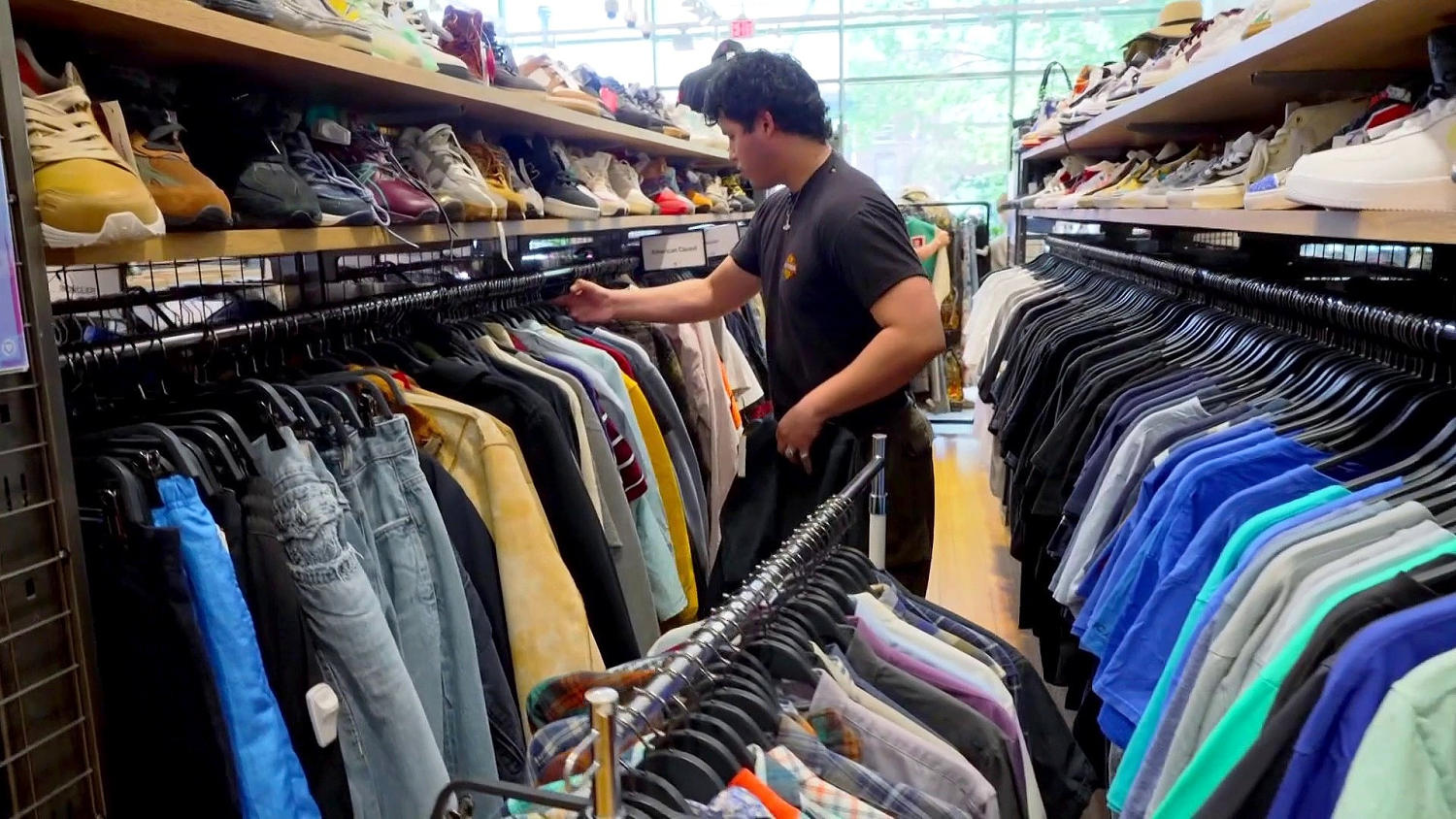
Buying and selling second-hand goods at thrift stores and online marketplaces like Depop are seeing a resurgence led by young shoppers hunting for a bargain. It comes as many Americans struggle to afford the basics with inflation at a three-year high and prices rising faster than wages for the first time since 2023. NBC’s Christine Romans reports for TODAY.
Indian stock market traded in deep red on Tuesday, with Sensex and Nifty falling more than 0.5% each as renewed tensions around the Iran-US war, along with persistent FII selling spooked investors.Sensex declined over 415 points to 73,852, while Nifty 50 fell 142 points to 23,240, as seen at 9.17 am. This came even as India VIX, which measures volatility in markets, tumbled 2.5% to 16.13.Bajaj Finance shares were the top losers on the index, falling nearly 3%. Eternal, Bharat Electronics (IBEL), Bajaj Finserv, Trent, NTPC, Power Grid, UltraTech Cement and L&T followed, dropping 1-2%. Bucking the trend, IT stocks including Infosys, TCS, TechM and HCL Tech gained 1-3%.Broader markets underperformed benchmarks, with Nifty Smallcap 100 and Nifty Midcap 100 indices falling around 1% each. Sectorally, Nifty Auto, Nifty Realty, Nifty Consumer Durables and few other indices declined more than 1% each. Bucking the trend, Nifty IT gained nearly 2%. Around 887 stocks advanced on NSE, while 1,650 declined and 97 remained unchanged.The trend of sustained AI trade, new records for markets in US, South Korea and Taiwan, sustained FPI selling in India and India’s underperformance are continuing with no immediate signs of reversal, said VK Vijayakumar, Chief Investment Strategist at Geojit Investments. “To add to India’s problems, the energy shock has led to downward revision of India’s GDP growth and upward revision of inflation this financial year. And now we have the additional threat of the IMD’s latest projection of monsoon rains at 90% of long term average, which will have negative implications for growth and inflation,” he added.A resolution of the West Asia conflict and the consequent dip in crude price will be a big positive, but expectations on that front have been belied and the issue continues to hang fire, the analyst explained. “In these tough times of huge uncertainty and challenges, the ideal strategy for investors is to stick to the basics. Do proper asset allocation based on one’s risk profile and financial goals and wait with patience,” he further said.Iran-US war uncertaintiesIran and US traded strikes, while Israel ordered troops to move further into Lebanon in its battle with the Tehran-backed Hezbollah militant group. The renewed tensions in the Middle East, after Washington hosted Israel-Lebanon peace talks on Friday, dimmed hopes that the US and Iran could soon announce an extension to their ceasefire, which continues to grow fragile.US President Donald Trump meanwhile took to Truth Social on Monday evening, saying that he persuaded Prime Minister Benjamin Netanyahu to call off the strike on Beirut, following which the Israeli leader "turned his troops around". "I had a conversation with Bibi Netanyahu today (Monday), asking him not to go into a major raid of Beirut, Lebanon. He turned his Troops around. Thank you Bibi," he said, referring to the Israeli prime minister by his widely used nickname.Trump said on Friday he would soon decide on a proposed deal to extend a ceasefire announced in early April. Israel would be key to any such deal, and Iran has said repeatedly that Hezbollah and Lebanon must be included. The US has proposed a "gradual de-escalation" plan, a US official said on Sunday.Oil prices riseBrent crude futures neared $95 per barrel mark while WTI Crude futures neared $92 per barrel as a result of the recent escalations. This comes after Brent and WTI Crude dropped 19% and 17% in May, recording their biggest monthly fall in absolute terms since March 2020 when the COVID-19 pandemic slashed energy demand.The rising military strikes in the geopolitically fragile Middle East raised worries over the prolonged closure of the Strait of Hormuz, a narrow 33-kilometre waterway connecting the Persian Gulf with the Gulf of Oman that handles over 20% of the world’s daily oil and gas shipments.FII selling continuesForeign investors remained net sellers of Indian equities, net selling shares worth nearly Rs 3,912 crore on Dalal Street on Monday. This came after a massive Rs 22,102 crore selloff in just one session on May 29. Notably, South Korea’s equity market has overtaken India’s as the world’s sixth largest, driven by a relentless surge in chip heavyweights powering the global artificial intelligence buildout.(With inputs from agencies)(Disclaimer: Recommendations, suggestions, views and opinions given by the experts are their own. These do not represent the views of The Economic Times)
Comments
During an interview with MS NOW's "The Weekend" panelist Eugene Daniels, Rep. Jim Clyburn (D-SC) acknowledged shortcomings in the Democratic Party's approach to addressing the concerns of black voters. The post Clyburn on Democrats: ‘We Have to Get Back to Some Basics — I Think That the Party Got Too Far’ appeared first on Breitbart.
People with coeliac disease say inflation and shrinking ranges are making food staples unaffordable Gluten-free versions of everyday staples such as bread and biscuits are becoming a luxury, with shoppers complaining that a “decent” small loaf now costs nearly £4. Consumers have always paid a premium for these specialist foods, making any price increases a source of concern, particularly for people who follow a gluten-free diet for medical reasons. Continue reading...
Making a film about the climate crisis is a daunting task. How does a filmmaker meet the urgency, enormity and impending doom of this crucial moment in time? Oscar-nominated “Fire of Love” director Sara Dosa goes back to basics: family, love, home. The documentarian partners with Icelandic poet and author Andri Snær Magnason to craft a […]
A FF Turbo Squared trampoline pod redefines the forefoot construction of the new Asics NovaBlast 6 running shoe
I have been an application-specific IC (ASIC) designer for almost three decades. Over that time, I’ve moved through the full academic trajectory, from graduate student to full professor; later, I transitioned to industry after an unsuccessful stint at entrepreneurship. When I made the switch to the private sector in 2019, I began focusing on a critically important aspect of the electronic industry: silicon intellectual property. As much as 80 percent of the physical area in today’s most advanced chips is occupied by blocks that aren’t made for specific products or even designed by the consumer-facing companies that built them. Instead, chipmakers draw heavily on established silicon IP from companies like Arm, Cadence, Rambus, Synopsys, and the company I work for, Silicon Creations. Throughout my career, I’ve designed chips for very different purposes, including enabling the research program in my academic lab and expanding the IP portfolio of my company. When I joined Silicon Creations, I had no idea how differently the industry approaches IC design and encountered a steep learning curve. Initially, it seemed that much of my two decades of academic research and training did not directly translate to the role. I had to learn new skills and adopt a new mindset. Today, demand for ASICs is rapidly growing, driven by the need for specialized chips in the automotive sector, AI applications, and more. By one market estimate, the ASIC market is expected to grow from US $23.4 billion to $38.8 billion by 2033, and the semiconductor industry as a whole is projected to hit $1 trillion by 2030. The industry needs more chip designers—but if you’re coming from an academic background as I did, there are a few things you’ll need to know. Different goals lead to different strategies The differences between industry and academe begin with a divergence in purpose. In academia, my primary objective was to generate new knowledge: to propose a novel circuit technique, validate an unconventional architecture, or explore the limits of performance in a given domain. A successful chip is one that demonstrates a concept. In industry, it is not nearly enough to prove that something can work. The goal is to ensure that it works reliably, repeatedly, and at scale. Success is measured not by novelty but by whether the silicon meets specifications, yields as expected in production, and supports a competitive product delivered on schedule. This leads to a stark contrast in risk tolerance. Academic designs often deliberately push into unproven territory, where even partial success can yield valuable insight. In industry, however, we systematically minimize risk. The cost of failure makes first-time silicon success a central requirement—especially at advanced technology nodes, where the lithography masks used to transfer circuit designs onto silicon wafers alone can cost tens of millions of dollars. As a result, industry design flows are built around eliminating uncertainty through conservative margins, extensive validation, and careful reuse of proven solutions. “Academia explores the design space, asking what is possible, while industry exploits it, determining what is viable at scale.” This paradigm has existed since the 1970s, when application-specific chip design was established. However, the gulf between academia and industry has expanded since the mid-2010s, when FinFET technology, a 3D architecture using vertical “fins” of silicon, was widely adopted in industry. System designs are also becoming increasingly modular with the advent of chiplets. This fundamentally altered the economics and complexity of ASIC development, with design costs rising by almost an order of magnitude. Initiatives like Taiwan Semiconductor Manufacturing Co.’s University FinFET Program and new government-funded chip-design hubs now let some well-resourced universities design for more advanced architectures, but the technology is still out of reach for many academics. What the industry-academia split means in practice Consider a startup developing an ASIC. Its engineering team may have deep expertise in a particular algorithm, sensor interface, or system architecture, the features that define its competitive advantage. But it is unlikely to possess world-class expertise in every supporting function. Developing each of these blocks internally would require significant time, capital, and specialized talent. Doing so could delay market entry beyond the startup’s viability. Even large semiconductor companies face similar constraints. Advanced-node development demands intense focus. Allocating a team to redesign a standard interface block that has already been implemented elsewhere may be difficult to justify when differentiation lies at the system level, such as an inference chip’s ability to speed up neural network computations. The time it takes to move a new chip from conception to market and risk mitigation, not self-sufficiency, govern most decisions about in-house development versus outsourcing. The economics of advanced IC manufacturing reinforce this reality. When the development cost of a leading-edge chip reaches hundreds of millions of dollars, minimizing risk becomes a central design imperative. In this context, silicon IP emerged as a practical solution. Similar to how software developers rely on preexisting libraries rather than writing every function from scratch, ASIC designers license predesigned, preverified silicon blocks—such as processor cores, memory interfaces, and security engines—from highly specialized IP vendors. These blocks can then be integrated into larger, increasingly complex systems. Design scope, verification, and time horizons With the use of silicon IP, industry is able to widen the scope of its designs. Academic efforts tend to focus on block-level innovation: a new analog-to-digital converter architecture or an ultralow-noise amplifier, for instance. These designs typically abstract away many of the complexities of bringing a chip to market, such as packaging constraints, long-term reliability, and manufacturing yield. In industry, the focus shifts to system-level integration. Modern systems on chips, or SoCs, incorporate dozens or even hundreds of functional blocks. Managing signal integrity, timing, firmware interaction, and system-level validation becomes as critical as the design of any individual block. Verification philosophy also diverges sharply. In academia, the goal of verification is to demonstrate that the concept works under nominal conditions, which may not always reflect how it would perform in real applications. Even if only a fraction of fabricated chips from a multiproject wafer operates correctly, the design may still be considered a success if it validates the underlying idea. At my academic lab for instance, we used to receive 40 chips from a TSMC prototyping service and started testing them in batches of five. If the first five or 10 chips proved functional, we had already collected more than enough data for a publication. If some of them failed, we weren’t required to mention this when publishing the results. In industry, verification is exhaustive, critical, and often dominates the development schedule. Failures are measured in parts per million, and even rare anomalies are carefully analyzed and documented to identify root causes and prevent recurrence. When I started at Silicon Creations, I was surprised by the level of detail and scrutiny designs face. Differences in time horizons and economic constraints reinforce each of these contrasts. Academic projects operate on flexible timelines aligned with research and funding cycles. If I missed a deadline, I just had to wait for the next cycle. Industry projects are driven by fixed product schedules and market windows, frequently targeting costly leading-edge nodes to achieve competitive performance, power, and area efficiency. Missing a deadline can negate the value of an entire design and may have major financial consequences along the entire supply chain. In essence, academia explores the design space, asking what is possible, while industry exploits it, determining what is viable at scale. Both are indispensable, but they operate under fundamentally different definitions of success. As ASIC complexity continues to grow, understanding both perspectives will be essential for the next generation of engineers navigating the evolving semiconductor landscape. This article appears in the June 2026 print issue.
Iranians are seeing the price of meat, and other basics, escalate due to the US blockade and sanctions.
From breezy basics at Aritzia to luxe-looking essentials from Quince and timeless staples from Simons, these wardrobe heroes will help you create your best-dressed summer 2026 yet.
ByteDance is set to procure millions of Qualcomm ASICs to support its AI agent software, marking a major push into AI infrastructure
REI’s annual Anniversary Sale — the retailer’s biggest of the year — is still going strong, letting you save on all kinds of outdoor essentials. If you’ve got a camping trip coming up, now is a good time to stock up on the basics, whether it be a tent, sleeping pad, or stove. If your […]
From leading brands like Nike, ASICS, and Lululemon, we're covering everything including trainers, stability support shoes, trail-ready designs, and more.
Many of the world’s most advanced electronic systems—including Internet routers, wireless base stations, medical imaging scanners, and some artificial intelligence tools—depend on field-programmable gate arrays. Computer chips with internal hardware circuits, the FPGAs can be reconfigured after manufacturing. On 12 March, an IEEE Milestone plaque recognizing the first FPGA was dedicated at the Advanced Micro Devices campus in San Jose, Calif., the former Xilinx headquarters and the birthplace of the technology. The FPGA earned the Milestone designation because it introduced iteration to semiconductor design. Engineers could redesign hardware repeatedly without fabricating a new chip, dramatically reducing development risk and enabling faster innovation at a time when semiconductor costs were rising rapidly. The ceremony, which was organized by the IEEE Santa Clara Valley Section, brought together professionals from across the semiconductor industry and IEEE leadership. Speakers at the event included Stephen Trimberger, an IEEE and ACM Fellow whose technical contributions helped shape modern FPGA architecture. Trimberger reflected on how the invention enabled software-programmable hardware. Solving computing’s flexibility-performance tradeoff FPGAs emerged in the 1980s to address a core limitation in computing. A microprocessor executes software instructions sequentially, making it flexible but sometimes too slow for workloads requiring many operations at once. At the other extreme, application-specific integrated circuits are chips designed to do only one task. ASICs achieve high efficiency but require lengthy development cycles and nonrecurring engineering costs, which are large, upfront investments. Expenses include designing the chip and preparing it for manufacturing—a process that involves creating detailed layouts, building masks for the fabrication machines, and setting up production lines to handle the tiny circuits. “ASICs can deliver the best performance, but the development cycle is long and the nonrecurring engineering cost can be very high,” says Jason Cong, an IEEE Fellow and professor of computer science at the University of California, Los Angeles. “FPGAs provide a sweet spot between processors and custom silicon.” Cong’s foundational work in FPGA design automation and high-level synthesis transformed how reconfigurable systems are programmed. He developed synthesis tools that translate C/C++ into hardware designs, for example. At the heart of his work is an underlying principle first espoused by electrical engineer Ross Freeman: By configuring hardware using programmable memory embedded inside the chip, FPGAs combine hardware-level speed with the adaptability traditionally associated with software. Silicon Valley origins: the first FPGA The FPGA architecture originated in the mid-1980s at Xilinx, a Silicon Valley company founded in 1984. The invention is widely credited to Freeman, a Xilinx cofounder and the startup’s CTO. He envisioned a chip with circuitry that could be configured after fabrication rather than fixed permanently during creation. Articles about the history of the FPGA emphasize that he saw it as a deliberate break from conventional chip design. At the time, semiconductor engineers treated transistors as scarce resources. Custom chips were carefully optimized so that nearly every transistor served a specific purpose. Freeman proposed a different approach. He figured Moore’s Law would soon change chip economics. The principle holds that transistor counts roughly double every two years, making computing cheaper and more powerful. Freeman posited that as transistors became abundant, flexibility would matter more than perfect efficiency. He envisioned a device composed of programmable logic blocks connected through configurable routing—a chip filled with what he described as “open gates,” ready to be defined by users after manufacturing. Instead of fixing hardware in silicon permanently, engineers could configure and reconfigure circuits as requirements evolved. Freeman sometimes compared the concept to a blank cassette tape: Manufacturers would supply the medium, while engineers determined its function. The analogy captured a profound shift in who controls the technology, shifting hardware design flexibility from chip fabrication facilities to the system designers themselves. In 1985 Xilinx introduced the first FPGA for commercial sale: the XC2064. The device contained 64 configurable logic blocks—small digital circuits capable of performing logical operations—arranged in an 8-by-8 grid. Programmable routing channels allowed engineers to define how signals moved between blocks, effectively wiring a custom circuit with software. Fabricated using a 2-micrometer process (meaning that 2 µm was the minimum size of the features that could be patterned onto silicon using photolithography), the XC2064 implemented a few thousand logic gates. Modern FPGAs can contain hundreds of millions of gates, enabling vastly more complex designs. Yet the XC2064 established a design workflow still used today: Engineers describe the hardware behavior digitally and then “compile the design,” a process that automatically translates the plans into the instructions the FPGA needs to set its logic blocks and wiring, according to AMD. Engineers then load that configuration onto the chip. The breakthrough: hardware defined by memory Earlier programmable logic devices, such as erasable programmable read-only memory, or EPROM, allowed limited customization but relied on largely fixed wiring structures that did not scale well as circuits grew more complex, Cong says. FPGAs introduced programmable interconnects—networks of electronic switches controlled by memory cells distributed across the chip. When powered on, the device loads a bitstream configuration file that determines how its internal circuits behave. “As process technology improved and transistor counts increased, the cost of programmability became much less significant,” Cong says. From “glue logic” to essential infrastructure “Initially, FPGAs were used as what engineers called glue logic,” Cong says. Glue logic refers to simple circuits that connect processors, memory, and peripheral devices so the system works reliably, according to PC Magazine. In other words, it “glues” different components together, especially when interfaces change frequently. Early adopters recognized the advantage of hardware that could adapt as standards evolved. In “The History, Status, and Future of FPGAs,” published in Communications of the ACM, engineers at Xilinx and organizations such as Bell Labs, Fairchild Semiconductor, IBM, and Sun Microsystems said the earliest uses of FPGAs were for prototyping ASICs. They also used it for validating complex systems by running their software before fabrication, allowing the companies to deploy specialized products manufactured in modest volumes. Those uses revealed a broader shift: Hardware no longer needed to remain fixed once deployed. Attendees at the Milestone plaque dedication ceremony included (seated L to R) 2025 IEEE President Kathleen Kramer, 2024 IEEE President Tom Coughlin, and Santa Clara Valley Section Milestones Chair Brian Berg.Douglas Peck/AMD Semiconductor economics changed the equation The rise of FPGAs closely followed changes in semiconductor economics, Cong says. Developing a custom chip requires a large upfront investment before production begins. As fabrication costs increased, products had to ship in large quantities to make ASIC development economically viable, according to a post published by AnySilicon. FPGAs allowed designers to move forward without that larger monetary commitment. ASIC development typically requires 18 to 24 months from conception to silicon, while FPGA implementations often can be completed within three to six months using modern design tools, Cong says. The shorter cycle and the ability to reconfigure the hardware enabled startups, universities, and equipment manufacturers to experiment with advanced architectures that were previously accessible mainly to large chip companies. Lookup tables and the rise of reconfigurable computing A popular technique for implementing mathematical functions in hardware is the lookup table (LUT). A LUT is a small memory element that stores the results of logical operations, according to “LUT-LLM: Efficient Large Language Model Inference with Memory-based Computations on FPGAs,” a paper selected for presentation next month at the 34th IEEE International Symposium on Field-Programmable Custom Computing Machines (FCCM). Instead of repeatedly recalculating outcomes, the chip retrieves answers directly from memory. Cong compares the approach to consulting multiplication tables rather than recomputing the arithmetic each time. Research led by Cong and others helped develop efficient methods for mapping digital circuits onto LUT-based architectures, shaping routing and layout strategies used in modern devices. As transistor budgets expanded, FPGA vendors integrated memory blocks, digital signal-processing units, high-speed communication interfaces, cryptographic engines, and embedded processors, transforming the devices into versatile computing platforms. Why the gate arrays are distinct from CPUs, GPUs, and ASICs FPGAs coexist with other processors because each one optimizes different priorities. Central processing units excel at general computing. Graphics processing units, designed to perform many calculations simultaneously, dominate large parallel workloads such as AI training. ASICs provide maximum efficiency when designs remain stable and production volumes are high. “ASICs can deliver the best performance, but the development cycle is long, and the nonrecurring engineering cost can be very high. FPGAs provide a sweet spot between processors and custom silicon.” —Jason Cong, IEEE Fellow and professor of computer science at UCLA. “FPGAs are not replacements for CPUs or GPUs,” Cong says. “They complement those processors in heterogeneous computing systems.” Modern computing platforms increasingly combine multiple types of processors to balance flexibility, performance, and energy efficiency. A Milestone for an idea, not just a device This IEEE Milestone recognizes more than a successful semiconductor product. It also acknowledges a shift in how engineers innovate. Reconfigurable hardware allows designers to test ideas quickly, refine architectures, and deploy systems while standards and markets evolve. “Without FPGAs,” Cong says, “the pace of hardware innovation would likely be much slower.” Four decades after the first FPGA appeared, the technology’s enduring legacy reflects Freeman’s insight: Hardware did not need to remain fixed. By accepting a small amount of unused silicon in exchange for adaptability, engineers transformed chips from static products into platforms for continuous experimentation—turning silicon itself into a medium engineers could rewrite. Among those who attended the Milestone ceremony were 2025 IEEE President Kathleen Kramer; 2024 IEEE President Tom Coughlin; Avery Lu, chair of the IEEE Santa Clara Valley Section; and Brian Berg, history and milestones chair of IEEE Region 6. They joined AMD’s chief executive, Lisa Su, and Salil Raje, senior vice president and general manager of adaptive and embedded computing at AMD. The IEEE Milestone plaque honoring the field-programmable gate array reads: “The FPGA is an integrated circuit with user-programmable Boolean logic functions and interconnects. FPGA inventor Ross Freeman cofounded Xilinx to productize his 1984 invention, and in 1985 the XC2064 was introduced with 64 programmable 4-input logic functions. Xilinx’s FPGAs helped accelerate a dramatic industry shift wherein ‘fabless’ companies could use software tools to design hardware while engaging ‘foundry’ companies to handle the capital-intensive task of manufacturing the software-defined hardware.” Administered by the IEEE History Center and supported by donors, the IEEE Milestone program recognizes outstanding technical developments worldwide that are at least 25 years old. Check out Spectrum’s History of Technology channel to read more stories about key engineering achievements.