Viking: 50 Years on Mars
Learn more about viking
Only 10 years before the Viking mission launched, Mars was still just a mottled orange ball when viewed through even the best Earthbound telescopes, with few discernable features.
Three NASA missions flew past in the 1960s, snagging grainy snapshots of a sliver of Mars as they hurtled by. In 1971, the Mariner 9 spacecraft arrived, and stayed — the first to orbit any other planet besides Earth. It photographed 85% of the Martian surface, revealing enormous volcanoes and canyons never seen before, and evidence that water once flowed across what had been thought to be a barren moonscape.
By then, NASA had already achieved the goal of landing, not one, but a dozen men on the Moon and returning them safely to Earth. But Mars remained an enigma — not even a robotic lander had gotten there to show us the view from the ground.
It was finally time to dig into the red rocks and see what was there, or had been there millions of years earlier when Mars was warmer and wetter.
On July 20, 1976 — the seventh anniversary of the Apollo 11 Moon landing — the Viking 1 lander touched down safely on the Red Planet, at 7:53 a.m. EDT. The radio signal confirming success took 19 more minutes to travel the 212 million miles to Earth, where the mission team gathered at NASA's Jet Propulsion Laboratory in Southern California. After celebrating the accomplishment, then marveling at the first two images the lander immediately relayed home, the team got to work.
Today NASA's Curiosity and Perseverance rovers are gathering more evidence, searching more territory, continuing the exploration that Viking began 50 years ago — a pursuit that coming missions will carry into the future and across the face of Mars.
A twin lander, Viking 2, arrived six weeks later, touching down on the other side of the planet Sept. 3, 1976. The Vikings were actually two pairs of spacecraft, the landers teamed with orbiters that ferried the surface craft to Mars, then remained aloft, circling the planet. The orbiters collected their own data, relayed those and the findings of the landers to Earth, and captured images from above Mars far superior to anything Mariner 9 managed only five years earlier — more than 52,000 images in all. The landers collected another 4,500+ — extending humankind's vision to Mars for the first time.
The Viking project certified the equipment and methods used to get a spacecraft safely on the Martian surface — a playbook missions followed successfully for decades thereafter. And for the first time humans packed and shipped a self-contained science lab to another world. It took the first measurements in an ongoing search for life beyond Earth, a journey that step-by-step took us through findings by successive missions. Those built upon each other, leading to recent discoveries by NASA's Curiosity Mars rover of organic compounds that can’t be fully explained by “non-biologic processes,” and by the agency's Perseverance rover of “potential biosignatures” — clues suggesting the presence of ancient microbial life, which then-NASA Administrator Sean Duffy called “the closest we have ever come to discovering life on Mars.”
Even today those rovers are gathering more evidence, searching more territory, continuing the exploration that Viking began 50 years ago — a pursuit that coming missions will carry into the future and across the face of Mars.
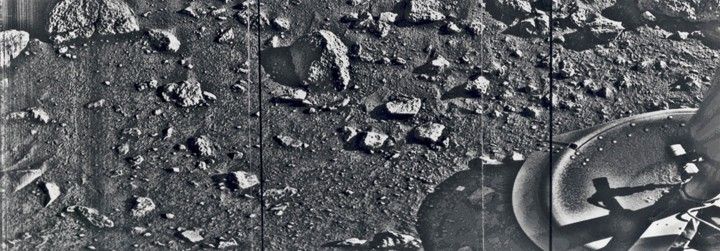
First Image From the Surface of Mars
Viking 1 was programmed to take an image right away, 25 seconds after touchdown. More than just a message home, confirming it had arrived safely, this view looking down at its footpad relayed the nature of the landing site. The surface was solid, safe, slightly rocky, with some dust and pebbles kicked up by the landing even settling on the spacecraft's footpad.
See More Images, and Learn the Story about First Image From the Surface of MarsHow Far We’ve Come
Then and now
From Viking to Perseverance
Two views from the surface of Mars — July 21, 1976, and July 23, 2024 — separated by 4,200 miles (7,200 kilometers) and 48 years.
Viking, 1976
Perseverance, 2026
‘There's no way to describe it. We were lifted up!’
This NASA documentary, “Viking: Mars Trailblazer,” features vintage mission footage and remembrances from team members.
‘Viking: Mars Trailblazer’ — Transcript and DownloadsThe Spearhead of '76
The Viking 1 landing — the first of what would be many by American spacecraft on the Red Planet — was supposed to coincide with the U.S. Bicentennial, July 4, 1976, celebrating the 200th anniversary of the Declaration of Independence. But a rocky landing zone delayed its arrival, and America's first impression on Mars had to wait two more weeks. Viking still took part in the festivities, though, remotely cutting the ribbon to open the brand-new Smithsonian Air and Space Museum on July 3.
Image: The flag of the United States on the Viking Lander 1 on Mars, July 26, 1976. The flag is on the RTG (Radioisotope Thermoelectric Generator) wind screen, and below it are the U.S. Bicentennial logo and the mission logo, showing an ancient Viking ship.
Credits: NASA/JPL
‘First U.S. Mars Landing’
Vintage NASA documentary from June 1976 previewing the Viking mission to Mars, with footage of the Viking 1 and 2 launches, and interviews with Viking team members Richard Young and Gerald Soffen.
Watch the VideoAstrobiology — Viking and the Search for Life
Besides taking digital images and collecting other science data on the Martian surface, the two landers conducted three biology experiments designed to look for possible signs of life. These experiments discovered unexpected and enigmatic chemical activity in the Martian soil, but provided no clear evidence for the presence of living microorganisms in soil near the landing sites.
In order to test instruments for the Viking Program, early astrobiologists and exobiologists at NASA traveled to some of Earth’s most remote environments, including the Dry Valleys of Antarctica and the Atacama desert in Chile. These places are thought to be some of the best analogs for Mars that we have on Earth, and studying life in such locations has become an important element of astrobiology research at NASA.
The Viking results also taught scientists a great deal about how little we knew about life on Earth and how to detect it. To this day, the results are helping to shape the development of life detection strategies and equipment at NASA and other international agencies.
Looking for Life on Another World — Starting With the Moon
This rediscovered footage from 1969 shows researchers at NASA’s Ames Research Center looking for signs of life in samples of Moon rocks and soil that astronauts brought back from the Apollo 11 mission. No lunar life was found, but these tests became the first time that NASA retrieved samples from another world to look for life on that world.
Learn More: ‘NASA Searches for Life from the Moon in Recently Rediscovered Historic Footage’Learn More
Deep Space Network
Viking landers and orbiters were able to send their images and data to Earth from Mars because of NASA's network of enormous dish antennas, the Deep Space Network. Vital transmissions that grew ever fainter as they crossed tens of millions of miles of space were gathered in by the 85-foot antennas in South Africa, Australia, and Goldstone, California.
The Source of Viking Power
The Viking landers functioned thanks to onboard nuclear electric power sources, pairs of radioisotope thermoelectric generators (RTGs), which provided electricity and heat beyond what other sources could offer. They're the same types of generator used by the Curiosity and Perseverance rovers today.
이 뉴스, 어떠셨어요?
탭 한 번으로 반응 · 로그인 불필요