BBC World
중도 성향
정치
부정적UK and allies sanction 'networks' enabling settler violence in West Bank
France will also bar far-right Israeli Minister Bezalel Smotrich from entry as part of the measures, which Israel condemns as "disgraceful".

"NETWORKS" · 부정 · 총 57건
필터 보기현재 지수
49.5
0 = 부정 우세
50 = 중립
100 = 긍정 우세
최근 7일 기준 85,558건을 분석한 결과, 뉴스 심리지수는 49.5(균형)입니다. 긍정 10,531건(12.3%)·중립 61,768건(72.2%)·부정 13,259건(15.5%)이며, 중립 비중이 뚜렷하게 높습니다. 성향 지수는 종합 20.8(보수 경향)입니다.
France will also bar far-right Israeli Minister Bezalel Smotrich from entry as part of the measures, which Israel condemns as "disgraceful".
LONDON/JERUSALEM, June 9 - Britain, Canada, France and Norway announced new coordinated sanctions on Tuesday against Israeli networks involved in financing, enabling and carrying out violence in the Israeli-occupied West Bank.
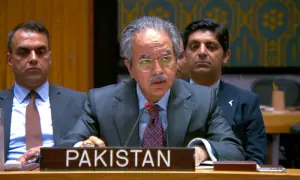
WASHINGTON: Pakistan’s envoy to the United Nations said on Monday that India’s key objectives in Afghanistan were “solely driven by the singular goal of destabilising Pakistan”. He made these remarks during a UN Security Council meeting on Afghanistan while responding to remarks by Afghanistan’s Permanent Representative to UN Nasir Ahmad Faiq. Earlier in the session, Pakistan’s Permanent Representative to UN Ambassador Asim Iftikhar Ahmad detailed the use of Afghan soil by terrorists and its impact on Pakistan, calling for the Afghan Taliban to take action against militants. He also spoke about Pakistan’s counter-terrorism measures. Faiq also commented on Pakistan’s counter-terrorism operations, in response to which Ambassador Ahmad said: “Pakistan’s actions, including those conducted in March, were directed solely against the terrorist and military support infrastructure that is operating from Afghanistan. And it is in no way directed against the brotherly people of Afghanistan.” ‘Verifiable, non-reversible action’ Ambassador Ahmad earlier told the UNSC that Islamabad’s demand from the Afghan Taliban was simple and clear: “verifiable and non-reversible action“ against terrorist groups operating from Afghan territory. “Regrettably, this demand remains unmet,” he said. And while the window for course correction was narrowing, it remained open, he added. “We hope the Taliban realise this in earnest and cooperate with the international community for the long-term peace and development of Afghanistan and, above all, in the best interest of all Afghans,” he said. There has been a resurgence in terrorism in Pakistan since the Afghan Taliban returned to power in Kabul in 2021. For its part, Islamabad has repeatedly urged the Taliban administration to dismantle terrorist sanctuaries on Afghan soil, particularly those linked to the banned Tehreek-i-Taliban Pakistan (TTP). But, officials say those appeals have gone unheedeed, while the Afghan Taliban reject these allegations. During the UNSC meeting, Ambassador Asim noted that it had been nearly half a decade since the Taliban takeover of Afghanistan in 2021. “It was hoped that this would end the bloodshed and Afghanistan would be at peace with itself and its neighbours,” he said. The envoy added that with the end of the civil war, it was “anticipated that the Taliban would take positive steps to transform into a responsible governing authority by adhering to their international obligations and commitments, and that they would lead Afghanistan into an era of stability and progress, provide the long-awaited relief to all Afghans and live in harmony with immediate neighbours”. “For decades, terrorism has been a major problem in Afghanistan, with implications not just for Afghanistan, but the immediate neighbourhood and beyond. Afghanistan has a history of being a safe haven for terrorist groups, including those used as proxies by our adversaries to target Pakistan and other countries,” he highlighted. It was “our expectation that the Taliban would take concrete and verifiable actions against terrorist groups such as the TTP, Balochistan Liberation Army (BLA) and its Majeed Brigade, Islamic State-Khorasan, East Turkestan Islamic Movement and their affiliates that are operating with impunity on Afghan soil”. “Regrettably, they have failed to undertake action, showing complete disregard for the legitimate security concerns of Pakistan and other countries,” the ambassador said. He added that, besides “independent analysis and reports of the Analytical Support and Sanctions Monitoring Team, which clearly outline the terrorism situation in Afghanistan and the ground realities, along with the recent exponential rise in terrorist attacks in Pakistan, these developments serve as glaring reminders of the precarious situation and the continuing threats posed to international peace and security”. “As a direct result of the freedom with which these terrorist groups operate in Afghanistan, Pakistan has borne the brunt of their attacks, as well as the Taliban’s growing nexus with these terrorist groups. “And once again, a significant number of Afghans are found to be involved in terrorism inside Pakistan,” he added. He said these terrorist groups had access to advanced weapons and sophisticated equipment, including drones. “Much of this can be traced back to the multi-billion dollar worth of arms and ammunition left behind by foreign forces — which was meant for use by the previous Afghan national government,” he said. Moreover, during counter-terrorism operations by Pakistan, there have been more than 290 cases of seizures of such weapons, which are used for terrorism and suicide bombings in the western parts of Pakistan, and which have exacted a heavy toll of human life and material losses, he told the UNSC. In 2025 alone, Pakistan reported more than 5,300 terrorist incidents and lost more than 1,200 lives to terrorism emanating from Afghanistan, he said. In this connection, he recalled that a vehicle-borne IED attack by the TTP on a police post in Khyber Pakhtunkhwa on May 9 resulted in the martyrdom of 15 police officers. “Our investigations revealed that the attack was planned by terrorists in Afghanistan.” Ambassador Ahmad said: “It is deplorable that the Taliban have reverted back to their old tactics of providing safe havens to terrorist groups and chosen the perilous path of complicity, backed by an outside actor, the historic spoiler and instigator of chaos — that has moved fast as an opportunist to wage a proxy war against Pakistan. “Let me make it clear: Pakistan will defend itself against whosoever attempts to harm our sovereignty, territorial integrity and national security.” He continued that Pakistan had always expressed openness for dialogue. “Numerous diplomatic efforts were made to counsel the Taliban. We thank friendly countries for their genuine mediation efforts, particularly Qatar, Turkiye, Saudi Arabia and most recently, China, to find amicable solutions. Yet the Taliban’s continued intransigence and even refusal to publicly denounce and condemn terrorist groups such as the TTP and BLA is deeply disturbing — it is evidence enough of their complicity and active support for these groups. Pakistan will not sit idle while suffering from terrorist acts. We will respond in self-defence, as and when needed and always in conformity with international law and International Humanitarian Law,” he said. Referring to a recent report by the UN secretary general, he said it “seems to largely externalise the responsibility for Afghanistan’s multifaceted challenges”. “The fatalities of terrorists and their supporters as a result of counter-terrorism operations are mentioned within the ambit of ‘civilian casualties’, posing serious questions on the credibility of UNAMA’s reporting from Afghanistan and the nature of their engagement with the Taliban. UNAMA is swift in reporting incidents of cross-border actions and casualties but fails to provide the overall context — which is the grave terrorist threat emanating from Afghanistan and its cross-border impact directed at Pakistan that is harming Pakistan and killing innocent Pakistanis,” he elaborated. He further said that the report also did not provide information on the destabilising accumulation of small arms and light weapons inside Afghanistan. “Nor does it adequately shed light on Afghanistan’s illicit economy, with its complex web of money laundering and terror financing networks, including hundi and hawala networks. Instead, the report resorts to shifting the blame on external dynamics, with little regard for the Taliban’s own policies that have brought Afghanistan to the brink of disaster,” he said. The envoy stressed that “we must not lose sight of the fact that it is the Taliban’s reckless style of governance and flawed ideologies of extremism, suppression and radicalisation that have brought upon Afghanistan the calamities it faces today”. “The Humanitarian Needs and Response Plan for 2026, we are told, is underfunded at 14 per cent — again a direct result of Taliban’s unwillingness to prioritise the welfare of Afghans over their own interest and authoritarian control,” he pointed out. Noting that several references had been made to the Pak-Aghan border closure in the report, he said: “Let me clarify that the closure of border between Pakistan and Afghanistan does not, from Pakistan’s perspective, affect the movement of humanitarian supplies. “Pakistan has been processing and facilitating the passage of humanitarian goods and material. However, the Afghan Taliban regime refuses to let them pass and keeps the border closed on its side, even to receive such life-saving cargoes, which obviously is to the detriment of the Afghan people.” He went on to say that the worsening human rights situation in Afghanistan “aligned with Taliban’s failings and deceitful narrative to meet the demands of the international community”. “Women and girls are denied their fundamental human rights and dignity, with discriminatory and abusive practices — a clear violation of their international obligations as well as of Islamic laws, traditions and tenets of the Muslim faith. The Afghan people are being held hostage to these inhumane restrictions, oppression and selfish behaviour,” he said. He said that Pakistan took numerous steps to support Afghanistan, including humanitarian relief efforts, political engagement, providing incentives to boost bilateral trade, offering transit concessions, issuing student and medical visas, conducting high-level visits to Kabul and participating in various regional cooperation initiatives to help Afghanistan succeed in its quest to find its rightful place in the international community. For over four decades, he continued, Pakistan welcomed millions of Afghan refugees “despite limitations and insufficient international support, dealing with huge caseloads of illegal Afghans, including those without documentation, posing a serious threat to our security”. But these were never meant to stay indefinitely, he added. The ambassador called on the UN secretary general to “clearly outline the status of third country resettlement cases of Afghans in a transparent manner — cases that are pending for years, despite being a tiny fraction of what Pakistan had to deal with, in the face of national security threats that no country would tolerate”. “While we provide all possible facilitation, the international community must step up and shoulder its responsibility. Shifting the blame of Afghanistan’s woes to the inflow of Afghan returnees will not solve the problem,” he said. Ambassador Ahmad further said, “We look forward to the next steps of the UN-led Doha Process and action plan for its Mosaic approach, to address Afghanistan’s multifaceted challenges comprehensively, with well-defined objectives and a realistic roadmap as the only viable pathway for normalisation”. Pakistan and Afghanistan, he said, were bound by geography, deep-rooted ties, civilisational links dating back centuries, and fraternal bonds of faith, culture and ethnicity. “No country has suffered more from the consequences of conflict and instability in Afghanistan than Pakistan. So we understand, and we also know, that no country stands to benefit more from peace, prosperity and stability in Afghanistan than Pakistan. “Pakistan’s demand from the Taliban is simple and clear: verifiable and non-reversible action against terrorists. Regrettably, this demand remains unmet. The window for course correction is narrowing but is still open. We hope the Taliban realise this in earnest and cooperate with the international community for the long-term peace and development of Afghanistan and, above all, in the best interest of all Afghans,” he said, concluding his address.
ISLAMABAD: Federal Investigation Agency Director General Dr Usman Anwar on Monday said that offloading was a “lawful, preventive, and protective measure” used only where credible risk indicators exist. “The objective is to facilitate lawful travel while protecting the country’s citizens, safeguarding human lives, countering organised criminal networks, and preserving the country’s international reputation,” the FIA chief said while talking to reporters here. Dr Anwar said the FIA has intensified intelligence-led passenger screening at international airports, bringing illegal migration through Malawi to “zero” and cutting irregular flows to the EU by 64 per cent in early 2026. He said the measures target human smuggling, trafficking and visa abuse, and are meant to protect people from “exploitation, detention, deportation, trafficking, and loss of life on dangerous migration routes,” not to restrict genuine travel. He said his agency has identified Belarus, Cyprus, Central Asian states and certain Eastern European transit corridors as routes “increasingly exploited by organised human smuggling networks” for onward illegal migration to Europe, he said. Malawi also emerged as a high-risk transit hub in 2025. Criminal facilitators, the DG said, lure vulnerable people with false promises of jobs, education, settlement and legal migration. The FIA’s Annual Risk Analysis Report 2025 listed Southeast Asian cyber-trafficking, organised migrant smuggling networks, and transit migration through Eastern Europe and Central Asia as critical threats. It also noted a rising trend of migration and deportation to Central Asian countries among young residents of Khyber Pakhtunkhwa, besides hotspot districts of Punjab. Published in Dawn, June 9th, 2026
You do the research, read lists of reviews, compare the filtration stages, and shell out a significant sum for the most promising, tech-savvy water purifier in the market. Then, just two months into installation, the machine starts throwing a series of confusing, flashing signals. The premium buying experience instantly evaporates, replaced by the sheer frustration of tracking down customer care and waiting at home for a technician to show up.In India’s competitive consumer durables sector, this exact friction point has transformed the landscape of water purifiers. The ultimate battle is no longer just about who can build and sell the best machine; it is increasingly about who can maintain trust after the hole has been drilled in the customer's kitchen wall.While the water purifier market is traditionally viewed through the lens of one-time appliance sales, companies like Eureka Forbes, the legacy player behind AquaGuard, are increasingly betting on a far larger opportunity hidden beneath the surface: the recurring service economy built around filters, annual maintenance contracts (AMCs) and nationwide technician networks.According to internal projections by Anurag Kumar, Chief Growth Officer at Eureka Forbes, the water purifier service market alone is on track to cross Rs 9,000 crore by FY30, nearly matching the projected Rs 10,000 crore size of the product market itself.131582773Also read: Beyond the room: Why India Inc's luxury hospitality bet is becoming an experience businessBreaking down the mathFor decades, the consumer durable playbook was simple: manufacture, distribute, sell, repeat. But water purification is far different from selling a television or a refrigerator; it is an active, evolving health product bound to the fluctuating quality of local municipal and groundwater supplies."The market for product categories for water purifiers is about Rs 3,800 crore today," Kumar says in an exclusive interview with ET Online. "I think you would add another, roughly about Rs 3,500 crore of service category as well to it."Citing independent industry reports, Kumar highlighted that by FY30, this parallel economy is set to explode. The product market will expand to over Rs 10,000 crore, while the service and aftermarket ecosystem will chase it tightly at more than Rs 9,000 crore, growing at a combined double-digit compound annual growth rate (CAGR) of 11% to 12%.This shifting weight from hardware to service fundamentally changes corporate strategies. For an industry dealing with an urban penetration rate of just 14% (and a mere 7% nationally), the recurring revenue from existing households forms a highly resilient cash-flow cushion that protects margins even during macro-economic slowdowns.131582808Service scale becomes the biggest moatThe Rs 9,000 crore service opportunity explains why tech-first aggregators and rental startups are rushing into the service category. However, scaling an on-demand service infrastructure across India’s complex geography is entirely different from coding an app.For legacy companies like Eureka Forbes, this operational network has become a major competitive advantage."After sales service can make or break a brand," says Kumar. "I think a lot of the trust that AquaGuard has today is really thanks to the fact that people have trust in our service... It's a very, very important integral part of our business and a very, very crucial moat that we continue to nurture."To defend this moat against new-age tech startups, Eureka Forbes operates at a scale that resembles a logistics company more than an appliance manufacturer. The company has deployed more than 8,000 technicians mapping out an operational footprint across 19,500 PIN codes.Also read: Apple expected to unveil new AI features at last developers conference with CEO Tim CookThe push to reduce maintenance costs"Once you sell a product, then you have it for life and there's some revenue which comes with it," Kumar says, referring to filter replacements, AMCs and servicing requirements.Interestingly, the biggest threat to this recurring service revenue is not new-age competitors, it has been consumer fatigue over high maintenance costs. Historically, the dread of paying steep annual fees to replace purifier filters has acted as a primary barrier keeping the remaining 86% of urban Indian households from adopting organised water purifiers.To beat this, Eureka Forbes pulled off a counter-intuitive strategic gear: they disrupted their own short-term revenue model to secure long-term market share.Last year, the company introduced a range of purifiers featuring "long-life" filters extending the replacement cycle from the traditional 12 months to a full two years."We did that because we fundamentally heard from consumers that there was also a barrier to the category around maintenance cost being high," Kumar reveals. "What two-year filters actually did was they actually lowered the maintenance cost because now you don't have to change filters every year. You have to change once every two years."Digitising a 1980s direct-sales DNAEureka Forbes, a company historically known for its door-to-door service, and making Aquaguard synonymous with water purifiers in India, faced a new piece of necessary upgrade with building digitisation. The multi-billion dollar service landscape required a complete digital overhaul of consumer interactions. The brand that built its empire in the 1980s on the soles of direct-sales agents knocking on suburban doors has had to pivot entirely to an on-demand, algorithmic infrastructure.An army of thousands of field technicians is only as efficient as the software directing them. For modern consumers who manage their entire lives via smartphone screens, a bland "technician will visit tomorrow" promise no longer cuts it."We've digitised that service," notes Kumar.The long-term playAs water contamination concerns spike across rapidly expanding urban clusters, the structural demand for pure drinking water will continue to climb, and so for water purifiers.However, as the hardware itself faces gradual commoditisation and intense price competition from newer market entrants, the center of gravity has largely shifted. Where the growth moves nextCapturing a dominant share of the service market is only half the blueprint. As Kumar maps out the strategic trajectory for Eureka Forbes over the next three to five years, the company's growth engine eyes two distinct tracks: aggressive geographic widening and targeted product diversification. Geographically, Kumar notes, the company is bypassing deep rural pockets for the time being to focus heavily on India’s rapidly urbanising Tier-2 and Tier-3 towns. Instead, the company is doubling down on smaller towns where they can immediately deploy their signature localised service infrastructure without stretching their logistics network too thin.Simultaneously, the brand is attempting to de-risk its reliance on the kitchen wall by expanding into adjacent consumer durables. Kumar outlined a product pipeline anchored in high-growth, premium categories, including robotic vacuum cleaners, air purifiers, and household water softeners. The underlying playbook here is pure cross-selling. By utilising the same 8,000-strong technician network to service these newer household appliances, Eureka Forbes is betting that its aftermarket footprint can drastically lower its customer acquisition costs; positioning the legacy firm to evolve from a single-product manufacturer into a broader home-health ecosystem player.
Donald Trump abruptly ended a "Meet the Press" interview with Kristen Welker, accusing her and major news networks of being "crooked" and "stupid" after she pressed him for evidence of election fraud. Trump also defended his "anti-weaponisation fund" proposal, claiming political prosecutions have destroyed lives.
Five young men thought they were going to Cambodia to intern at a casino. Instead they say they became enslaved in one of the world’s most sophisticated fraud networks.
Five subcommittees have been set up to intensify efforts against cybercrime, scam networks and illegal foreign nominee businesses, while the government reported a sharp decline in technology-related crime cases over the past year.
Anthropic has reportedly placed engineers within the NSA to help deploy its advanced 'Mythos' AI for cyber operations, despite an ongoing legal dispute with the Department of War. This 'undercover' collaboration aims to customize AI for national security, with the technology designed for infiltrating foreign networks. The move is controversial given the Pentagon's prior 'supply-chain risk' label on Anthropic.
Nurlan Yermekbayev highlighted that cyber fraud, attacks on critical infrastructure, illegal data trafficking, and the deployment of generative neural networks for criminal purposes are now everyday realities
[UN News] What began as a geopolitical crisis in the Middle East nearly 100 days ago is increasingly becoming a food security crisis elsewhere, with UN agencies warning of rising hunger in Africa and malnourished children being turned away from medical clinics in Afghanistan.
For over two decades, Pakistan has been locked in a war, not of its choosing but one that it cannot escape. Long after the withdrawal of Western forces from Afghanistan in August 2021, Pakistan continues to absorb the strategic shockwaves of a conflict whose centre of gravity may have shifted, but not disappeared. The return of the Taliban to power in Kabul has transformed the security landscape of South and Central Asia, with Pakistan bearing the most immediate and severe consequences. This is not merely a bilateral problem between neighbours. It is a global security challenge with implications stretching from West Asia to Europe, amid growing international concern over Afghanistan becoming a renewed militant hub. Pakistan’s role in the post-9/11 international order was clear and costly. As a frontline partner of the United States and Nato, Pakistan provided intelligence cooperation, logistics, and sustained military operations against Al Qaeda and affiliated networks. It was later designated a Major Non-Nato Ally, reflecting its centrality to global counterterrorism efforts. Yet, while international forces eventually exited Afghanistan, Pakistan’s war did not end. Instead, it evolved into a long war of attrition aimed at preventing the spillover of militancy from Afghan territory into the region and beyond. The cost Pakistan has paid is extraordinary. Over the past two decades, approximately 100,000 Pakistanis have lost their lives to terrorism, including civilians, security personnel, and children, most tragically symbolised by the massacre at the Army Public School in Peshawar. The site of a truck bomb attack on the Marriott hotel in Islamabad on September 20, 2008. — Reuters/File The economic toll exceeds $150 billion, encompassing destroyed infrastructure, lost investment, and enduring reputational damage. These figures are not abstractions; they represent one of the highest sacrifices borne by any country in the global war on terror. Over the years, Pakistan has pursued a sustained counterterrorism strategy. It dismantled major terrorist sanctuaries through sequential operations, strengthened its legal framework via the Anti-Terrorism Act and National Action Plan, operationalised dedicated counterterrorism institutions, and imposed financial controls to disrupt terrorist funding. By the late 2010s, violence had dropped sharply, and Pakistan had rebuilt a measure of internal security through institutional resilience rather than episodic force. That progress has been severely undermined by the Taliban’s return to power. Despite commitments under the 2020 Doha framework to prevent Afghan soil from being used against other states, militancy accelerated after the release of thousands of prisoners and the collapse of the Afghan republic. Today, Afghanistan has once again become a permissive environment for transnational jihadist groups, as documented by the United Nations Monitoring teams, contradicting the Doha pledge that Afghan soil would not be used to threaten the security of the United States and its allies. What makes the current situation uniquely dangerous is that the Taliban are no longer an insurgent movement operating from the shadows; they control an entire state. They possess territory, resources, institutions, and an education system that is being systematically redesigned to serve ideological ends. Analysts warn that this form of state capture amounts to long-term societal engineering with consequences that do not remain confined to one country. For Pakistan, the impact is direct and violent. Afghan soil is being used as a launchpad for cross-border terrorism. Pakistani authorities have identified camps, staging areas, and logistics nodes inside Afghanistan operated by the Tehreek-i-Taliban Pakistan (TTP) and other groups. Leaders of the TTP terror outfit operate openly from Afghan cities, enjoying protection and material support. A security personnel stands guard at an imambargah following an explosion, in Islamabad on February 6, 2026. — AFP/File In 2025 alone, Pakistan conducted more than 75,000 intelligence-based operations across the country, dismantling terrorist formations and neutralising militants. A striking proportion of those involved were Afghan nationals, reflecting the depth of Afghan-side involvement in anti-Pakistan terrorism. This has repeatedly surfaced in international reporting as Pakistan confronted a sustained spike in attacks and arrests tied to cross-border militant facilitation. Pakistan’s geographic exposure magnifies the threat. It shares a 2,670-kilometre border — by far the longest of any neighbouring state. The border cuts through rugged terrain and dense kinship networks, which are routinely exploited by militant groups for infiltration, making Pakistan the primary firewall against the westward diffusion of jihadist violence. The notion that Pakistan can be destabilised without broader repercussions is therefore dangerously myopic. Policies that tolerate, enable, or instrumentalise militant proxies against Pakistan may appear tactically convenient to some regional actors, but they undermine collective security. Terrorist ecosystems, once empowered, rarely remain controllable. As global benchmarking shows, Pakistan continues to rank among the states most affected by terrorism, reinforcing the scale of the threat confronting it. Afghanistan’s transformation into a hub for transnational militancy is now acknowledged not only by Pakistan but by Russia, China, Iran, Central Asian states, as well as UN monitoring bodies. The problem is no longer one of competing narratives; it is a documented security reality, as international reporting continues to describe Afghanistan as a post-withdrawal magnet for armed networks. Despite immense pressure, Pakistan has consistently chosen engagement over abandonment. When Kabul fell in 2021, and much of the international community closed its embassies, Pakistan kept its mission open and facilitated evacuations. Defence Minister Khawaja Asif and Afghan Defence Minister Maulvi Sahib Muhammad Yaqub Mujahid shake hands after signing a ceasefire deal between Pakistan and Afghanistan in Doha, Qatar on October 19, 2025. — X/@KhawajaMAsif/File It has advocated for humanitarian support to the Afghan people, called for the unfreezing of Afghan assets to prevent economic collapse, and invested in trade, transit, and border mechanisms to stabilise livelihoods. Pakistan has also hosted millions of Afghan refugees for decades, absorbing a humanitarian burden that few states would tolerate, even though it is not a signatory to the 1951 Refugee Convention. These actions underscore a central truth: Pakistan’s objective is not confrontation with Afghanistan but containment of a threat that endangers the region and the world. Yet engagement without accountability has limits. The Taliban’s failure to take verifiable action against terrorist groups operating from Afghan soil has turned Afghanistan into a net exporter of insecurity. Major reporting has consistently linked Afghanistan’s permissive environment with the rising tempo of attacks in Pakistan. Allowing this trajectory to continue unchecked risks recreating the pre-9/11 environment — this time with more sophisticated networks, advanced weaponry left behind after the Western withdrawal, and digital tools that accelerate recruitment and radicalisation. Evidence of ideological-military institutionalisation is increasingly visible, including reports of new militant training camps in Afghanistan linked to Taliban factions and allied groups. For major powers, the strategic implications are clear. Supporting Pakistan in its efforts to eradicate cross-border terrorism is not a favour; it is a strategic necessity that requires intelligence cooperation, diplomatic backing, and coordinated international pressure on the Taliban to honour their commitments, dismantle terrorist sanctuaries, and end cross-border militancy. The alternative strategic neglect or proxy-driven destabilisation would be far costlier. Pakistan’s war on terror has never been only Pakistan’s war. It has been fought, often quietly and at enormous human cost, on behalf of a global order that depends on preventing ungoverned or ideologically weaponised spaces from becoming incubators of transnational violence. Pakistan’s 2025 operational tempo and threat environment have been extensively documented in international reporting tracking the resurgence of militant violence. If the international community fails to recognise this reality, it risks learning once again, perhaps too late, that terrorism ignored at its source rarely stays there. The warning is no longer theoretical: international reports increasingly describe Afghanistan’s post-2021 environment as a convergence space for armed networks with regional reach, reinforcing the urgency of collective action against the renewed Afghanistan-based militant threat. The views expressed in this article are those of the author and do not necessarily reflect the views of Dawn.
The strike is the latest in a series of operations targeting suspected drug-trafficking networks conducted under the Trump administration.
Like Palo Alto Networks before it, CrowdStrike beats financial expectations but sees its stock get punished
Kazakhstan is turning to a US government agency for help on water conservation. Experts from the Kazakh water-management agency Kazvodhoz held talks recently with representatives of the US Bureau of Reclamation on ways to reduce water use in the agricultural sector, the Kazakh news outlet InBusiness.kz reported. The US Embassy in Astana facilitated the discussions. "The parties paid particular attention to the implementation of digital water metering and telemetry systems within irrigation networks," Kazakhstan’s Ministry of…
Analysts attribute the stock drop to profit-taking, the timing of AI contributions and changes to reporting conventions.
The beat comes on lowered expectations, after the company gave disappointing guidance in February that fell short of analyst estimates.
Security forces killed 17 terrorists during intelligence-based operations (IBOs) in different districts of Balochistan following the suicide car bomb attack against a shuttle train in Quetta, said a statement released by the Inter-Services Public Relations (ISPR) on Tuesday. At least 14 people were killed and 20 others were injured in the incident, which took place on May 24. The IBOs were conducted in the districts of Mastung, Nushki, Khuzdar and Kech. The military’s media wing added that multiple terrorist locations were targeted by security personnel during these operations. “Following intense and fierce exchanges of fire, 17 terrorists belonging to Indian-sponsored Fitna al Hindustan have been sent to hell, giving a significant blow to the terrorist networks operating in these areas,” the statement read. The state has designated Balochistan-based terrorist groups as Fitna-al-Hindustan to highlight India’s alleged role in terrorism and destabilisation across Pakistan. ISPR added that weapons, ammunition and a large cache of explosives were recovered from the dead terrorists, as well as improvised explosive devices (IEDs). It added that the terrorists remained actively involved in numerous terrorist activities in the area. “Sanitisation operations continue to eliminate terrorists from these areas, as [the] relentless counter-terrorism campaign under vision ‘Azm e Istehkam’ (as approved by Federal Apex Committee on National Action Plan) by security forces and law enforcement agencies of Pakistan will continue at full pace to wipe out the menace of foreign-sponsored and supported terrorism from the country,” ISPR stated. Last month, a major was among five soldiers martyred during an area sanitisation operation in Balochistan’s Barkhan district, according to ISPR. At least seven terrorists were also killed during the operation, and the operation was carried out by the Pakistan Army and Frontier Corps. There has been a resurgence in terrorism in Pakistan since the Afghan Taliban returned to power in Kabul in 2021. Islamabad has repeatedly urged the Taliban administration to dismantle terrorist sanctuaries on Afghan soil, particularly those linked to the banned TTP. Officials say those appeals have gone unheeded.
중국의 한 기술기업이 시민의 이동 동선과 인터넷 사용 기록을 인공지능(AI)으로 분석해 앞으로 정부에 비판적 인물이 될 가능성이 있는 사람을 찾아내는 기술을 개발 중인 것으로 드러났다.미국 뉴욕타임스(NYT)는 1일(현지시간) 중국 기업 지지네트웍스(Geedge Networks)의 유출 문서를 분석한 밴더빌트대 연구진을 인용해 이같이 보도했다. 이 기술은 아직 연구·개발 단계로 보이며, 실제 완성되거나 배치됐다는 증거는 확인되지 않았다.지지네트웍스는 중국 당국이 온라인 활동을 통제하는 데 쓰는 감시·검열 체계인 이른바 ‘만리방화벽’의 상업용 버전을 판매하는 회사다. 기존 기술은 인터넷 트래픽을 감시하고, 사용자가 검열 우회 수단을 쓰려 할 때 이를 표시하는 방식으로 작동한다.하지만 유출 문서에 따르면 이 회사는 위치 정보와 인터넷 사용 기록을 AI로 분석해 특정 시민이 정부를 비판하는 말이나 행동을 할 가능성이 있는지 예측하는 새 제품을 개발하고 있었다.밴더빌트대 연구진은 지
The largest petrol station networks in occupied Crimea have suspended petrol ration coupon sales due to shortages.