Fox News
보수 성향
기타
부정적Grandparents are identity theft's biggest payday
FBI reports $352 million in AI-related scam losses among victims 60 and older, as voice-cloning tools make grandparent scams more convincing than ever.

"ENTITY" · 부정 · 총 86건
필터 보기현재 지수
49.4
0 = 부정 우세
50 = 중립
100 = 긍정 우세
최근 7일 기준 92,501건을 분석한 결과, 뉴스 심리지수는 49.4(균형)입니다. 긍정 11,169건(12.1%)·중립 66,897건(72.3%)·부정 14,435건(15.6%)이며, 중립 비중이 뚜렷하게 높습니다. 성향 지수는 종합 20.9(보수 경향)입니다.
FBI reports $352 million in AI-related scam losses among victims 60 and older, as voice-cloning tools make grandparent scams more convincing than ever.
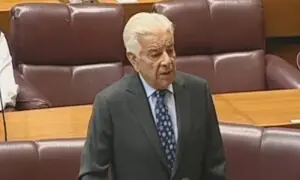
As tensions persist in Azad Jammu and Kashmir (AJK), Defence Minister Khawaja Asif on Thursday urged the now proscribed Joint Awami Action Committee (JAAC) to let the people of the region decide whether the 12 refugee seats should be abolished. The regional administration and the JAAC remain at odds over various issues, most notably the committee’s demand to abolish the 12 seats in the region’s Legislative Assembly that are reserved for refugees from Indian-occupied Jammu and Kashmir who settled in mainland Pakistan after 1947. Speaking on the floor of the National Assembly, the defence minister called on the JAAC to raise the issue in the upcoming elections, scheduled for July 27, and “take the issue to the public”. He questioned why the group was intent on deciding the issue pre-emptively, suggesting that it might be an attempt to shape the assembly “as per their will”. Asif noted that Kashmiri refugees settled in Pakistan had paid a “heavy price” to migrate to the country, and that the JAAC had no right to demand the “taking away of their right to vote”. “The AJK that we have today is due to the sacrifices made by the Pakistan armed forces and people from across the country, not just Kashmiris,” the defence minister said, asserting that 250 million Pakistanis had a “stake” in the region. He held that there was a story in every Pakistani household of the sacrifices made for the disputed region. “Does that mean nothing? I do not want to take names, but what have they sacrificed for Kashmir? They do not have any stake, nor have they invested anything in the liberation of Kashmir,” the defence minister said. The defence czar warned that if people took the law into their own hands, the government could not be expected to “stay silent”. He also recalled that Kashmiri refugees in his constituency did not have access to basic facilities such as electricity and gas due to uncertainty surrounding their status. However, “we had their status finalised”, he said, reiterating that the way forward was dialogue, not confrontation. “I wonder if this hatred has been imported from across the line,” Asif said, in an apparent reference to the Line of Control (LoC). He maintained that the group could not “take away the identity” of Kashmiri refugees, advising that the matter should be resolved in the Legislative Assembly. “How could you exclude them from the electoral process?” the defence minister said. Asif remarked that the status “Azad” in AJK had been secured and protected by Pakistanis. “The word Azad would not have been there if it were not for Pakistan,” he said, adding that the armed forces stationed atop mountains protecting Kashmir were all Pakistanis, including Punjabis, Baloch, Pashtuns and Sindhis. Unrest in AJK continues Earlier reports suggested that activists and supporters of the proscribed JAAC had reached the outskirts of Rawalakot from multiple directions, determined to proceed through the town towards the regional capital of Muzaffarabad. On Tuesday night, a large number of protesters from Mirpur, Kotli and Bhimber districts, including the town of Dadyal, had managed to enter the territorial limits of Poonch district via Tatta Pani amid reported clashes with law enforcers. Several casualties were reported in the violence, but there was no official confirmation. On Wednesday, the protesters, who had stayed overnight at different locations in Hajira tehsil, resumed their journey towards Khaigalla, some 10 kilometres from Rawalakot, where another rally from Sudhnoti district joined them. Witnesses and official sources said that by evening, the crowd had reached Chehr Bazar and camped in the industrial area near the Eidgah, on the eastern side of the town. Another group of protesters from the Mang and Thorar areas of Poonch district had separately camped at the bus terminal on the southern side of the town. A third, relatively smaller group from Bagh district had stationed itself at a high school in Kotehri village on the northern side. Residents said Rawalakot, like the rest of AJK, observed a complete shutdown on Wednesday, with public transport off the roads and only negligible private traffic visible. Throughout the day, announcements were made over mosque loudspeakers in Rawalakot, directing citizens to restrict movement and warning that anyone attempting to enter the town from outside would be responsible for any repercussions. According to local sources, law enforcement personnel had blockaded roads leading into the city and taken positions at several locations to thwart any attempts by protesters to enter. A senior government official told Dawn that Umar Nazir Kashmiri, considered a hardline JAAC leader, had reportedly submitted a “six-point petition” to the “decision-making authorities” in an effort to defuse the situation. The demands included the withdrawal of the Home Department’s notification proscribing the group, conditions related to the deaths during the protests and cases registered over them, the lifting of any restrictions on movement, and the initiation of negotiations. The petition further stated that, pending a decision, both law enforcement personnel and protesters should remain at their respective positions. The official added that the JAAC leader had assured the authorities that protesters would not move forward. No JAAC leader was available to confirm or deny the claim. Proscribed Last Friday, following the announcement of the JAAC’s June 9 strike, the AJK government declared the body a proscribed organisation, stating that it was “engaged in terrorism” and had acted in a manner “prejudicial to peace and security” of the state. A day later, AJK authorities launched a crackdown on the JAAC, arresting scores of its leaders and activists from different areas. Sedition proceedings against two of its leaders have also been ordered, and a Rs10 million reward for information leading to the arrest of four leaders has been announced. Tensions in the region particularly flared up after a violent protest in Rawalakot, during which at least four law enforcement personnel and seven civilians lost their lives. Islamabad has also dispatched federal paramilitary forces to reinforce the region’s thinly stretched police force, and intending visitors have been advised to postpone their trips until June 20.
With a sensual voice that contrasts with the strength of her lyrics, Mélissa Laveaux creates music that blends her Haitian and Canadian heritage with themes of history, sexuality, and the dark humour she brings to questions of life and death. She joins us in the studio to discuss her latest album, “At My Softest, I Am Most Dangerous”, and her exploration of Voodoo traditions and beliefs surrounding mortality. We also look at her personal geography – the places and influences that have shaped her artistic journey. We also discuss Paris's first Pride Ball, a star-studded gala celebrating LGBTQ+ communities.

Security forces have reached the remote village, but the identity of the perpetrators is yet to be known
The fraudsters allegedly told the woman that her identity documents had been misused in a money laundering case, and that multiple criminal cases had been registered against her

Police who arrested Amanda Maria Souza de Oliveira say she admitted that she had lied to obtain financial support A 38-year-old woman has been arrested in Brazil, accused of pretending to be a 12-year-old girl, allegedly to deceive a couple who took her into their home for more than a year. Amanda Maria Souza de Oliveira was charged in the southern state of Santa Catarina with fraud and false identity offences. Continue reading...
The victim’s identity and gender have yet to be determined, say firefighters.

Complaints of theft or loss of mobile phones are registered in the Central Equipment Identity Register (CEIR) portal

Russian independent media site Agentstvo reported that this is the first instance in which the Kremlin refused to acknowledge the victim’s identity in the assassination of a Russian army official.

The lowest ever viewing figures, an identity crisis for the show and a confusing Billie Piper-based cliffhanger – whoever takes on the BBC fantasy drama has quite the job on their hands … The announcement that the BBC has abandoned the planned Doctor Who Christmas special, and is ending its partnership with showrunner Russell T Davies and Bad Wolf production company, will not have come as much of a surprise to many fans. It has been rumoured for some time. Aside from the gossip, the fact that no filming appeared to have taken place for a programme that traditionally requires a lengthy post-production process had already suggested something was up. The BBC has said the show remains an important part of its portfolio, stating it wants to ensure that “when the Tardis lands once more, it does so in all its glory”. While it isn’t inconceivable that Bad Wolf might bid to make the show under a new regime, Davies appears to have hung up his Tardis keys for good, posting on Instagram: “Now I’m as excited as anyone to see what comes next!” Continue reading...
A Nigerian man, Atuchukwu Markrufus Onyeanusi, has been sentenced in the United States after being convicted of fraud and misuse of visas, permits, and other documents linked to the use of a false identity to obtain employment. The post Nigerian man jailed in US after using false ID to secure job appeared first on Vanguard News.
THREE parallel events now underway or recently held carry the potential in varying measure to reset India’s destiny, in all likelihood for the better. From a bird’s eye view, the field looks set for a change. The fact that Germany lost the election for the first time in 40 years for a non-permanent member’s seat at the UN Security Council offers stark lessons for the Modi government to ponder. Germany turned Palestine averse and cosied up to Israel, much like Narendra Modi’s India, with Chancellor Friedrich Merz in the saddle. The UN defeat is being linked to Merz’s embrace of Benjamin Netanyahu. British Prime Minister Keir Starmer’s future is also under a cloud, his ties with the Zionist lobby being a key factor. Ergo: Israel’s chums are being globally isolated. India’s proximity to Israel was nudged by right-wing ideologues to counter Russian prime minister Yevgeny Primakov’s 1998 doctrine to form the Russia-India-China group as a stabilising force in a post-USSR Global South. The Western countermeasures included America’s ‘pivot to the east’, dragging India into the Quad. But when the RIC went on to become BRICS, a ‘West Asian Quad’ was conceived including India, Israel, the UAE and the US. The faint outlines of the outcome of the Iran war are threatening to end India’s entanglement with both Quads. And the German debacle at the UN is the writing on the wall. Potentially, also crucial for the country’s future is the internet-spawned Cockroach Janta Party, which launched its first street protests in New Delhi over the weekend. The party minted into an untested force after a senior judge insulted unemployed youth as cockroaches. The ‘cockroaches’ have given a tart reply to the judiciary, but they’re also demanding the resignation of Modi’s education minister, hitherto an unthinkable prospect. The third albeit widely underplayed event is the fractious INDIA opposition group seeking to get its act together. Twenty-three parties, including Mamata Banerjee’s Trinamool Congress were holding a make-or-break meeting on Monday (June 8) under the Congress party’s stewardship. All three events have the heft to cause tremors in the Modi establishment. Some say the jolt could be more rattling to him than he experienced in 12 years of unbridled power. Questions have surfaced over the Cockroach lot with insinuations that the cluster of motivated urban youth is supported by the Hindutva order to vent the steam gathering from months of a crippling economic crisis, not all of which is linked to the Iran war. There is also the issue of an overtly corrupt administration keeling over with criminal incompetence amid lacerating acts of omission and commission. Hundreds of thousands of school-leaving students and admission-seeking medical college aspirants have been grievously harmed by leaked papers and erring tabulation mechanisms. The Cockroach party has sought probity in judiciary, education and the nexus between business and the media, but its critics have sought to portray the group as left oriented with some of them belonging to this or that communist party. Another suggestion is that they are an extension of the Aam Aadmi Party, a ploy to shift the focus from the improving chances of opposition unity. It’s a fact that AAP came out of the India Against Corruption campaign of 2011 in which the RSS played a backroom role to successfully undermine the Manmohan Singh government. There’s no need to spread fear of those such as the Cockroach party before they do something wrong. While the AAP’s birth pangs indeed created the grounds for the coronation of Narendra Modi as prime minister in May 2014, it is equally a fact that AAP was applauded the following year as the sheet anchor that stalled the BJP juggernaut in Delhi. Before this, the Modi wave had easily evicted Congress governments in Maharashtra and Haryana polls. And there was no AAP in Maharashtra to blame the defeat on, although in Haryana it did cut some votes. The AAP subsequently propagated a soft temple-hopping Hindutva, in which Arvind Kejriwal scrupulously avoided standing with Muslims when they were under attack from the BJP and the police in 2020. But if he or the Cockroach group can yet consciously or unwittingly help stall the rightward, obscurantist drift the Modi government has set India on, it would make Deng Xiaoping’s spirit burst into a smile. “It doesn’t matter whether a cat is white or black, as long as it catches mice.” Deng’s dictum applies to anybody who would rescue India from its current trauma. And there’s no need to spread fear of those such as the Cockroach party before they do something wrong. But let’s not get too swayed also by the shouts of youth power or the roar of something called Gen Z. As far as one could see, it was the youth that demolished the Babri Masjid with their raw sinews. It’s the youth that goes about lynching and harassing innocent citizens in the name of religion. Of course, on the other side, it’s the youth that’s languishing in Modi’s prisons, if they are not out on strictly monitored bail terms, for fighting for a just and equal society in a democratic system that doesn’t discriminate between citizens. Think Umar Khalid. There’s a youth component in almost every political party. The mighty US is split between youthful Zionists and their youthful adversaries. When I looked up Gen Z on a search engine, an option pointed to Gen Ziaul Haq! I think the idea of Gen Z or Gen Alpha etc is conjured to obscure the reality of universal class struggle, and in India’s of its defining caste identity. A few donning cockroach masks at the Delhi rally were seen carrying portraits of Bhimrao Ambedkar thereby putting Dalit politics at the centre. But again, hasn’t everyone used Ambedkar’s portraits to lure support? Finally, while Deng’s point is priceless, a useful caution in T.S. Elliott’s line says: “Youth is cruel and has no remorse. It smiles at situations which it cannot see.” A fair point to ponder. The writer is Dawn’s correspondent in Delhi. jawednaqvi@gmail.com Published in Dawn, June 9th, 2026
The Trump administration is stepping up efforts to revoke the citizenship of naturalised Americans, with the US Justice Department on Monday filing lawsuits against 17 people accused of obtaining citizenship through fraud or concealing serious crimes. Among those targeted is a Chinese-born resident of the state of Georgia who prosecutors say hid a prior deportation order and immigration history under a different identity before becoming a US citizen in 2006. The announcement was accompanied by...
Iran on Monday said it was ending its latest military operation against Israel after the first exchanges of fire between the foes since a shaky ceasefire began, but warned it could inflict a more “crushing” response. United States President Donald Trump earlier on Monday told both Iran and key ally Israel to stop fighting, against the background of reports of an increasingly testy relationship between the US leader and Israeli Prime Minister Benjamin Netanyahu. Iran fired dozens of missiles at Israel overnight and Israel responded by targeting military sites in the Islamic republic, sparking fears the escalation could usher in a new full-scale conflict after the April 8 truce. “Israel and Iran must immediately stop ‘shooting.’ President DONALD J. TRUMP,” the US leader wrote on his Truth Social network. Minutes later, he added in a new post that “final negotiations” towards peace were proceeding “subject to ignorance or stupidity getting in its way.” Iran’s military command then said it was halting the operation against Israel after delivering a “painful response”. But it warned “that should acts of aggression and hostility continue, including in southern Lebanon, much more severe and crushing measures than before will follow”. Shortly after, Israel’s army intercepted three projectiles fired from Lebanon, according to an AFP journalist near their shared border, with the military confirming the munitions had targeted its forces operating in Lebanon’s south. “Some of the projectiles were intercepted prior to crossing into Israeli territory, and an additional projectile fell near IDF soldiers. No injuries were reported,” the military said. Tehran’s earlier strikes followed attacks by Israel against targets of the Lebanese group Hezbollah in the southern suburbs of Beirut. Iran had repeatedly warned it would strike Israel if the Lebanese capital was targeted. ‘People frustrated’ On Monday in Tehran, there was little sign of any return to war, with cafe terraces packed. Traffic seemed lighter than usual for a weekday, suggesting that some people had stayed home and there were also many more people queuing at gas stations. Maryam, 41, an accountant in Tehran, described “a sense of uncertainty and confusion”. “You don’t know if there’s going to be a war, nor do you know if the peace agreement will last. Nothing is clear. People are frustrated,” she said. Residents of Tel Aviv meanwhile went to shelters as sirens went off. “I hope it will be short, but you can never know. Last time we thought it will be short and then it was a month, so I don’t know,” said Jonathan Ariel, 30. Oil prices surged more than five per cent on worries that war could break out again, with hopes now punctured of a rapid end to the standoff that has seen shipping limited through the key Strait of Hormuz trade bottleneck. The strikes also came at a critical moment with diplomatic efforts to end the conflict involving mediator Pakistan on a knife-edge. Iranian foreign ministry spokesman Esmaeil Baqaei warned at a press conference in Tehran attended by AFP that diplomacy was continuing but risked being “affected” by the escalation. As he was speaking at the foreign ministry, a huge explosion shook the building, followed by repeated explosions believed to be from air defence systems, the AFP reporter said. Pakistan Interior Minister Mohsin Naqvi visited Tehran to deliver what he said was a “special letter” to Iran’s supreme leader Mojtaba Khamenei, according to Iranian state television. He has since travelled back to Pakistan, an official Pakistani source said on Monday. Iranian President Masoud Pezehskian wrote on X that Tehran was still “at the negotiating table”. ‘Prepared for long-term war’ No casualties have been reported in either Israel or Iran after the exchange of fire. The Israeli military said it struck and dismantled Iranian defence systems deployed across several areas in the country. Iran fired nearly 30 missiles towards Israel since Sunday night, an Israeli military official said. An AFP correspondent also saw a missile fall in agricultural land in the area of Najha, in the countryside of the Syrian capital Damascus, causing a fire around the impact site but no reported human casualties. “Material damage is minor, but the psychological impact is significant. The area is home to children, farm caretakers, livestock and solar power installations,” said Fadil Ataya, a local farmer. A military source told the Tasnim news agency that “Iran is prepared for a long-term war with the Zionist regime and for strikes against US interests” in the region. It also remains unclear who is leading decision-making in Tehran with Mojtaba Khamenei, said to have been wounded in a US-Israeli strike, yet to appear in public after taking over from his father Ali Khamenei who was assassinated on the first day of the war on February 28. The European Union’s top diplomat Kaja Kallas called on both sides to “sit down to a negotiation table and agree”, adding that “the region does not need an escalation.” Israeli strikes on Iran ‘fully coordinated’ with US, says Tehran Iran said on Monday that the recent wave of Israeli strikes against the country was “fully coordinated” with US forces. Tehran’s statement comes after Israel and Iran exchanged attacks for the first time since the shaky ceasefire in the Middle East war took effect on April 8, despite Trump calling for restraint. The flare-up, which also drew in other countries in the region, saw Israel striking Iran after the latter targeted it in vengeance for an airstrike on Beirut’s southern suburbs. No casualties have been reported so far in either Israel or Iran. “The direct responsibility of the United States for the actions of the Zionist regime is clear, and the consequences of escalating tensions will also fall on the United States,” Baqaei told a new briefing, according to state news agency IRNA. “No one believes that the Zionist regime would carry out any action without prior coordination and cooperation with the United States,” Baqaei said. “It is perfectly natural that the diplomatic process initiated to put an end to this imposed war would be affected,” the official observed. Nonetheless, Baqaei said that Pakistan’s mediation efforts to end the war with the US were continuing even after fighting resumed with Israel. “Diplomatic consultations are naturally continuing in all circumstances,” the spokesman said. Baqaei further stressed that it had “been frequently repeated by us together with the Pakistani mediator that Lebanon is part and parcel of the [ceasefire] agreement”, according to Al Jazeera. “We cannot allow the Zionist entity or the United States to undermine this part of the part of the deal,” he was quoted as saying. “These events [of the past day] will definitely intensify suspicions. We were already exchanging messages with the American side in an atmosphere of extreme suspicion,” the Iranian official noted. “The US’s contradictions to date — whether intentional or unintentional — have caused enough chaos in the diplomatic process. The incidents that have occurred in the past 24 hours will only fuel this chaotic situation in the diplomatic process,” he added. Baqaei also reiterated Tehran’s stance that the head of the United Nations’ nuclear watchdog was disregarding the realities of the conflict and held biased views. He contended that International Atomic Energy Agency (IAEA) Director General Rafael Grossi was “acting with deliberate bias against Iran and the Iranian nuclear issue”, according to Al Jazeera. Tit-for-tat strikes after Iran’s warning Earlier on Monday, an Israeli airstrike targeted a petrochemical firm in southwestern Iran, causing partial damage to the industrial complex, Iranian officials said. Iran’s Islamic Revolutionary Guard Corps (IRGC) said Tehran had retaliated against the attack by striking similar industrial targets in Israel’s Haifa. Israel’s attacks had followed missile launches by Iran, whose military said it targeted Israel’s Ramat David Airbase with ballistic missiles in response to Israeli attacks in southern Lebanon and Beirut. The statement warned that any further attacks would be met with “a broader and more severe” Iranian response. Last night, the IRGC demanded that the Israeli army stop its attacks on Lebanon. “We had previously warned that if the crimes in the Dahieh area of Beirut expand, we will attack targets in the occupied territories,” the IRGC’s top joint military command said. On late Saturday night, Iran’s Foreign Minister Abbas Araghchi also shared an image on X depicting Iran and Lebanon’s national flags. Earlier on Saturday, Israel launched strikes in the Beirut area for the first time since the US announced a truce plan for Lebanon last week. The region has been on edge since the US and Israel launched airstrikes on Iran on February 28, triggering Iranian retaliation on Israel and other regional countries hosting US military sites. A temporary ceasefire was reached on April 8, but negotiations later stalled amid disputes over its implementation and subsequent regional developments.
With roots in Armenia, Syria and Saudi Arabia, the singer-songwriter now lives in the US. But despite her Carole King-style sound, her homelands are never far from her mind The title song to Azniv Korkejian’s fourth album as Bedouine, Neon Summer Skin, recreates a perfect day from childhood. “Being taken to the pool, where my only worry is being dragged away when the sun’s setting,” she says, calling from Los Angeles. “Later on, mom and dad wash me in the tub and put me to bed.” Steeped in dreamy 70s soft pop, the track isn’t merely an exercise in nostalgia. “I wanted to paint a picture of what it’s like to feel safe,” she says. “So much of the record is about not having the luxury to not consider your own safety. I think about this a lot when it comes to the children in Palestine and Lebanon, who are not afforded that right.” The conflicts that have ravaged the Middle East are context for Neon Summer Skin, but the album’s themes of displacement, identity and insecurity – wrapped in the deceptively soft sound of 1970s-style MOR pop – are also personal. Korkejian’s family are Armenian, but she and her parents were born in Syria, while her brothers were born in Saudi Arabia, where the Korkejians lived, “on a US compound that was like a gated community”, until 1995. That year, unnerved by the proximity of the recent Gulf war, the family successfully applied for the green card lottery and relocated to the US. “And thank God, because we would eventually have had to return to Syria,” Korkejian says. “I don’t know what would have happened to us then.” Continue reading...
ISLAMABAD: In a landmark judgment, the Supreme Court ruled on Monday that “vitriolage” (acid attack) is an offence more heinous than homicide. The ruling came after Abdul Manan, convicted for throwing acid on a young woman in Faisalabad, appealed against a 2022 Lahore High Court (LHC) order. The LHC had upheld an Anti-Terrorism Court (ATC) verdict sentencing him to life imprisonment along with a fine of Rs1 million. Justice Muhammad Hashim Khan Kakar, heading a three-judge bench consisting of Justice Salahuddin Panhwar and Justice Ishtiaq Ibrahim, upheld the LHC order. The ruling comes only days after an acid attack on a female doctor in Quetta’s Civil Hospital. Following the attack on 29-year-old Mahnoor Nasir, doctors in Quetta went on strike, demanding a thorough investigation. “Unlike death, which consumes its victim only once, the victim of an acid assault is relegated to a living death, where they are compelled to endure the agony of their trauma and the degradation of their physical self on a daily basis,” observed Justice Kakar in a 14-page strongly worded judgment he authored. In the court ruling, federal and provincial governments were also recommended to consider accommodating acid attack victims under disability quotas along with enactment and enforcement of specialised legislation for establishment of a National Acid Survivors’ Rehabilitation Fund. The ruling added that such a statutory fund should provide comprehensive medical coverage for extensive reconstructive surgeries and specialised physical therapy. The fund should also provide mandatory access to professional trauma counselling, psychotherapy and psychiatric care for psychological and social rehabilitation. “The perpetrator’s objective is not merely to kill, but to extinguish the victim’s soul, leaving the living corpse as a permanent reminder of their depravity,” Justice Kakar said. The apex court also recommended a mandatory monthly stipend for survivors who, due to the nature of their injuries or ongoing medical conditions, are rendered incapable of financial self-support. Justice Kakar also suggested the formulation of national rehabilitation guidelines as a standardised framework ensuring gratuitous, lifelong medical and mental health treatment across all state-mandated and private medical facilities through the fund. He further observed that acid violence is a tool of patriarchal dominance. “In the past, such incidents have occurred following rejection of marriage proposals or sexual advances, as well as dowry disputes.” The ruling added that acid violence is used to inflict a social death upon women by destroying their physical identity. The primary deterrent against such depravity lies in a dual strategy of rigorous criminalisation followed by stringent regulation of corrosive substances, Justice Kakar observed, citing a number of examples from foreign jurisdictions such as Bangladesh and Cambodia. The first essential step towards eradication is the categorical criminalisation of the act itself, he added. The judgment also highlighted that the eradication of acid violence was inextricably linked to restrictions on access to corrosive substances. While the legislative amendments of 2011 served to criminalise acid violence with the severity it warrants, the persistence of such atrocities reveals that penal sanctions alone are insufficient to address the root of the problem, Justice Kakar observed. “As long as corrosive substances remain easily available, the deterrent effect of penal consequences will be perpetually undermined.” In this context, the Punjab Acid Control Act 2025 represents a watershed moment in provincial jurisprudence. Justice Kakar cited it as an example of a shift from post-occurrence punishment to pre-emptive regulation, noting that the Act mandates a rigorous licensing regime and categorically prohibits the sale of acid to individuals under the age of 18. “It is our sanguine expectation that the rigorous enforcement of such specialised regulatory regimes will effectively dismantle the accessibility of these lethal instruments, thereby serving as a robust bulwark to curb and eventually eradicate this heinous offence from our social fabric,” Justice Kakar emphasised. He added that the ordeal of an acid attack survivor does not end with the conclusion of the criminal trial. Instead, it marks the beginning of a gruelling, lifelong journey of medical intervention. Survivors are frequently subjected to an exhaustive series of reconstructive surgeries and specialised procedures that are not only physically agonising but also financially prohibitive, rendering essential healthcare inaccessible to the majority of victims, the judgment noted. Citing the Asian Human Rights Commission, the judgment said the devastating impact of acid violence in Pakistan was exemplified by survivors such as Irum Saeed and Memuna Khan, who underwent 25 and 21 reconstructive surgeries respectively following attacks triggered by marital rejection and inter-family disputes. Justice Kakar added that despite existing laws, their purpose was defeated if implementation and enforcement remained weak, as evidenced by recurring incidents across the country. The SC also strongly recommended that the high courts actively monitor and ensure that, in cases of vitriolage, statutory timelines provided under relevant laws for the completion of trials are strictly adhered to. The prime intent of the legislature is to ensure swift adjudication and prevent secondary victimisation, the judgment added. Vitriolage is an offence deeply rooted in gender-based violence, deep-seated misogyny and patriarchal aggression, the judgment said. The Supreme Court also recommended that the federal and all provincial governments impose a complete ban on the sale of acid to private individuals. For legal acid sales, the court suggested a centralised digital system governed and monitored by the relevant authorities in real time. Under this system, entities intending to purchase acid must apply through prescribed electronic forms, disclosing the purpose of purchase and the name and details of the purchaser, along with a photograph and biometric thumb impression. Such a real-time system will completely eradicate manual record-keeping and enable the trade to be managed with absolute transparency, the ruling added. The apex court judgment was forwarded to all High Courts and relevant departments of the federal and provincial governments. Case history On September 4, 2019, the accused threw sulfuric acid on the victim’s face while she was cooking in the kitchen of her home. The victim sustained extensive burns on her face, chest, back, left leg and foot, as well as “complete destruction of the left ear”, court documents state. The victim was examined on January 16, 2020, during trial proceedings. At the time, “she was unable to recline, move or walk”, according to court documents. The victim has been bedridden since the incident. Abdul Manan denied the allegations but failed to provide evidence in his defence. At the time of the incident, he was a minor, with court documents stating his age as 17–18. The petitioner’s lawyer requested leniency owing to his young age, while the prosecutor argued that “age cannot be a shield for such barbaric acts”. On February 1, 2020, the Anti-Terrorism Court (ATC) Faisalabad sentenced the accused to life imprisonment along with a fine of Rs1 million to be paid to the victim. Following an appeal, the Lahore High Court (LHC) upheld the ATC’s ruling on November 21, 2022.
Personal belongings and other articles recovered from the deceased matched the description and identity details of Rahul. However, officials said scientific confirmation through DNA testing is still pending.
Iran said on Monday that a recent wave of Israeli strikes against the country was “fully coordinated” with the United States’ forces. Tehran’s statement comes after Israel and Iran exchanged attacks for the first time since the shaky ceasefire in the Middle East war took effect on April 8, despite US President Donald Trump calling for restraint. The flare-up, which also drew in other countries in the region, saw Israel striking Iran after the latter targeted it in vengeance for an airstrike on Beirut’s southern suburbs. No casualties have been reported so far in either Israel or Iran. “The direct responsibility of the United States for the actions of the Zionist regime is clear, and the consequences of escalating tensions will also fall on the United States,” Foreign Ministry Spokesperson Esmaeil Baqaei told a new briefing, according to state news agency IRNA. “No one believes that the Zionist regime would carry out any action without prior coordination and cooperation with the United States,” Baqaei said. “It is perfectly natural that the diplomatic process initiated to put an end to this imposed war would be affected,” the official observed. Nonetheless, Baqaei said that Pakistan’s mediation efforts to end the war with the US were continuing even after fighting resumed with Israel. “Diplomatic consultations are naturally continuing in all circumstances,” the spokesman said. Baqaei further stressed that it had “been frequently repeated by us together with the Pakistani mediator that Lebanon is part and parcel of the [ceasefire] agreement”, according to Al Jazeera. “We cannot allow the Zionist entity or the United States to undermine this part of the part of the deal,” he was quoted as saying. “These events [of the past day] will definitely intensify suspicions. We were already exchanging messages with the American side in an atmosphere of extreme suspicion,” the Iranian official noted. “The US’s contradictions to date – whether intentional or unintentional – have caused enough chaos in the diplomatic process. The incidents that have occurred in the past 24 hours will only fuel this chaotic situation in the diplomatic process,” he added. Baqaei also reiterated Tehran’s stance that the head of the United Nations’ nuclear watchdog was disregarding the realities of the conflict and held biased views. He contended that International Atomic Energy Agency (IAEA) Director General Rafael Grossi was “acting with deliberate bias against Iran and the Iranian nuclear issue”, according to Al Jazeera. Tit-for-tat strikes after Iran’s warning Earlier on Monday, an Israeli airstrike targeted a petrochemical firm in southwestern Iran, causing partial damage to the industrial complex, Iranian officials said. Iran’s Islamic Revolutionary Guard Corps (IRGC) said Tehran had retaliated against the attack by striking similar industrial targets in Israel’s Haifa. Israel’s attacks had followed missile launches by Iran, whose military said it targeted Israel’s Ramat David Airbase with ballistic missiles in response to Israeli attacks in southern Lebanon and Beirut. The statement warned that any further attacks would be met with “a broader and more severe” Iranian response. Last night, the IRGC demanded that the Israeli army stop its attacks on Lebanon. “We had previously warned that if the crimes in the Dahieh area of Beirut expand, we will attack targets in the occupied territories,” the IRGC’s top joint military command said. On late Saturday night, Iran’s Foreign Minister Abbas Araghchi also shared an image on X depicting Iran and Lebanon’s national flags. Earlier on Saturday, Israel launched strikes in the Beirut area for the first time since the US announced a truce plan for Lebanon last week. The region has been on edge since the US and Israel launched airstrikes on Iran on February 28, triggering Iranian retaliation on Israel and other regional countries hosting US military sites. A temporary ceasefire was reached on April 8, but negotiations later stalled amid disputes over its implementation and subsequent regional developments.
The latest in our series of writers highlighting their most rewatched comfort films is a dread-filled journey into the woods I’m not sure I could blame anyone for choosing, as their feelgood film, a film in which the characters feel good. Cinema is supposed to manipulate us emotionally - that’s the whole point. Nemo feels good when he’s found, and we feel good for him. By this logic, horror films should make us feel bad. So, when it was released in 1999, why did The Blair Witch Project – a film in which three film students are hunted, terrorised and presumably killed by an unseen entity – make nearly $250m at the box office? That’s the same as Love Actually. Of all the millions of people who paid to sit and watch Eduardo Sánchez and Daniel Myrick’s claustrophobic found-footage nightmare, I’m sure that not a single one of them entered the cinema hoping for their day to be ruined. I was technically too young to see The Blair Witch Project when it came out, but like so many other children of laissez-faire 90s parents, I found a way. And that way was a friend’s sleepover. Fingers slick with Pizza Hut grease, we slid the 15 certificate VHS cassette into the player and gleefully waited to have the shit scared out of us. And it did. But not in the way we were used to. Up until this point, I’d seen the likes of Hellraiser, Candyman and Nightmare on Elm Street – horror meant guts strewn across the screen like party streamers. But what Blair Witch lacked in viscera is made up for in pure, uncut dread. The fact that you never even see the titular witch somehow made it even more terrifying. Believe me, in the imagination of a child who’d been fed horror films like multipack breakfast cereals, that witch was scarier than Pinhead and Freddy Krueger’s bastard baby. And I … loved her? Continue reading...