Malay Mail
보수 성향
기타
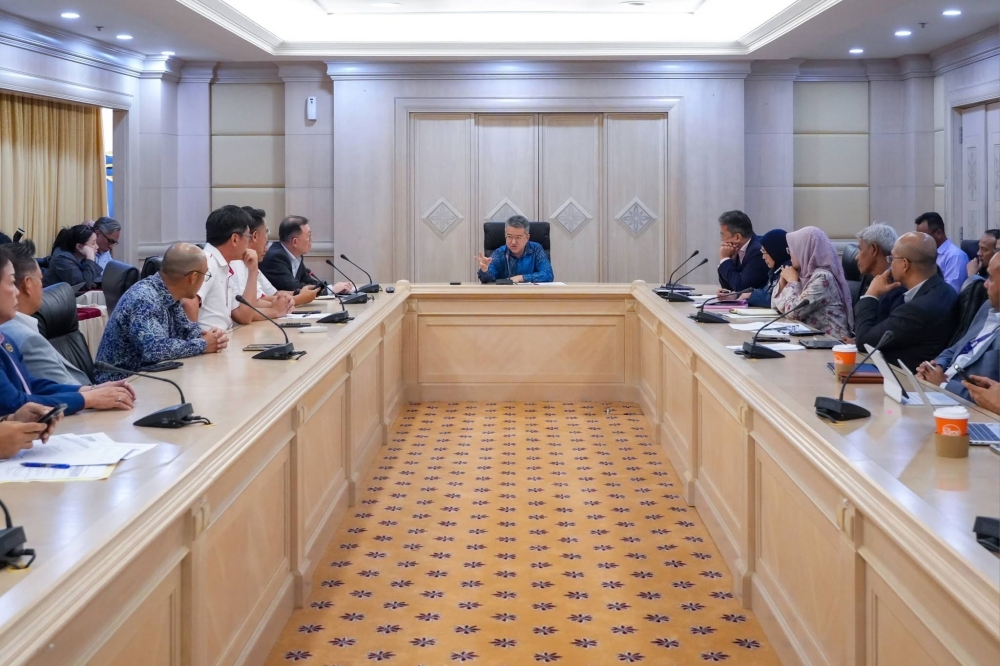
Finance Ministry leads push to stop illegal foreign goods and businesses and protect Malaysian jobs
KUALA LUMPUR, June 10 — The Ministry of Finance (MOF) is leading relevant ministries and agencies in adopting a &l...
"ADOPTING" · 총 50건
필터 보기현재 지수
49.5
0 = 부정 우세
50 = 중립
100 = 긍정 우세
최근 7일 기준 85,635건을 분석한 결과, 뉴스 심리지수는 49.5(균형)입니다. 긍정 10,547건(12.3%)·중립 61,820건(72.2%)·부정 13,268건(15.5%)이며, 중립 비중이 뚜렷하게 높습니다. 성향 지수는 종합 20.8(보수 경향)입니다.
KUALA LUMPUR, June 10 — The Ministry of Finance (MOF) is leading relevant ministries and agencies in adopting a &l...
Swedes' support for adopting the euro is falling, according to the latest survey by number-crunchers Statistics Sweden.
From low-carbon building materials to district-wide cooling systems, developers are adopting new technologies and design strategies to reduce energy consumption and operating costs.

The prosecution of a teacher for allegedly murdering a baby he was adopting 'rests on a theory of circumstantial evidence', a court heard today.

Washington keeps adopting tools that can shape, track or influence the federal workforce before Congress sets clear rules for how those tools may be used.

This article is brought to you by AGILINK. Throughout the exhibition hall at the 2026 IEEE International Conference on Robotics (ICRA), in Vienna, one demonstration seemed to attract a disproportionate amount of attention. Two robotic hands were making a balloon dog. Slowly and deliberately, the robot twisted a long balloon into loops, bends, and joints without popping it. Visitors stopped, watched, and often returned with colleagues to watch again. AGILINK’s balloon dog demonstration draws a crowd at ICRA 2026.AGILINK At first glance, the demonstration appeared almost playful. Among roboticists, however, balloon twisting is widely recognized as an unusually difficult manipulation task. A balloon is lightweight, highly deformable, slippery, and extremely sensitive to force. Every twist changes its geometry and internal pressure, turning a seemingly simple activity into a continuously changing physical interaction problem. Humans navigate those changes almost intuitively. While making a balloon animal, people rarely think consciously about force regulation, slip prevention, or contact stability. They simply adjust. For robots, those adjustments remain remarkably difficult. The challenge is not merely moving fingers to the right positions. The harder part is maintaining stable interaction while the object itself is changing. Highlights from AGILINK’s ICRA 2026 demonstrations, including visuotactile sensing, in-hand manipulation, balloon-animal shaping, and other contact-rich tasks enabled by the company’s latest OmniHand platform.AGILINK That distinction helps explain why the balloon dog drew so much attention in Vienna. What appeared to be a dexterity demonstration was, in many ways, a demonstration about contact itself. As robotic manipulation continues to advance, a growing number of researchers are arriving at a similar conclusion: many of the hardest problems in robotics begin only after contact occurs. Motion and Contact Intelligence for Robot Manipulation Balloon twisting combines two challenges that robotics has traditionally struggled to solve simultaneously: long-horizon task execution and contact-rich manipulation. The first concerns motion. A balloon dog is not created through a single grasp or twist. It emerges through a carefully ordered sequence of manipulations, each setting the conditions for what follows. A small rotational error introduced early may appear insignificant at first, yet several steps later it can prevent the final structure from forming altogether. In that sense, balloon twisting is a long-horizon task. Success depends not only on performing individual actions correctly, but also on preserving the future feasibility of the entire manipulation process. To address this challenge, AGILINK began by collecting demonstrations from professional balloon artists. Human actions were mapped onto robotic hands to establish an initial manipulation policy. But successful demonstrations alone were insufficient. In practice, some of the most valuable learning occurred when execution began to drift toward failure. Whenever instability emerged, human operators intervened and corrected the manipulation in real time. Those interventions were recorded and incorporated into reinforcement-learning cycles, allowing the system to learn not only how successful demonstrations unfold, but also how experienced operators recover when things start to go wrong. Through this process, the robot gradually acquired the capabilities required for long-horizon task execution—a collection of abilities that AGILINK groups under the term motion intelligence: the ability to generate actions, coordinate bimanual behaviors, and execute extended manipulation sequences under real-world uncertainty. OmniHand 3 Ultra-M on display at ICRA 2026.AGILINK Yet motion alone does not explain why balloon twisting remains difficult. The second challenge is contact. The robot must continuously regulate force, adjust contact locations, and respond to subtle changes in the object’s state. These decisions are difficult to encode through explicit rules. Even skilled human operators often rely on tactile intuition developed through experience rather than consciously articulated strategies. Analysis of those interventions revealed that many failures did not originate from incorrect action sequences, but from the breakdown of contact itself. To better capture those interaction dynamics, AGILINK collected contact-centric intervention data and incorporated those interactions into reinforcement-learning training. Rather than learning only which motions to perform, the system also learned how humans maintain stability when contact conditions begin to deteriorate. AGILINK describes this capability as contact intelligence: the ability to establish, maintain, and adapt physical interaction as force distribution, friction, deformation, and contact geometry continuously evolve. The distinction between the two capabilities is subtle but important. Motion intelligence determines what the robot intends to do. Contact intelligence determines whether it can continue doing it. For balloon twisting, both are necessary. One provides the sequence of actions. The other keeps those actions physically viable. YouTuber KhanFlicks follows OmniHand’s motions while learning to fold a balloon dog at the AGILINK booth.AGILINK Between a balloon slipping away and a balloon bursting lies a narrow region of stability. Successful manipulation depends on finding that region—and remaining within it throughout the task. Introducing the OmniHand 3 Ultra-M Dexterous Hand The balloon dog demonstration showcased a manipulation capability. It also revealed a broader question. How much contact intelligence can be achieved through learning alone? A robot can only regulate what it can perceive. It can only respond as quickly as its hardware allows. As manipulation tasks become increasingly complex, researchers are finding that progress depends not only on better policies, but also on richer sensing and faster physical response. That realization formed the backdrop for AGILINK’s second major announcement at ICRA 2026. Alongside the balloon dog demonstration, the company introduced the OmniHand 3 Ultra-M. OmniHand 3 Ultra-M closely matches the size of an adult human hand.AGILINK The two exhibits represented different stages of the same technological trajectory. If the balloon dog demonstrated what contact intelligence can already accomplish today, Ultra-M was designed to explore what contact intelligence may require next. Building Hardware for Contact Intelligence Roughly the size of an adult human hand, the OmniHand 3 Ultra-M integrates 20 active degrees of freedom within a human-scale form factor. Its most distinctive feature is a fully direct-drive architecture. By adopting direct-drive actuation throughout the system, the hand is designed to enable faster and more transparent force regulation and higher force-control bandwidth, enabling faster response as contact conditions change. For contact-rich manipulation, responsiveness can be as important as sensing itself. By adopting direct-drive actuation throughout the system, the OmniHand 3 Ultra-M is designed to enable faster and more transparent force regulation and higher force-control bandwidth, enabling faster response as contact conditions change. The platform also incorporates tactile sensing across nearly the entire hand. Each fingertip contains a miniature vision-based tactile sensor, while more than 300 three-dimensional tactile sensing points are distributed throughout the palm. Together, they provide information not only about where contact occurs, but how contact is evolving. The system is designed to estimate pressure distribution, shear forces, local deformation, slip tendencies, and other interaction dynamics that often remain invisible to conventional position-based control systems. According to AGILINK’s tests, individual sensors achieve force resolution of approximately 0.005 N—roughly equivalent to detecting the weight of a sheet of paper resting on a fingertip. Spatial resolution reaches approximately 0.04 mm, while sensing density approaches 50,000 sensing points per square centimeter. OmniHand 3 Ultra-M recognizes feather texture through vision-based tactile sensing.AGILINK For dexterous robots, contact has traditionally been a largely hidden process. Ultra-M is designed to make that process more observable. Rather than simply detecting that contact has occurred, the system attempts to resolve where interaction is happening, how forces are distributed, whether instability is beginning to emerge, and how manipulation strategies should adapt in response. The balloon dog offered a glimpse of what contact intelligence can already accomplish. Ultra-M explores a different question: what capabilities may be required to push contact intelligence further? The Physical World Remains the Hardest Benchmark The significance of contact intelligence extends far beyond balloon animals. Many tasks that continue to resist automation involve unstable or deformable interaction: cable insertion, garment handling, flexible packaging, delicate assembly, connector mating, tool use, and household manipulation. These tasks are difficult not because robots cannot reach the correct location, but because maintaining stable interaction after contact begins remains extraordinarily hard. For decades, robotics achieved many of its successes by reducing uncertainty. Factories were engineered to make robotic motion predictable, repeatable, and highly structured. The physical world behaves differently. A growing share of robotics research is shifting toward interaction itself—understanding how robots can establish, maintain, and adapt physical contact within environments that remain fundamentally unpredictable. Objects shift. Materials deform. Friction changes. Contact evolves. Real environments rarely follow scripts. Seen through that lens, the balloon dog was never really about the balloon dog. What attracted attention at ICRA was not simply a visually impressive demonstration, but what it revealed: intelligence in the physical world is ultimately measured through interaction. As motion generation continues to mature, a growing share of robotics research is shifting toward interaction itself—understanding how robots can establish, maintain, and adapt physical contact within environments that remain fundamentally unpredictable. For robots moving beyond structured environments and into less predictable real-world settings, managing contact may become as important as motion itself.

Long championed as a leader in adopting digital technology, Sweden is set to ban mobile phones in schools beginning in the fall for the next academic year.
You do the research, read lists of reviews, compare the filtration stages, and shell out a significant sum for the most promising, tech-savvy water purifier in the market. Then, just two months into installation, the machine starts throwing a series of confusing, flashing signals. The premium buying experience instantly evaporates, replaced by the sheer frustration of tracking down customer care and waiting at home for a technician to show up.In India’s competitive consumer durables sector, this exact friction point has transformed the landscape of water purifiers. The ultimate battle is no longer just about who can build and sell the best machine; it is increasingly about who can maintain trust after the hole has been drilled in the customer's kitchen wall.While the water purifier market is traditionally viewed through the lens of one-time appliance sales, companies like Eureka Forbes, the legacy player behind AquaGuard, are increasingly betting on a far larger opportunity hidden beneath the surface: the recurring service economy built around filters, annual maintenance contracts (AMCs) and nationwide technician networks.According to internal projections by Anurag Kumar, Chief Growth Officer at Eureka Forbes, the water purifier service market alone is on track to cross Rs 9,000 crore by FY30, nearly matching the projected Rs 10,000 crore size of the product market itself.131582773Also read: Beyond the room: Why India Inc's luxury hospitality bet is becoming an experience businessBreaking down the mathFor decades, the consumer durable playbook was simple: manufacture, distribute, sell, repeat. But water purification is far different from selling a television or a refrigerator; it is an active, evolving health product bound to the fluctuating quality of local municipal and groundwater supplies."The market for product categories for water purifiers is about Rs 3,800 crore today," Kumar says in an exclusive interview with ET Online. "I think you would add another, roughly about Rs 3,500 crore of service category as well to it."Citing independent industry reports, Kumar highlighted that by FY30, this parallel economy is set to explode. The product market will expand to over Rs 10,000 crore, while the service and aftermarket ecosystem will chase it tightly at more than Rs 9,000 crore, growing at a combined double-digit compound annual growth rate (CAGR) of 11% to 12%.This shifting weight from hardware to service fundamentally changes corporate strategies. For an industry dealing with an urban penetration rate of just 14% (and a mere 7% nationally), the recurring revenue from existing households forms a highly resilient cash-flow cushion that protects margins even during macro-economic slowdowns.131582808Service scale becomes the biggest moatThe Rs 9,000 crore service opportunity explains why tech-first aggregators and rental startups are rushing into the service category. However, scaling an on-demand service infrastructure across India’s complex geography is entirely different from coding an app.For legacy companies like Eureka Forbes, this operational network has become a major competitive advantage."After sales service can make or break a brand," says Kumar. "I think a lot of the trust that AquaGuard has today is really thanks to the fact that people have trust in our service... It's a very, very important integral part of our business and a very, very crucial moat that we continue to nurture."To defend this moat against new-age tech startups, Eureka Forbes operates at a scale that resembles a logistics company more than an appliance manufacturer. The company has deployed more than 8,000 technicians mapping out an operational footprint across 19,500 PIN codes.Also read: Apple expected to unveil new AI features at last developers conference with CEO Tim CookThe push to reduce maintenance costs"Once you sell a product, then you have it for life and there's some revenue which comes with it," Kumar says, referring to filter replacements, AMCs and servicing requirements.Interestingly, the biggest threat to this recurring service revenue is not new-age competitors, it has been consumer fatigue over high maintenance costs. Historically, the dread of paying steep annual fees to replace purifier filters has acted as a primary barrier keeping the remaining 86% of urban Indian households from adopting organised water purifiers.To beat this, Eureka Forbes pulled off a counter-intuitive strategic gear: they disrupted their own short-term revenue model to secure long-term market share.Last year, the company introduced a range of purifiers featuring "long-life" filters extending the replacement cycle from the traditional 12 months to a full two years."We did that because we fundamentally heard from consumers that there was also a barrier to the category around maintenance cost being high," Kumar reveals. "What two-year filters actually did was they actually lowered the maintenance cost because now you don't have to change filters every year. You have to change once every two years."Digitising a 1980s direct-sales DNAEureka Forbes, a company historically known for its door-to-door service, and making Aquaguard synonymous with water purifiers in India, faced a new piece of necessary upgrade with building digitisation. The multi-billion dollar service landscape required a complete digital overhaul of consumer interactions. The brand that built its empire in the 1980s on the soles of direct-sales agents knocking on suburban doors has had to pivot entirely to an on-demand, algorithmic infrastructure.An army of thousands of field technicians is only as efficient as the software directing them. For modern consumers who manage their entire lives via smartphone screens, a bland "technician will visit tomorrow" promise no longer cuts it."We've digitised that service," notes Kumar.The long-term playAs water contamination concerns spike across rapidly expanding urban clusters, the structural demand for pure drinking water will continue to climb, and so for water purifiers.However, as the hardware itself faces gradual commoditisation and intense price competition from newer market entrants, the center of gravity has largely shifted. Where the growth moves nextCapturing a dominant share of the service market is only half the blueprint. As Kumar maps out the strategic trajectory for Eureka Forbes over the next three to five years, the company's growth engine eyes two distinct tracks: aggressive geographic widening and targeted product diversification. Geographically, Kumar notes, the company is bypassing deep rural pockets for the time being to focus heavily on India’s rapidly urbanising Tier-2 and Tier-3 towns. Instead, the company is doubling down on smaller towns where they can immediately deploy their signature localised service infrastructure without stretching their logistics network too thin.Simultaneously, the brand is attempting to de-risk its reliance on the kitchen wall by expanding into adjacent consumer durables. Kumar outlined a product pipeline anchored in high-growth, premium categories, including robotic vacuum cleaners, air purifiers, and household water softeners. The underlying playbook here is pure cross-selling. By utilising the same 8,000-strong technician network to service these newer household appliances, Eureka Forbes is betting that its aftermarket footprint can drastically lower its customer acquisition costs; positioning the legacy firm to evolve from a single-product manufacturer into a broader home-health ecosystem player.
The program allows children to take authorized leave from school on weekdays to spend time with family for educational activities.
A woman's journey of adopting a homeless woman's son unfolds challenges and secrets, revealing what her husband discovered about Noah after 14 years.
The 37-year-old allegedly drank from a baby bottle, used a pacifier, slept with a comfort cloth, and even faked night terrors to sell her sick charade.
Vienna, OPEC+ ministers decided Sunday to increase oil quotas by a total 188,000 barrels per day for July, in a move analysts said would be unlikely to have an impact on prices sent higher by the Mideast war.Jorge Leon, analyst at Rystad Energy, said ahead of the expected increase that it "means very little while the Strait of Hormuz remains closed".He added: "The market is not short of quota announcements; it is short of physical barrels that can actually move. In that sense, the 188,000 barrels per day increase would be more of a policy signal than a real supply boost."The hiked production output was agreed Sunday in a video meeting of oil ministers from key OPEC+ countries Saudi Arabia, Russia, Iraq, Kuwait, Kazakhstan, Algeria and Oman, a statement from the organisation said.The increase was similar to ones decided in previous months.The OPEC+ statement said the latest agreed hike was "to support oil market stability" but that the seven countries also saw an opportunity "to accelerate their compensation" in a time of historically high oil prices.It added that the ministers "reaffirmed the importance of adopting a cautious approach and retaining full flexibility to increase, pause or reverse the phase out of the voluntary production adjustments, including reversing the previously implemented voluntary adjustments announced in November 2023".Leon, at Rystad Energy, said that OPEC+ was wary in case the Mideast war changes, and Iran's stranglehold on the Strait of Hormuz eases."When the Strait of Hormuz reopens, the market could move very quickly from fear of shortage to fear of surplus," he said."Returning OPEC+ supply, a stronger US shale response and weaker demand after a period of very high prices could leave the market with a very large oversupply problem," he said.
A month after adopting Jennifer, a chilling warning from their 4-year-old daughter leaves a mother questioning her husband and the secrets he may be hiding.
Comments
Sports Illustrated Swimsuit model Carol Alt reveals she battled exhaustion and allergies throughout her career before adopting a raw food lifestyle.
Vice-Chancellor of BLDE Deemed University, Vijayapura, Arun C. Inamadar has said that adopting Artificial Intelligence and Machine Learning in health sciences had become a necessity more particularly for the students now
The document lists nuclear power as one of the sources that the State should explore in adopting a “long-term strategy” for energy security
A 37-year-old woman in Brazil is arrested for deceiving a family into adopting her as a 12-year-old girl, revealing a web of fraud and false identity.
Italy began its journey towards re-adopting nuclear power generation on Thursday after the nation's Chamber of Deputies overwhelmingly voted in favor of a new "sustainable nuclear energy bill." The post Italy Begins Journey Back to re-Adopting Nuclear Power appeared first on Breitbart.
Dinnerstein/Baroklyn (Naïve) With a refreshingly organic approach, the US pianist and her string ensemble revitalise the modern minimalist master’s score for The Hours and his Tirol Concerto Getting ahead of next year’s 90th birthday celebrations, American pianist Simone Dinnerstein presents two works by Philip Glass, performing alongside her own string ensemble. Baroklyn – the name conflates her home borough of Brooklyn and the baroque sensibilities of JS Bach – take a far-from-mechanical approach to the composer’s minimalist tics. Their aim is to emulate the passage of time like sand through an hourglass (hence the title) rather than chopping the music into segments like the hands of a clock. And it works. Arranged by Michael Riesman, Suite from The Hours splices Glass’s score for Stephen Daldry’s film into an almost symphonic three-movement work. The story’s pain and poetry is encapsulated in an immersive score for piano, strings, harp and celesta, with Dinnerstein raising the emotional stakes by adopting considerably slower tempi than the movie soundtrack. Continue reading...