Spiral Graph: Cluster Buster
이 뉴스, 어떠셨어요?
한 번의 탭으로 반응을 남겨요 · 로그인 불필요
Explore This Section…
Citizen Science Projects
Spiral Graph: Cluster Buster
Projects
Highlights
Publications
NASA Citizen Scientists
Science Activation
Resources
Spiral Graph: Cluster Buster
How big is the black hole in the center of that galaxy? And how much dark matter does that galaxy contain? If it’s a spiral galaxy, its arms might give you a clue! Some spiral galaxies have arms that are wound tight like a spring. In others, the arms curl loosely, like a pinwheel. NASA’s new Spiral Graph: Cluster Buster project invites you to help verify the work of a computer model tasked with identifying individual spiral arms of galaxies to help scientists seeking answers to galactic secrets.
The Spiral Graph: Cluster Buster project builds on an earlier citizen science project called simply “Spiral Graph.” In this older project, volunteers made tracings of the arms in more than 20,000 images of galaxies. The scientists then built a computer model to cluster these traces into the individual spiral arms they represent. Sometimes this computer model assigned traces to the wrong arm, or didn’t succeed in constructing any arm at all. You’ll examine the model’s output to the original tracings and decide if the model got it right. Your contributions will also help scientists train new and better models that use artificial intelligence.
Go to Project Website about Spiral Graph: Cluster Buster
project task
Examine images
division
Astrophysics/ Universe
where
Online
launched
2026
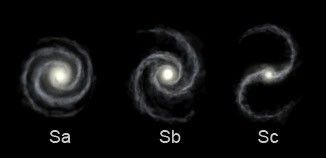
These three spiral (“S”) galaxies observed by Hubble illustrate variation in the
tightness of their curled arms to the galaxy centers. The galaxy labeled “Sa” is an example of
tightly wrapped arms. Galaxy labeled “Sa” shows tightly wrapped arms. The galaxy labeled
“Sb” shows gently wrapped arms. The galaxy labeled “Sc” shows loosely wrapped arms.
Credit: Ville Koistinen. File may be found at
https://commons.wikimedia.org/wiki/File:Hubble_sequence_photo_spiral.jpg, and is licensed
under the Creative Commons Attribution-Share Alike 3.0 Unported license.
What you’ll do:
View drawings of spiral arms made by previous volunteers who traced images of spiral galaxies.
Compare them with patterns made by a computer based on what the volunteers drew. These patterns are clusters of the tracings made by volunteers.
Click “yes” or “no” to answer the prompt, “do the tracings appear to be clustered correctly?”
If you want to, you can discuss what you find with other volunteers and scientists in the Talk forum.
Requirements
Time: 10-15 minutes to complete the tutorial, then as much time as you like.
Equipment: An internet-connected computer, tablet, or smartphone
Knowledge: None. The in-project tutorial provides all the necessary information.
Get started!
Visit the project website.
Click on “Classify,” and complete the in-project tutorial to learn about the task and project tools.
Still have questions? Check out the answers on the Frequently Asked Questions (FAQ) page.
Start assessing how the algorithm has grouped the volunteers’ tracings of galactic arms.
Learn more:
Visit Spiral Graph: Cluster Buster’s About tab to read more about the Research being pursued by the project, the team of scientists behind it, and access answers to Frequently Asked Questions related to doing the project itself. The project’s Education page has resources for educators who are teaching high school students about galaxies.
Spiral Graph: Cluster Buster logo
Image A shows the grey traces of galaxy arms made by volunteers in the Spiral project). Image B shows the work of Spiral Graph: Cluster Buster’s algorithm’s attempt to group the traces into individual galactic arms, each with its own color. Note that the purple arm as assembled by the algorithm has two distinct clusters to the left of center of the galaxy: this is in fact TWO distinct arms.
Image credit: Spiral Graph: Cluster Buster
Get to know the people of Spiral Graph: Cluster Buster!
Patrick Treuthardt
Astrophysicist, North Carolina Museum of Natural Sciences
Visit Team Page
Alp Tezbasaran
Research Adjunct, North Carolina Museum of Natural Sciences
Visit Team Page
Ian Hewitt
Research Adjunct, North Carolina Museum of Natural Sciences
Visit Team Page
Ankit Biswas
Volunteer, North Carolina Museum of Natural Sciences
Visit Team Page
Visit Team Page
Volunteer, North Carolina Museum of Natural Sciences
Visit Team Page