Hubble Details Early Galaxy Transforming Neighborhood
이 뉴스, 어떠셨어요?
한 번의 탭으로 반응을 남겨요 · 로그인 불필요
Explore HubbleScience
Hubble Space Telescope
Hubble Details Early Galaxy…
Hubble Home
OverviewAbout Hubble
The History of Hubble
Hubble Timeline
Why Have a Telescope in Space?
Hubble by the Numbers
At the Museum
FAQs
Impact & BenefitsHubble’s Impact & Benefits
Science Impacts
Cultural Impact
Technology Benefits
Impact on Human Spaceflight
Astro Community Impacts
ScienceHubble Science
Science Themes
Science Highlights
Science Behind Discoveries
Universe Uncovered
Hubble’s Partners in Science
Hubble & Citizen Science
AI & Hubble Science
Explore the Night Sky
ObservatoryHubble Observatory
Hubble Design
Mission Operations
Science Operations
Astronaut Missions to Hubble
Hubble vs Webb
TeamHubble Team
Career Aspirations
Hubble Astronauts
MultimediaImages
Videos
Online Activities
e-Books
Sonifications
Podcasts
3D Hubble Models
Lithographs
Posters
Hubble on the NASA App
Glossary
NewsHubble News
Social Media
Media Resources
35th Anniversary
MoreOnline Activities
5 Min Read
Hubble Details Early Galaxy Transforming Neighborhood
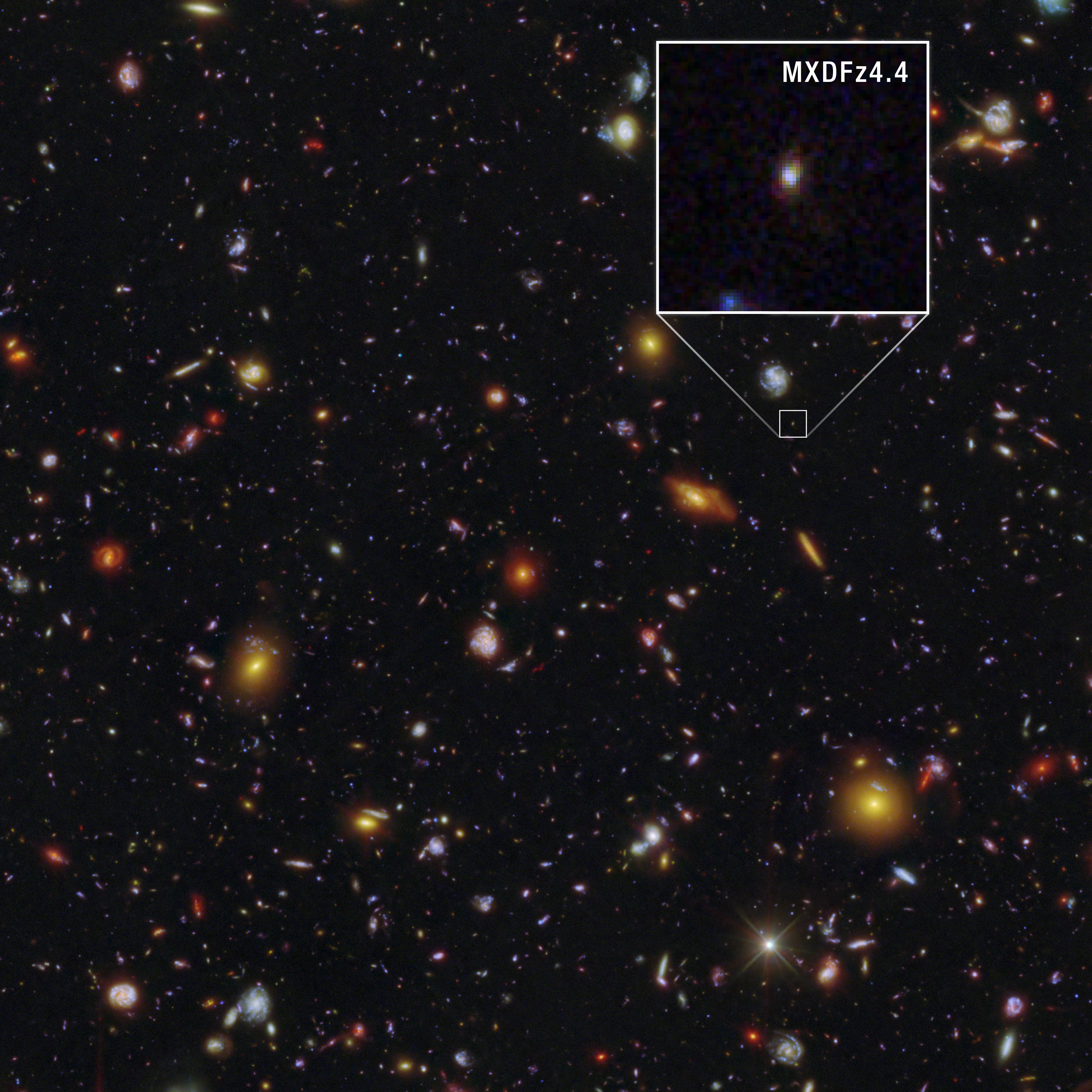
Detailed visible-light images from Hubble reveal that several bursts of younger stars cleared the space in and around galaxy MXDFz4.4. Astronomers have long sought evidence to explain this transition — and Hubble has provided the first example in this time period.
Credits:
Image: NASA, ESA, CSA, STScI, Ilias Goovaerts (STScI), Marc Rafelski (STScI, JHU), Anton Koekemoer (STScI); Image Processing: Alyssa Pagan (STScI)
Astronomers using NASA’s Hubble Space Telescope have found something they never expected — ultraviolet light from a galaxy that existed just 1.4 billion years after the big bang. That galaxy contains tightly clustered young stars that produce ionizing light capable of transforming the opaque, neutral gas within and immediately around the galaxy, clearing our view. This suggests that similar galaxies in the early universe were responsible for clearing the neutral fog of hydrogen gas that once filled the cosmos.
A paper describing this discovery was published June 23 in the Astrophysical Journal.
The galaxy, cataloged MXDFz4.4, existed at the end of the Era of Reionization, a transformative period in our universe. During roughly the first billion years of the cosmos, the gas between stars and galaxies was opaque to energetic ultraviolet light. As time wore on, gas everywhere became transparent or ionized. The changeover was not like an on/off switch, but likely took hundreds of millions of years. Researchers are still collecting evidence to fully understand how this happened, which is why MXDFz4.4 sets a critical precedent.
“Observing a galaxy like this was thought to be impossible,” said lead author Ilias Goovaerts, a postdoctoral fellow at the Space Telescope Science Institute (STScI) in Baltimore. “Researchers expected the ‘fog’ or neutral hydrogen that filled the early universe would be too thick and obscure our view of its ionizing light. Hubble not only spotted that light, but it also helped reveal incredible details about the galaxy’s characteristics.”
Detailed visible-light images from Hubble reveal that several bursts of younger stars cleared the space in and around galaxy MXDFz4.4. Astronomers have long sought evidence to explain this transition — and Hubble has provided the first example in this time period.
Image: NASA, ESA, CSA, STScI, Ilias Goovaerts (STScI), Marc Rafelski (STScI, JHU), Anton Koekemoer (STScI); Image Processing: Alyssa Pagan (STScI)
Great light ‘escape’
Young, massive stars emit ultraviolet light capable of ionizing hydrogen atoms. As this light traveled for over 12 billion years to reach Hubble, space expanded, and the light stretched or redshifted into visible light. Hubble’s wavelength coverage, combined with the sensitivity and resolution of its space-based vantage point, makes it the only telescope capable of capturing this ultraviolet light from the early universe.
“Astronomers have found many galaxies that existed at this point in the history of the universe, but we haven’t detected ionizing photons from any of them, making MXDFz4.4 one of a kind,” said Marc Rafelski, a co-author and Hubble deputy mission head at STScI.
Hubble’s long exposures, pulled from several existing surveys, revealed that the galaxy’s young, massive stars are the source of the ultraviolet light, which cleared the surrounding space. These stars formed in bursts within the last few million years of MXDFz4.4’s existence and are crammed together.
Amplifying this crowding effect, MXDFz4.4 is about 100 times smaller by area than our Milky Way galaxy, but is forming stars 10 times faster.
“A lot of young, hot, massive stars in a small space do a better job of blasting through opaque gas,” Goovaerts said. The researchers estimate that 50 to 100% of the young stars’ energetic ionizing light is escaping the surrounding gas.
Massive stars’ lifetimes also play a role, since they live for only a few million years. Many explode as supernovae, releasing gigantic amounts of energy and blowing colossal holes that allow even more light to escape.
This illustration portrays galaxy MXDFz4.4 when it existed 1.4 billion years after the big bang. At this time, the universe was still a mix of opaque and transparent gas as the Era of Reionization was gradually ending.
Illustration: NASA, ESA, Leah Hustak (STScI)
Partnering with other observatories
Hubble could not do this alone. These conclusions are supported by survey data taken by NASA’s James Webb Space Telescope in near-infrared light and the MUSE eXtremely Deep Field or MXDF, the galaxy’s namesake, captured by the European Southern Observatory’s Very Large Telescope (VLT) in visible light.
The team used Webb’s data to determine the galaxy’s mass, analyze its older stars, and measure the galaxy’s star formation history. The galaxy’s older stars are less massive and cooler, and therefore not responsible for changing the gas around them.
Comparing Hubble and Webb data also showed that recent star formation happened in bursts. “Without Webb to clarify what we saw in Hubble’s images, we couldn’t make these conclusions,” Rafelski said.
Data from the VLT pinpointed when MXDFz4.4 existed: 1.4 billion years after the big bang. Before this discovery, researchers had only identified a galaxy emitting ionized light from a time when the universe was 1.6 billion years old. Only a few additional examples have been identified, and those existed when the universe was about 2 billion years old. MXDFz4.4 brings researchers closer to drawing firm conclusions about how the Era of Reionization unfolded.
Credit: NASA’s Goddard Space Flight Center; Lead Producer: Paul Morris
Expanding what we know
Studying the Era of Reionization is a decades-old endeavor. Researchers use statistics about star populations in nearby galaxies, which we can observe in great detail, to make well-informed assumptions about what might be happening in galaxies in the early universe, in part because their star populations are too distant to resolve in any detail.
In 2023, researchers using Webb showed that galaxies’ stars emitted enough light to heat and ionize the gas around them 900 million years after the big bang. This was a breakthrough, but astronomers need galaxies like MXDFz4.4 to fully explain how the process happened, since it shows how the high-energy light from young stars managed to escape the gas and dust within the galaxy itself.
It’s possible other galaxies like MXDFz4.4 are waiting to be discovered.
“Hubble’s observations of MXDFz4.4 let us test our hypotheses much closer to the Era of Reionization than ever before,” Rafelski said. “Finding more galaxies, especially at slightly later cosmic times where larger samples are within reach, would let us refine these measurements and figure out what cleared our view as that era was ending.”
The Hubble Space Telescope has been operating for over three decades and continues to make ground-breaking discoveries that shape our fundamental understanding of the universe. Hubble is a project of international cooperation between NASA and ESA (European Space Agency). NASA’s Goddard Space Flight Center in Greenbelt, Maryland, manages the telescope and mission operations. Lockheed Martin Space, based in Denver, also supports mission operations at Goddard. The Space Telescope Science Institute in Baltimore, which is operated by the Association of Universities for Research in Astronomy, conducts Hubble science operations for NASA.
Facebook logo
@NASAHubble
@NASAHubble
Instagram logo
@NASAHubble
Related Images & Videos
Galaxy MXDFz4.4 (Hubble and Webb Image)
Detailed visible-light images from Hubble reveal that several bursts of younger stars cleared the space in and around galaxy MXDFz4.4. Astronomers have long sought evidence to explain this transition — and Hubble has provided the first example in this time period.
Galaxy MXDFz4.4 (Artist’s Concept)
This illustration portrays galaxy MXDFz4.4 when it existed 1.4 billion years after the big bang. At this time, the universe was still a mix of opaque and transparent gas as the Era of Reionization was gradually ending.
Galaxy MXDFz4.4 (Hubble and Webb Compass Image)
This shows the galaxy MXDFz4.4, enlarged at right, in the Hubble Ultra Deep Field (HUDF), captured by both the Hubble Space Telescope’s Advanced Camera for Surveys (ACS) and the James Webb Space Telescope’s NIRCam (Near-Infrared Camera).
Share
Details
Last Updated
Jun 23, 2026
Editor
Andrea Gianopoulos
Location
NASA Goddard Space Flight Center
Contact
Media
Claire Andreoli
NASA’s Goddard Space Flight Center
Greenbelt, Maryland
claire.andreoli@nasa.gov
Claire Blome, Christine Pulliam
Space Telescope Science Institute
Baltimore, Maryland
Related Terms
Hubble Space Telescope
Astrophysics
Astrophysics Division
Galaxies
Goddard Space Flight Center
James Webb Space Telescope (JWST)
Origin & Evolution of the Universe
Related Links and Documents
The science paper by Ilias Goovaerts et al.
This release on the ESA/Hubble website.
Keep Exploring
Discover More Topics From Hubble
Hubble Space Telescope
Since its 1990 launch, the Hubble Space Telescope has changed our fundamental understanding of the universe.
Hubble Science Highlights
Hubble Images
Hubble News