More Cartilage, Blood Pressure Studies on Station as Crew Swap Preps Begin
More Cartilage, Blood Pressure Studies on Station as Crew Swap Preps Begin
Cartilage engineering and blood pressure studies to improve health on Earth and in space continued aboard the International Space Station on Tuesday. The Expedition 74 crew members also serviced an experimental module, configured a temporary sleep station, and began preparing for the return to Earth of three crewmates.
Lab-grown cartilage tissues on Earth are subject to gravity resulting in lesser quality than samples engineered in the weightless environment of the orbital outpost. NASA flight engineer Jessica Meir is helping scientists take advantage of microgravity to mimic how cartilage tissues are produced in the human body. Meir continued processing the growing cartilage cells inside the Kibo laboratory module’s Life Science Glovebox for viewing inside a fluorescent microscope. Observations from the biotechnology study may enable the engineering of more natural cartilage tissues than those produced on Earth leading to the advanced treatment and prevention of cartilage and joint injuries.
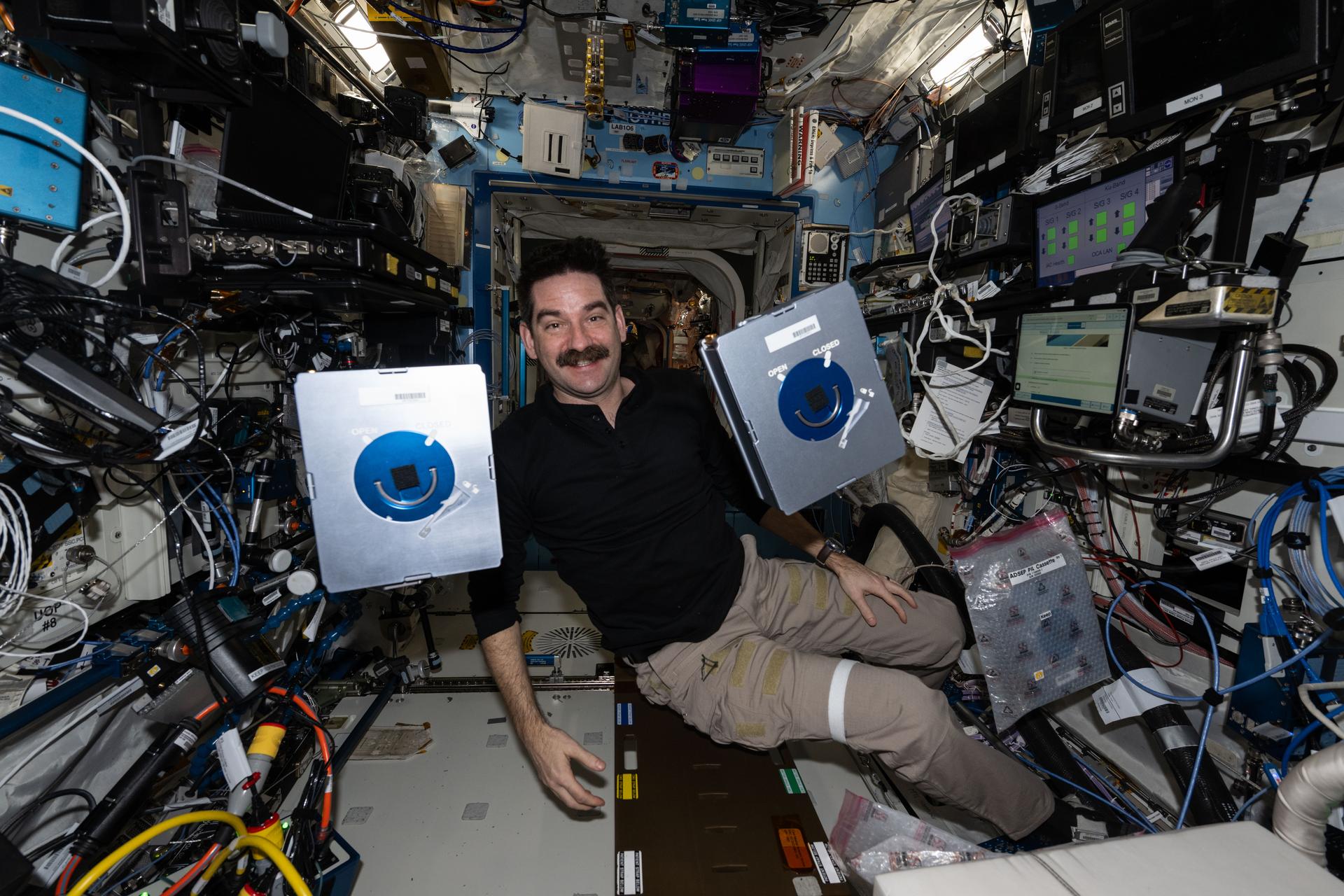
NASA flight engineer Jack Hathaway spent his day on maintenance and stowage inside BEAM, the Bigelow Expandable Activity Module, attached to the Tranquility module. Hathaway first replaced batteries inside sensors that monitor BEAM’s internal and external condition. Next, he opened BEAM’s hatch and packed excess hardware and cargo inside the experimental module that was installed on April 16, 2016. Meir assisted Hathaway with the BEAM work during a break in her cartilage research.
NASA flight engineer Chris Williams, who will be returning to Earth soon with Roscosmos cosmonauts Sergey Kud-Sverchkov and Sergei Mikaev, recorded a video message for European students describing the effects of microgravity and readjusting to Earth’s gravity. Williams also worked inside the Quest airlock inspecting tethers and stowing tools that he and Meir used during a spacewalk on June 30. He wrapped up his shift in the Columbus laboratory module replacing air ducts and measuring the airflow in an upgraded temporary sleep station in preparation for the arrival of a new crew next week.
Flight engineer Sophie Adenot of ESA (European Space Agency) began her shift retrieving cartilage cell samples from an incubator and handing them over to Meir for her research. Adenot then collected and analyzed her saliva samples using the Aphrodite portable device. The biomedical gear enables real-time, diagnostic health monitoring in space without sending samples back to Earth for analysis. Next, she worked on orbital plumbing inside Tranquility then installed protective covers on sensitive scientific equipment inside Kibo.
Kud-Sverchkov and Mikaev are preparing for their upcoming return to Earth with Williams aboard the Soyuz MS-28 spacecraft. The duo called down to Roscosmos mission controllers for a conference with the support personnel who will greet the trio after they complete their eight-month space research mission at the end of July. The two cosmonauts then continued their cardiac research using light-based sensors and lasers on their skin to measure how blood flows in their tiny vessels, or the micro-circulatory system.
Roscosmos flight engineer Andrey Fedyaev spent most of his shift collecting station water and atmospheric moisture samples for analysis. Fedyaev also checked the operation of life support equipment in the Zvezda service module and cleaned ventilation systems in the Zarya module.
Learn more about station activities by following the space station blog, @space_station on X, as well as the ISS Facebook and ISS Instagram accounts.
이 뉴스, 어떠셨어요?
한 번의 탭으로 반응을 남겨요 · 로그인 불필요