From NASA to the classroom: The engineer bringing AI to those left behind
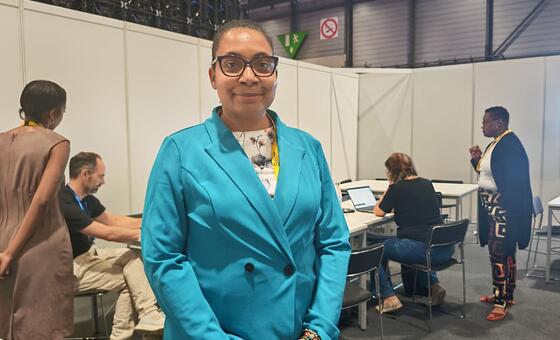
From NASA to the classroom: The engineer bringing AI to those left behind
Nia Jetter spent two decades building spacecraft and robots. Now she is trying to make sure the artificial intelligence revolution doesn't leave anyone behind.
Growing up in New Jersey, Ms. Jetter saved the quarters her grandfather gave her – not for sweets, but for batteries and light bulbs, so she could build circuits from whatever she found around the neighbourhood.
Her father took her to the library for materials; her mother, a kindergarten and special education teacher, taught her how to explain complex ideas simply.
Three decades later, that curious child had helped build the GPS satellite system much of the world now depends on, worked at NASA, Boeing and Raytheon, and held one of the highest technical positions at Amazon: senior principal technologist in robotics AI, a role reserved for only a handful of engineers worldwide.
Then, at the peak of her career, she found a new calling.
“I studied artificial intelligence before it was as cool as it is now,” she said.
A decisive moment
Ms. Jetter studied mathematics and computer science at the Massachusetts Institute of Technology, specialising in planetary science, followed by a master's in aeronautics and astronautics at Stanford and 20 years developing autonomous algorithms for spacecraft and robots.
By any measure, she was at the top of her field. But something troubled her.
“This moment in time is so important for the world because of how AI is shaping our society and how people are shaping AI,” she said. “If we do not have all the right voices in the room shaping artificial intelligence...the product we end up with will not be the best one for us as a global community.”
That conviction changed everything. Ms. Jetter decided her experience was better spent making sure no one was left out.
A right, not a privilege
That is how her non-profit, thinqueBytes, was born – first as a personal project developed over five years, later as part of the Distinguished Minds Institute.
Its mission is to expand access to artificial intelligence and STEM education among communities historically underserved by the tech sector. It has trained more than 1,000 young people across four continents.
The approach is simple: break down complex subjects – AI, robotics, rocket science – into short videos, or “bytes”, each answering a basic question. What is artificial intelligence? Should I be afraid of it? Will it take my job? For Ms. Jetter, understanding emerging technology “should not be a privilege; it should be a right.”
There is a personal dimension to that belief. Ms. Jetter attended an engineering school where, she said, “there were definitely more men than women”, and has experienced the bias of people resistant to a different reality — “and sometimes that different reality is simply brilliant people who deserve a place in this world.”
From AI safety to global governance
Ms. Jetter is no naïve techno-optimist. She likens AI to a hammer: “In the right hands, it builds a house, protects people and saves lives. In the hands of someone very different, it can be used to cause harm.”
That is why she believes rules matter – not as an obstacle, but as a compass to help people understand when and how a product can cause harm.
he describes a world moving so fast that “regulations are sometimes being written while we are building”, often by people who lack the foundational knowledge to build responsibly.
Consensus in Geneva
In early July, that conviction collided with the global agenda. Ms. Jetter and her team joined the UN's first Global Dialogue on AI Governance in Geneva, the first UN General Assembly-established forum on AI with every country at the table.
Opening the summit, Secretary-General António Guterres said AI, used well and shared widely, could “compress decades of development into years” and become “the great equaliser of the twenty-first century” - but warned the choice was to “govern by design or drift by default.” He noted that 2.2 billion people, one in four worldwide, remain disconnected from the digital world altogether.
ITU Secretary-General Doreen Bogdan-Martin echoed the message: for AI to benefit everyone, technology and international cooperation must advance together.
Days later, at the AI for Good Global Summit, where Ms. Jetter also spoke, the conversation turned concrete — AI for early cancer detection, internet access for remote schools, and critical-thinking skills for a generation growing up talking to machines.
Ms. Jetter could return to her old career at any time. Instead, somewhere in a classroom in Ghana, or on a screen anywhere in the world, someone who never imagined understanding an algorithm is learning about one — because an engineer decided AI's future should be written in classrooms, not only in corporate labs.
이 뉴스, 어떠셨어요?
탭 한 번으로 반응 · 로그인 불필요
공식 발표 ↔ 진영별 보도
보도 없음
보도 없음
보도 없음