The need for robust debate
이 뉴스, 어떠셨어요?
한 번의 탭으로 반응을 남겨요 · 로그인 불필요
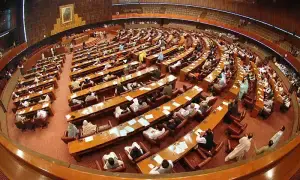
Parliament passed the Rs18.8 trillion budget FY27 on Tuesday, June 23, 11 days after its presentation on June 12, following successive daily sittings. The budget incorporated around 30 major government-backed amendments while rejecting all of the opposition’s proposals. The proceedings were marked by repeated disruptions and heated protests from opposition parties throughout the budget sittings.
A robust budget debate, with active parliamentary participation, meaningful Senate scrutiny and detailed examination by parliamentary committees, is widely regarded as essential to an effective budget process. It strengthens democratic oversight, promotes transparency and accountability, improves the quality of fiscal decision-making and helps ensure that public spending better reflects the priorities and aspirations of the people through their elected representatives.
There has been some progress, with greater parliamentary participation and a more active role of the finance committee in budget scrutiny, supported by technical experts. Yet Pakistan still has a long way to go to make the process more inclusive, rigorous and effective. Allowing more time for parliamentary scrutiny, instead of rushing the budget through in little over a week, would be an important step. Globally, legislative budget debates range from two weeks to over three months, while in Bangladesh and Sri Lanka they typically last at least three weeks.
The Pakistan Institute of Legislative Development and Transparency tracks the quantitative aspects of budget debates in both houses, including the number of sittings, hours and legislators’ participation. “Most speeches are not focused on the budget but on constituency issues and politics. I am not aware of anyone systematically assessing the quality of the budget debate,” says Ahmed Bilal Mehboob, its founding president.
‘Parliament in session is parliament on display; parliament in committees is parliament at work’
He was reluctant to say that the overall quality of budget debates has improved definitively, but highlighted a notable advance over the past two years: the National Assembly Standing Committee on Finance has begun scrutinising the budget with technical support from experts provided by the United Nations Development Programme. He credited committee chairman Syed Naveed Qamar for the initiative, calling it a significant improvement.
Mr Mehboob said the effectiveness of budget debates should be judged by time allocated, attendance, opposition participation, committee activism and amendments resulting from deliberations. He added that parliamentary debate can influence fiscal decisions, particularly when widely supported and amplified by the media, and described the finance committee’s growing activism as the strongest recent improvement.
In his study, ‘Critical study of budget making process’, Saddam Hussein, a researcher at the Pakistan Institute of Development Economics, identifies several structural flaws that undermine both budget formulation and implementation. Besides limited parliamentary debate, he points to legislators’ weak economic understanding and the bureaucracy’s overwhelming dominance of the process.
Mr Hussein advocates participatory budgeting, under which citizens directly help decide how a portion of public funds is spent. “It enables taxpayers to work with government to make budget decisions that affect their lives,” he explains. Citing Brazil’s experience, he argues that participatory budgeting helped counter patronage, inequity, and corruption and merits experimentation in Pakistan to improve transparency, accountability and citizens’ participation in revenue and spending decisions.
The OECD recommends presenting budgets at least three months before approval, but Pakistan’s parliament typically has barely two to three weeks, compared to seven to eight weeks in India
Mukhtar Ahmad Ali, Executive Director of the Centre for Peace and Development Initiatives (CPDI), argued that democratic accountability requires that every rupee raised or spent undergo meaningful parliamentary scrutiny. Yet, he said, Pakistan’s legislatures play a limited role in budget preparation, approval and oversight.
While the Organisation for Economic Cooperation and Development (OECD) recommends presenting budgets at least three months before approval, Pakistan’s parliament typically has barely two to three weeks, compared to seven to eight weeks in India, where subject committees conduct three to four weeks of detailed scrutiny.
A key weakness, he noted, is that Pakistan’s budget is not referred to relevant standing committees for line-by-line examination. Instead, only the finance committees review it, with little time and a focus largely on headline figures. The situation is worse in provincial assemblies, which typically pass budgets within a week without any committee scrutiny.
Mr Ali called for stronger parliamentary oversight by empowering standing committees to undertake detailed reviews and consult experts and civil society. “Parliament in session is parliament on display; parliament in committees is parliament at work,” he remarked, arguing that Pakistan’s budget debates often become political theatre while serious scrutiny remains largely absent.
Salahuddin Safdar, a senior expert at Free and Fair Election Network, said this year’s budget process has yet to be analysed, but noted that coalition governments generally face greater scrutiny than single-party administrations, as coalition partners often press for amendments that are incorporated into the budget. By contrast, constitutional provisions requiring ruling-party legislators to support the budget presented by their party leave little room for change in majority governments.
He also pointed to a reform introduced around 2015, when the National Assembly’s rules were amended to require ministries to submit development budget proposals to relevant standing committees by March for input. While the change has potential to strengthen parliamentary oversight, Mr Safdar said its impact has been limited because implementation depends largely on the commitment of the committee chairpersons, and the process has not been followed as rigorously as intended.
Published in Dawn, The Business and Finance Weekly, June 29th, 2026 ...