Economic path lost — the policy puzzle
이 뉴스, 어떠셨어요?
한 번의 탭으로 반응을 남겨요 · 로그인 불필요
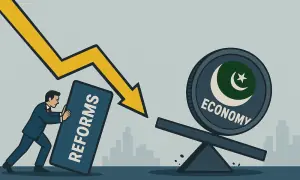
Chasing ambitious economic targets without a coherent policy framework is like walking onto a cricket field without a bat — yet that is precisely what we insist on.
We have been pursuing investments for a long time and are especially fond of foreign direct investment (FDI). We believe — and rightly so — that Pakistan offers a range of attractive opportunities for investors.
However, the fact remains that our investment-to-GDP ratio, which averaged 18 per cent for nearly 40 years (1980s–2018), sharply fell from 17.2pc in 2018 to 15.5pc in 2019 in the very first year of the International Monetary Fund’s (IMF) ‘stabilisation’ programme, touching a historic low of 13.1pc of GDP in 2024. Meanwhile, FDI fell from 1pc to 0.5pc of GDP over the same period.
Governments communicate with investors and businesses primarily through their policies, which enable them to navigate decisions by anticipating policy direction in the foreseeable future. In the absence of a clear, consistent and predictable policy environment, only speculative economic activities tend to flourish while the long-term investment horizon and risk appetite of investors and businesses are significantly constrained, according to Pakistan Policy Dialogue 2026, hosted by the Policy Research & Advisory Council (PRAC).
The problem is not the absence of investment opportunities; the real challenge lies in creating a policy environment that makes these opportunities commercially viable and attractive
The main hurdle in realising our economic ambitions is the disconnect between our plans and policies. The government’s key planning documents, Uraan Pakistan (2024-30) and the prime minister’s Economic Transformation Agenda and Implementation Plan (2024-2029) target economic growth of 6-7pc per annum while increasing per capita income by 43pc in dollar terms by 2029-30.
On the other hand, the economic team is religiously following the IMF programme’s contractionary monetary policy of high real interest rates (4-5pc above inflation) and very high, rather punitive, and contractionary taxation policy. With such a disconnect, no wonder these plans have so far fallen way short of their growth targets.
Another major issue in our understanding of the country’s economic challenges is the gaslighting effect of our donors’ preachings and propagation on their ardent followers in the country. Many of us have been made to believe that IMF-dictated contractionary policies have brought much-needed stability to our economy. It is true if one chooses to ignore the devastating impact on many socio-economic indicators.
In May 2019, before leaving my position as finance secretary and taking early retirement, I met and warned the Prime Minister about the poorly negotiated IMF programme which would stifle economic growth, accelerate poverty, and drive up unemployment. Unfortunately, those warnings were realised on every count, and there has been no sign of relief since 2019.
Pakistan’s investment-to-GDP ratio, which averaged 18pc for nearly 40 years (1980s–2018), sharply fell to 15.5pc in 2019 in the very first year of the IMF’s programme, touching a historic low of 13.1pc of GDP in 2024
The IMF review published last month stated that strong policy implementation had continued to support Pakistan’s economic recovery, build confidence, and bolster its resilience to shocks, with GDP growth accelerating in the first half of FY26.
However, Pakistan’s ‘economic recovery’ is an average economic growth of 2.7pc since 2019 and two years of negative growth, compared with an average of 5.5pc during 2003-2018 period.
Meanwhile, the World Bank said Pakistan’s once-promising poverty-reduction trajectory has come to a troubling halt, reversing years of hard-fought gains. After dramatically reducing poverty from 64.3pc in 2001 to 21.9pc in 2018, it is now at about 25.3pc.
While the Bank shied away from blaming the IMF programme, which had itself projected these outcomes — using the World Bank’s international lower-middle-income poverty line of $4.20 per day (2017 PPP), nearly 45pc of Pakistan’s population falls below the poverty threshold. Overall unemployment is reported to have increased to 7.1, but the Youth (ages 15–29) NEET (Not in Employment, Education, or Training) rate stands at a staggering 37pc, up from 29.7pc in 2019.
While the IMF claims its programme has built confidence, the Overseas Investors Chamber of Commerce & Industry’s (OICCI) latest survey reports that business confidence weakened sharply, with 70–80pc of companies delaying or revising investment decisions amid rising economic uncertainty. The country faces high levels of debt, with it skyrocketing from Rs29.9tr in 2018 to Rs. 95.5tr, partly due to rupee devaluation but mostly due to unduly high real interest rates. With the interest payments taking away almost 70pc of our net federal revenues, there is very little room for resilience to shocks by any standard.
In a policy environment of economic stagnation, high interest rates, and extremely high tax rates, our leadership is seeking to attract foreign investment. Until a couple of months back (before the war on Iran), we witnessed regular capital flight from the country, as also verified by our interior minister.
The problem is not the absence of investment opportunities. The real challenge lies in creating a policy environment that makes these opportunities commercially viable and attractive.
The writer was formerly a federal secretary and caretaker provincial minister. He is currently the chairman of the Policy Research and Advisory Council. This is the first article of a two-part series.
Published in Dawn, The Business and Finance Weekly, June 29th, 2026 ...