NASA’s Next Generation Telescope Arrives in Florida Ahead of Launch
이 기사, 관심 있으세요?
한 번의 탭으로 관심을 남겨요 · 로그인 불필요
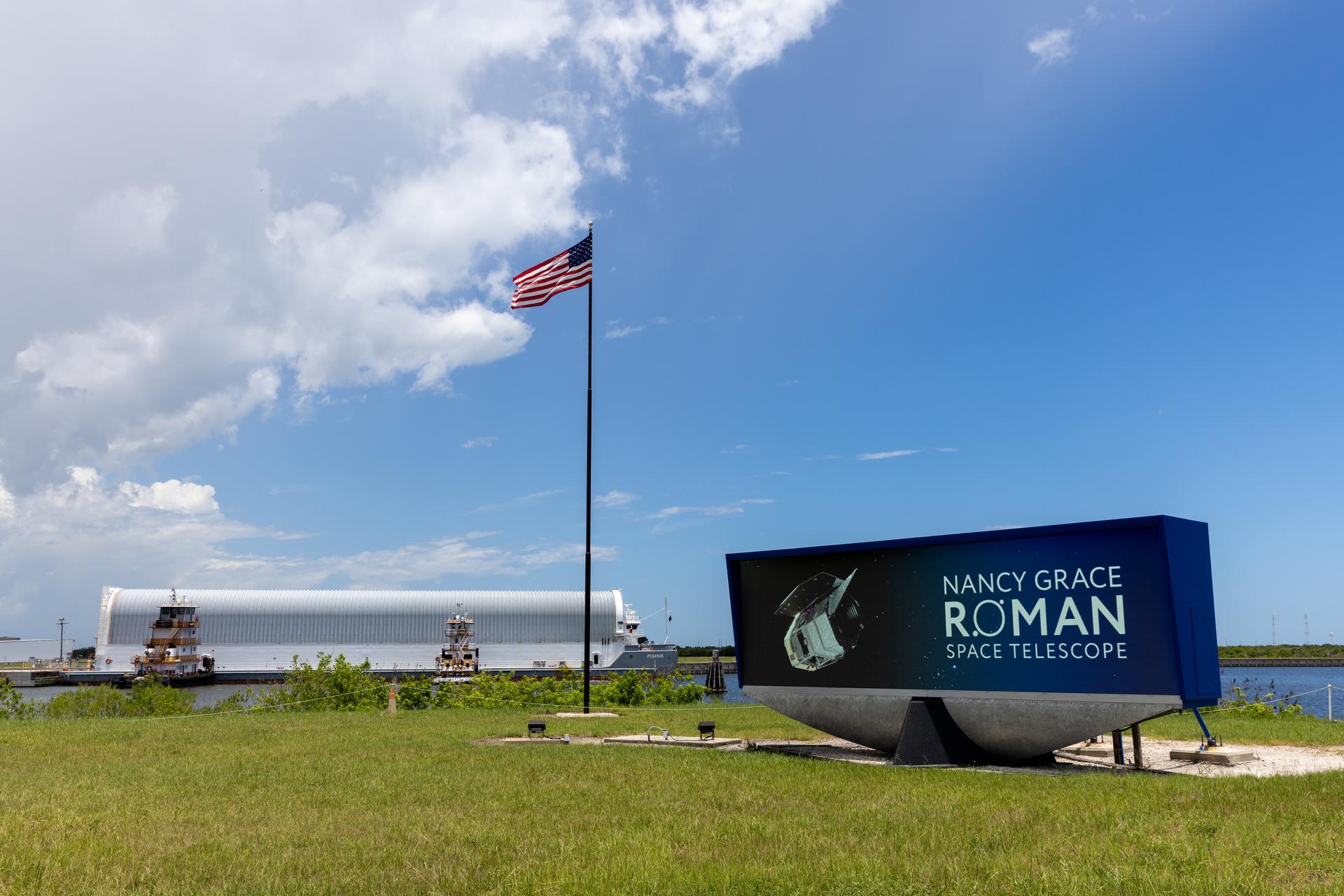
NASA’s Pegasus barge arrives at the Launch Complex 39 turn basin at the agency’s Kennedy Space Center in Florida carrying NASA’s Nancy Grace Roman Space Telescope on Sunday, June 21, 2026.
NASA/Amber Jean Notvest
NASA’s Nancy Grace Roman Space Telescope arrived June 21, at the agency’s Kennedy Space Center in Florida, marking the start of final prelaunch preparations before liftoff later this summer.
After teams completed integration and testing on the observatory at NASA’s Goddard Space Flight Center in Greenbelt, Maryland, they loaded Roman into a protective and environmentally controlled transportation container and drove it to the port of Baltimore. There, the agency’s Pegasus barge safely transported the nearly 18,000-pound (8,200-kilogram) spacecraft down the coast of the Atlantic Ocean to its new home in Florida at the Payload Hazardous Servicing Facility, which recently completed upgrades to prepare for Roman’s arrival.
Technicians met the telescope at NASA Kennedy’s turn basin wharf and offloaded the trailer carrying the observatory from the barge where they connected it to a truck that transported Roman to the servicing facility.
When the spacecraft arrives at the facility, technicians will complete initial cleaning outside the building before moving the shipping container into the facility’s air lock. Once in the air lock, they will perform additional cleaning to reduce any remaining contaminants from the trip. The facility’s air filtration system also will scrub the air until the team can safely open the inner door. Once inside, technicians will unbox the spacecraft, raise it to a vertical position in the air lock, and move it into the clean room.
On Monday, June 22, technicians plan to remove the cover from the transport container and move Roman into the high bay. Later technicians will use large cranes to move Roman to its work platform, called the Pantheon. During the observatory’s time at the processing facility, technicians will perform several tasks, including testing the six solar panels and inspecting Roman’s insulation and thermal blankets to ensure the observatory is fully protected and flight ready. Specially trained team members will load about 290 gallons of hydrazine fuel into the spacecraft’s tanks.
NASA is targeting launch no earlier than Sunday, Aug. 30, on a SpaceX Falcon Heavy rocket from Launch Complex 39A at Kennedy. This puts Roman eight months ahead of schedule.
After launch, Roman will travel to the second Sun-Earth Lagrange point, or L2. There, it will make observations that give astronomers the chance to study an incredible number of new objects. Roman’s wide field of view and rapid survey capabilities will reveal billions of galaxies, hundreds of thousands of new exoplanets, hundreds of blackholes, and will provide vast volumes of daily data for astronomers to study.
The observatory also will map how common different kinds of planets are in our galaxy and help answer big questions about the universe, like what’s causing its rapid expansion and what distant worlds and cosmic objects look like in infrared light. In addition to its main instrument, which features a 300-megapixel camera, Roman will demonstrate technology designed to block starlight to directly image exoplanets and planet-forming disks.
Alongside Roman, the Pegasus barge also carried a weather cover for the Artemis III SLS (Space Launch System) core stage. The cover will protect the stage thermal systems while it sits at Launch Pad 39B in its short stack configuration. Because schedules aligned, the barge was able to transport NASA’s next flagship astrophysics mission together with the Artemis hardware, maximizing resources to support missions across the agency during the Golden Age of innovation and exploration.
To learn more about the Roman mission, visit:
https://science.nasa.gov/mission/roman-space-telescope/
이 뉴스, 독자들은 어떻게 느꼈나요?
첫 반응을 남겨보세요로그인하면 감정 반응에 참여할 수 있어요.