Transit trade with Kabul hits historic low
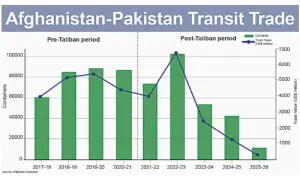
• Falls to 11,592 containers worth $367m in FY26
• Afghanistan increasingly relies on Iran, Central Asian trade routes
• Reverse transit collapses from $454m in FY25 to just $7m
ISLAMABAD: Afghanistan-Pakistan transit trade has suffered one of its steepest declines, plunging to just 11,592 containers worth $367 million in the outgoing fiscal year from nearly 89,000 containers valued at $5 billion before the Taliban returned to power, as Kabul’s growing reliance on Iranian routes and Pakistan’s border curbs reshaped the decades-old trade corridor.
At first glance, the collapse appears to validate the widely held view that Pakistan’s decision to close its border with Afghanistan in October 2025 over security concerns brought bilateral transit trade to a standstill.
However, while the border closure undoubtedly accelerated the decline, data shows that transit trade had already begun losing momentum well before Islamabad adopted its most strict restrictions.
Trade analysts say the border closure did not initiate Kabul’s search for alternative trade routes. Rather, it marked the culmination of a strategy the Afghan Taliban had already begun to reduce Afghanistan’s dependence on Pakistani ports. Kabul has pursued a deliberate policy of expanding trade through Iran and strengthening commercial links with Central Asian neighbours. Pakistan served for decades as Afghanistan’s cheapest and principal gateway to international markets.
The latest transit trade data show that Afghan transit through Pakistan expanded steadily during the period of the democratically elected government. Container traffic increased from about 60,500 containers in FY17 to nearly 89,000 containers in FY21, immediately before the Taliban returned to power.
This growth occurred despite often strained political relations between Pakistan and the government of former Afghanistan president Ashraf Ghani.
Although diplomatic ties remained tense, Kabul continued to rely on Pakistani ports as its primary gateway for international trade and did not discourage importers from using them. One reason may have been to help Afghan businesses import essential goods at lower transport costs and limit inflationary pressure in a highly import-dependent economy.
Following the Taliban’s return to power, transit cargo via Pakistan initially recovered, with container traffic reaching 102,886 and cargo valued at $6.7bn in FY23.
However, this marked the peak rather than the start of sustained growth. Transit volumes fell to 54,114 containers in FY24 and 42,959 containers worth $1.36bn in FY25, well before Pakistan closed the border in October 2025.
The decline suggests that the Taliban had already begun diverting part of Afghanistan’s trade to alternative routes before Islamabad’s decision to close the border on security grounds.
Reverse transit
The collapse in reverse transit was even more dramatic. Reverse transit, which allows Afghan exports to reach third countries, particularly India, through the Wagah border and Karachi ports, fell from $454m in FY25 to just $7m in FY26, bringing a decades-old trade corridor almost to a halt.
However, while the Taliban managed to secure alternative import routes, especially through Iran, the shift came at a high economic cost.
According to the World Bank’s Afghanistan Economic Monitor 2026, Afghanistan’s imports rose 15pc to $13.2bn in FY25. Iran emerged as the largest source of imports with a 31.3pc share, while Iran’s direct and transit corridors accounted for 48.6pc of Afghanistan’s total imports, highlighting growing reliance on Iranian routes.
This diversion reduced Pakistan’s leverage but carried economic costs for Afghanistan. The country lost export opportunities, particularly for agricultural products and coal, while longer and more expensive supply routes increased import costs, adding to inflationary pressure on businesses and consumers.
The World Bank notes that prolonged closures of key Pakistan border crossings, coupled with conflict and geopolitical tensions in the Middle East, have weakened Afghanistan’s external trade by disrupting traditional transit routes and increasing transport and logistics costs. The diversion of trade away from Pakistan has also imposed high costs on Afghanistan’s economy through lower revenue collection and falling exports in FY25.
Traders report sharp increases in the prices of essential goods, including rice, vegetable ghee and pharmaceutical products, as imports are increasingly routed through longer and more expensive corridors.
The higher transport and logistics costs are ultimately passed on to consumers, adding to inflationary pressure. The burden falls disproportionately on eastern and southern Afghanistan, particularly Pakhtun communities that have traditionally relied on Pakistani goods and cross-border commerce.
The economic disruption extends beyond higher consumer prices. The near-collapse of transit trade has affected thousands of people whose livelihoods depend on cross-border commerce, including truck drivers, loaders, customs clearing agents, warehouse workers and other semi-skilled labourers.
Reduced commercial activity has also translated into fewer employment opportunities and lower household incomes on both sides of the border.
Published in Dawn, July 19th, 2026 ...
이 뉴스, 어떠셨어요?
탭 한 번으로 반응 · 로그인 불필요