Students Connect NASA Science With Indigenous Knowledge to Study Coastal Erosion
Story by Keri Moskowitz, Gulf of Maine Research Institute
For the Pleasant Point Passamaquoddy Reservation, or Sipayik, the ocean has always been a teacher. Situated in what is known as Downeast Maine, along the shores of Passamaquoddy Bay, generations of Indigenous people have lived along the coast, learning from the tides, the land, and their elders. But today, the shoreline is changing more rapidly. Coastal erosion is slowly taking land away. Land that already holds a history of loss.
In the summer of 2023, inspired by a trip to Fairbanks, AK to attend Climate Change in My Community – a workshop organized by the NASA Science Activation (SciAct) program’s Arctic and Earth Signs project – SciAct’s Learning Ecosystems Northeast (LENE) team began working with partners, including Indigenous leaders and scientists, to ask an important question: What does coastal erosion mean to people who have already lost land?
By November 2024, planning was underway at Sipayik Elementary School. The goal was to bring together Western science and Indigenous knowledge so students could understand the changes happening in their own community.
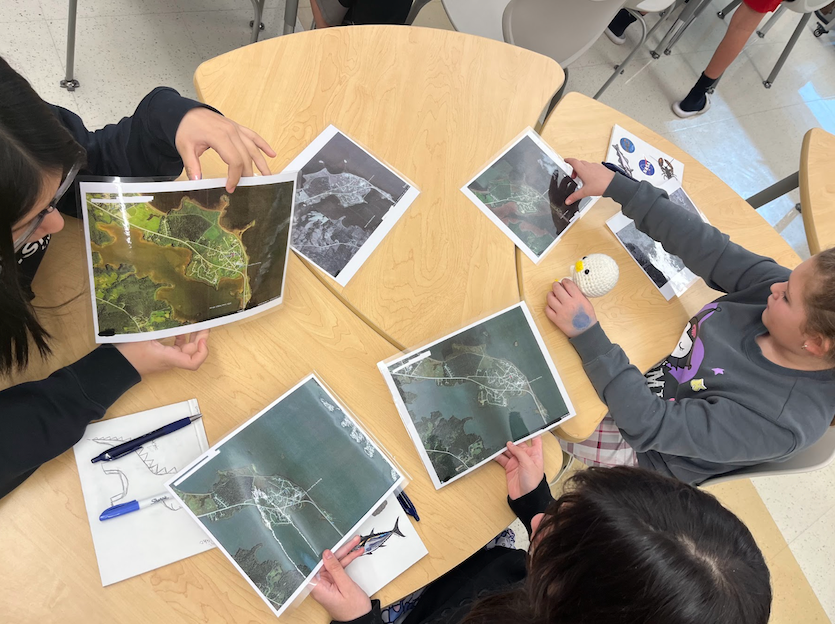
The lessons began in March 2025. For five weeks, nine 5th-grade students explored erosion in many ways. They visited local field sites and listened to elders share stories about how the coastline used to look. Learners used these accounts to measure the changes, both on the coast and via maps back in the classroom. They built erosion trays from simple materials to test how waves shape the land. They measured current high tide lines and compared them to historical ones. They studied old photographs and aerial images from 1942 to 2023 to see how much the shoreline had moved. They even compared 300-year-old tribal maps with future flood projections.
Students learned that science does not only live in textbooks. As one observer shared, “Our people were scientists without having to go to school.”
The students were curious, engaged, and proud. They saw that resilience is part of who they are. They have always adapted while holding on to culture.
In June of 2026, the students were invited to the Gulf of Maine Research Institute to present their work to scientists, staff, and REU (Research Experience for Undergraduate) interns. They traveled 3.5 hours for this opportunity, and the journey proved worthwhile. During the Q&A portion following their slideshow, someone asked whether learning to read the various maps was difficult. One student responded with a reminder: these were not merely maps but NASA satellite images.
Future goals for the project include inviting more elders and adding more field sites in the work, strengthening language and cultural connections, sharing student learning with other Native youth, and planning resilience strategies like marsh restoration in coordination with tribal leadership. When the students were asked if they planned to continue their studies and work on this cause after their time in the classroom ended, they all resoundingly stated “YES”.
In Sipayik, the story of erosion is not just about land washing away. It is about memory, knowledge, identity, and the strength of a community that continues to learn from the shore.
이 뉴스, 어떠셨어요?
한 번의 탭으로 반응을 남겨요 · 로그인 불필요