World News in Brief: Sexual violence in DR Congo, deaths in Ukraine and Russia, crime in Southeast Asia
World News in Brief: Sexual violence in DR Congo, deaths in Ukraine and Russia, crime in Southeast Asia
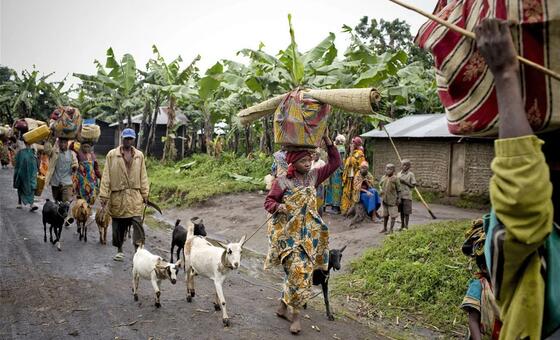
Independent UN human rights experts on Tuesday condemned the M23 armed group’s “reign of terror” over territory it controls in eastern Democratic Republic of the Congo (DRC), calling for an end to the Rwanda-backed group’s sexual torture and violence against civilians.
“Rapes, gang rapes, violent assaults and killings of civilians are a common feature of M23’s modus operandi,” the experts said in a press release. “While these crimes are not exclusive to M23, the number of individuals affected is staggering and must end.”
The most recent conflict in the eastern DRC began in 2021 when the Rwandan-backed and Tutsi-led M23 militia took up arms against the Congolese military. The fighting, which traces back to the 1994 genocide against the Tutsi in Rwanda, has already displaced more than eight million people during decades of conflict.
An April report by UN Secretary-General António Guterres found that cases of sexual violence perpetrated by M23 against civilians more than doubled between 2024 and 2025. This violence disproportionately impacts women and girls.
M23 commits further violations
The armed group, whose stated goal is to protect the Tutsi population in the DRC, exercises control over the civilian population through arbitrary arrest and detention, torture, forced labour, arson, abduction, blackmail and forced armed recruitment.
UN reports show that M23 cites unlawful and arbitrary reasons for its treatment of civilians, including collaboration with the DRC’s armed forces, failure to comply with compulsory communal labour or a mere suspicion of criminal activity.
The UN experts noted that M23 holds those arrested in severely overcrowded and unsanitary conditions, where detainees face frequent beatings and are often deprived of food, water and medical care.
“The violence is unacceptable. It must end immediately and be thoroughly investigated so that those responsible are held accountable,” the Human Rights Council-appointed experts said.
The experts are in contact with the DRC’s government and have raised their concerns to the Rwandan government, which helps fund M23.
Dozens more civilians injured, killed in Russia-Ukraine War
Attacks on residential buildings and critical civilian infrastructure in Ukraine must stop, a spokesperson for the UN’s human rights agency (OHCHR) said on Tuesday.
The call comes as dozens of civilians were killed and injured in recent days, including in Kyiv, Odesa and Zaporizhzhia in Ukraine – and in Moscow and Tambov in Russia.
At least 35 Russian ballistic and hypersonic missiles hit Kyiv on Sunday, killing one and injuring 20. The same day, glide bombs killed three and injured 41 in Zaporizhzhia City, and a Russian strike killed four and injured 20 near Kharkiv City.
Russian cruise missiles struck a Guinea-Bissau-flagged merchant vessel near Odesa on Sunday, killing 10 civilians and injuring seven more.
Meanwhile, long-range drone attacks by Ukraine into Russian territory have also caused civilian casualties, with eight killed and 86 more injured overnight between Friday and Saturday in Russia.
Attacks on civilians must stop: Multiple UN agencies
On Monday, the UN Children’s Fund (UNICEF) expressed concern after two children were killed and at least 50 more were injured in attacks across Ukraine last week.
“These attacks must end. Children and humanitarian facilities must be protected,” UNICEF wrote in a press release. “Above all, children in Ukraine need a lasting peace.”
OHCHR stressed that civilians and civilian infrastructure are strictly protected under international humanitarian law, and any such deliberate attack against either is a war crime
Southeast Asian organised crime poses increasing threat: UN report
Organised crime in Southeast Asia has fundamentally changed in the past few years.
Local crime syndicates in Southeast Asia have transformed separate criminal markets into a single transnational criminal economy that is increasingly immune from law enforcement, according to a new report by the UN Office on Drugs and Crime (UNODC).
The report details the growth of multiple organised criminal activities in the region, including money laundering, online fraud and scams, illegal gambling, online child sexual exploitation, and the trafficking of drugs, firearms and people.
“What we are seeing is a shift in which groups that stayed within their own geographic domain and criminal specialty are now operating across multiple illicit markets at once, relying on the same service streams,” UNODC regional representative Delphine Schantz said on Tuesday.
Released on Tuesday, the report details how traditional organised crime activities like synthetic drug trafficking continue to thrive, but syndicates have also taken advantage of emerging technologies to evade governance.
Online fraud grows alongside drug trafficking
UNODC also found that organised crime in the region has shifted from moving physical goods to selling criminal services.
Scam losses across East Asia, Southeast Asia, Australia and New Zealand reached between $88 billion and $114 billion in 2025 – larger than the GDP of many countries – according to the report.
Technology is also making organised crime more powerful: generative artificial intelligence can produce phishing emails and deepfake videos, cryptocurrency replaces traditional money laundering and satellite internet allows scam centres to operate even when the government attempts to disrupt communications.
이 뉴스, 어떠셨어요?
탭 한 번으로 반응 · 로그인 불필요
공식 발표 ↔ 진영별 보도
보도 없음
+10
보도 없음