Al Jazeera English
진보 성향
정치
US releases video of warship firing missiles in strikes on Iran
Video released by US Central Command shows what the military says are ‘self-defence’ strikes on Iranian targets.
"SELF-DEFENCE" · 총 35건
필터 보기현재 지수
49.4
0 = 부정 우세
50 = 중립
100 = 긍정 우세
최근 7일 기준 84,138건을 분석한 결과, 뉴스 심리지수는 49.4(균형)입니다. 긍정 10,371건(12.3%)·중립 60,613건(72.0%)·부정 13,154건(15.6%)이며, 중립 비중이 뚜렷하게 높습니다. 성향 지수는 종합 21.3(보수 경향)입니다.
Video released by US Central Command shows what the military says are ‘self-defence’ strikes on Iranian targets.
The United States launched fresh attacks against Iran on Thursday, prompting Tehran to retaliate, as US leaders accused their counterparts of dragging out negotiations for a deal to end the three-month war. The second straight day of tit-for-tat strikes, with Iran targeting US bases across the Gulf, sent oil prices rising again. US President Donald Trump, who had repeatedly said negotiations with Tehran were close to an end, said on Wednesday that Iran keeps “playing us for suckers” and will now “have to pay the price”. Hours after, US Central Command (Centcom) said American forces began “additional self-defence strikes” at 5:15pm on Wednesday Washington time — early Thursday in Iran — in response to what it called Tehran’s “unwarranted and continued aggression”. Iranian media reported explosions across the south near the Strait of Hormuz, with explosions heard in Bandar Abbas, Qeshm and Minab, and sources reporting hits by “enemy projectiles” in Kargan and Sirik. Centcom said later that it had “completed” its strikes on “Iranian military surveillance capabilities, communication systems, and air defence sites”. American forces “fired precision munitions on Iranian targets that posed a threat to US forces and international commercial ships transiting regional waters”, the command said. The renewed hostilities came as Pentagon chief Pete Hegseth said that if Trump required it, “we’ll negotiate with bombs, and we’re very good at it”. In response to the US strikes, Iran’s Islamic Revolutionary Guard Corps (IRGC) said they had struck US targets on bases in Kuwait and Bahrain, and that they also “hit and destroyed Sheikh Isa air bases”, according to the state-run IRNA news agency. Iranian media said the army had conducted drone strikes targeting communications antennas and radar facilities belonging to the US Fifth Fleet in Bahrain. An air raid alert was issued in Bahrain and residents were urged to “head to the nearest safe place”, the Gulf nation’s interior ministry said on X. Kuwait closed its airspace temporarily as its military said its air defence systems were working to intercept “hostile aerial targets”. Iran also renewed its warning over the Strait of Hormuz, a vital waterway for oil and gas transport which it has essentially closed. “Are you making the sacred Strait of Hormuz unsafe?! We will make the region hell for you,” Majid Mousavi, the head of the Iranian Guards’ aerospace force, said in a social media post. The Iranian navy said it had hit two ships trying to sail through the Strait of Hormuz, state television IRIB and the Mehr agency reported. Another Iranian news agency, Tasnim, quoted the country’s military operational command as saying the crucial waterway was “completely closed” and that “any vessel traffic” there would be targeted. Centcom denied that, saying “commercial ships are continuing to transit in and out of the Strait of Hormuz tonight”. Trump said on Wednesday that the US military had secretly helped 100 million barrels of oil pass through the contested strait. ‘Bomb the s out of them’ Earlier, American broadcaster Fox News reported that Trump said Iranian leaders had called him directly in the White House Situation Room as the US bombs began falling. Iran’s IRGC quickly denied Tehran had done so, the IRNA news agency said. Trump said US forces hit Iran with 49 Tomahawk missiles and some targets were as close as 60 kilometres from Tehran, Fox News said. Its reporter Trey Yingst, who spoke to Trump, quoted the president as saying that if Iran did not accept US terms for ending the war, “We’ll bomb the S out of them tomorrow night”. It was the second straight day of US attacks, following tit-for-tat strikes this week partly in response to the Iranian downing of an American helicopter. The fresh salvos followed Trump’s complaint that Tehran’s negotiators were taking too long, having suggested earlier this week that an accord was days away. “We hit them hard yesterday. We’re going to hit them again hard today,” Trump told reporters on Wednesday morning. “We were really close to a deal, but they keep tapping us along.” Hegseth suggested the strikes could extend into a third night, saying they would be “strong” and “clear”. The escalation drew international calls for restraint on the eve of the World Cup, which the United States is co-hosting and Iran is participating in. UN chief Antonio Guterres cautioned against a return to “full war”. Iran’s UN Ambassador Amir Saeid Iravani, meanwhile, rejected Trump’s threat, saying “no sustainable deal can be reached through threats, intimidation, or the use of force”. Still, diplomacy has not collapsed entirely, with Qatari negotiators travelling to Tehran “to meet with the Iranians in an effort to bridge the remaining gaps”, a diplomat with knowledge of the situation said. The war began in February with US-Israeli strikes on Iran, shaking the geopolitical balance in the Middle East and roiling global markets before a ceasefire took effect on April 8. Asian stocks tracked losses in New York, while oil prices jumped as much as two per cent on Thursday, extending similar gains the day before. Iran has also insisted that any deal to end the war must include a truce in Lebanon, where Israel and Hezbollah have been fighting.
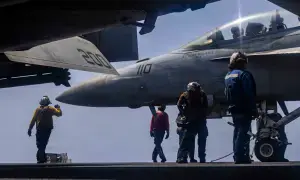
The US Central Command released video of self-defense strikes against Iranian military targets, including radar and air defense sites. The operation, involving 49 Tomahawk missiles, was a response to Iran's alleged aggression threatening US forces and international shipping. This marks a significant escalation in regional tensions.
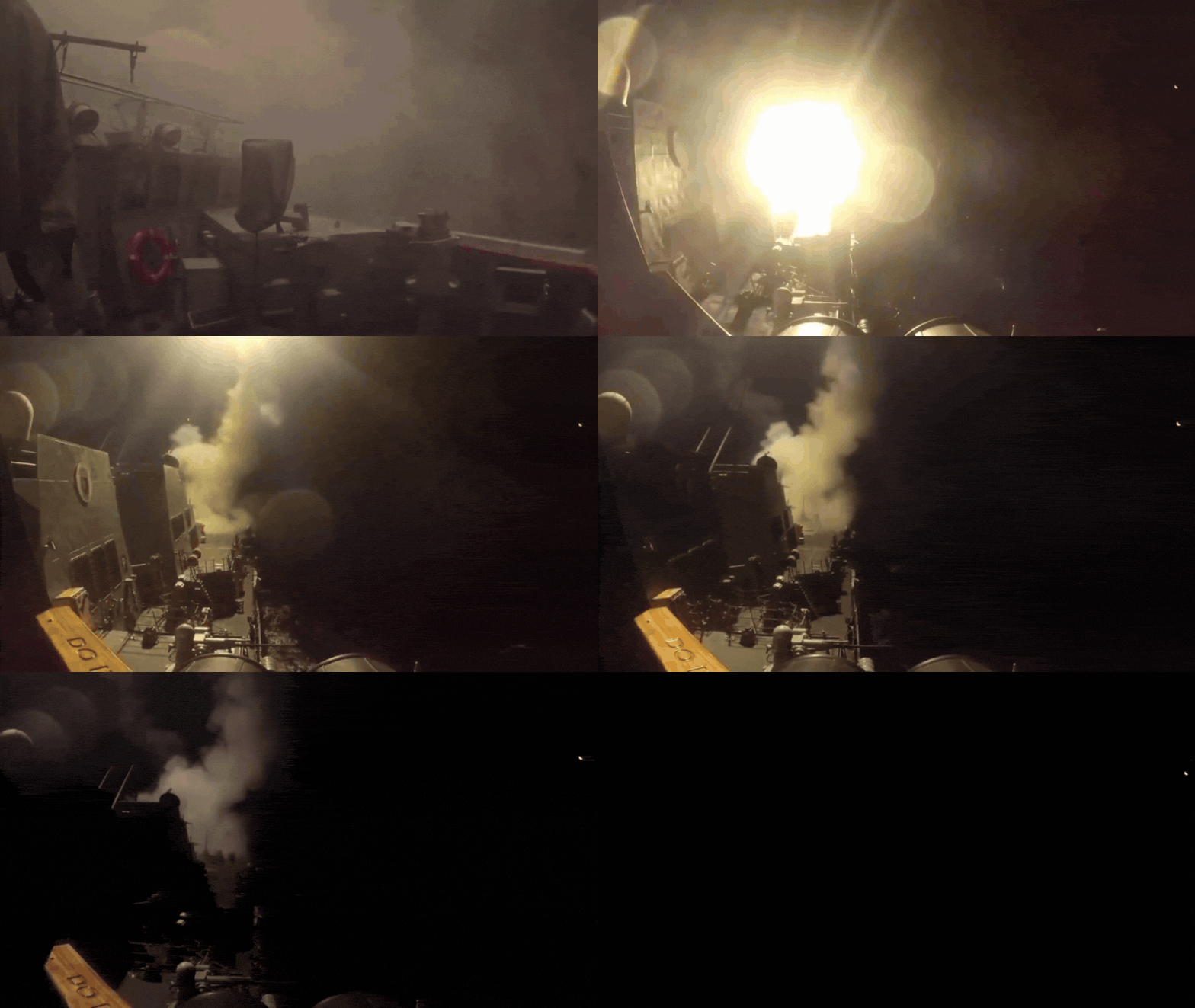
This comes in the second straight day of American attacks on the Islamic republic.
Inside Karmelo Anthony case: See full details about key motive, trial timeline, final verdict The murder trial of Karmelo Anthony has gained nationwide attention, raising concerns about self-defence, race, and accountability. The Texas teenager was sentenced to 35 years in prison on...

US Central Command (CENTCOM) says its forces began launching ‘self-defence’ strikes against Iran.
‘The mission is a proportional response to unjustified Iranian aggression,’ U.S. Central Command said in a brief statement
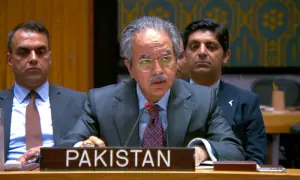
WASHINGTON: Pakistan’s envoy to the United Nations said on Monday that India’s key objectives in Afghanistan were “solely driven by the singular goal of destabilising Pakistan”. He made these remarks during a UN Security Council meeting on Afghanistan while responding to remarks by Afghanistan’s Permanent Representative to UN Nasir Ahmad Faiq. Earlier in the session, Pakistan’s Permanent Representative to UN Ambassador Asim Iftikhar Ahmad detailed the use of Afghan soil by terrorists and its impact on Pakistan, calling for the Afghan Taliban to take action against militants. He also spoke about Pakistan’s counter-terrorism measures. Faiq also commented on Pakistan’s counter-terrorism operations, in response to which Ambassador Ahmad said: “Pakistan’s actions, including those conducted in March, were directed solely against the terrorist and military support infrastructure that is operating from Afghanistan. And it is in no way directed against the brotherly people of Afghanistan.” ‘Verifiable, non-reversible action’ Ambassador Ahmad earlier told the UNSC that Islamabad’s demand from the Afghan Taliban was simple and clear: “verifiable and non-reversible action“ against terrorist groups operating from Afghan territory. “Regrettably, this demand remains unmet,” he said. And while the window for course correction was narrowing, it remained open, he added. “We hope the Taliban realise this in earnest and cooperate with the international community for the long-term peace and development of Afghanistan and, above all, in the best interest of all Afghans,” he said. There has been a resurgence in terrorism in Pakistan since the Afghan Taliban returned to power in Kabul in 2021. For its part, Islamabad has repeatedly urged the Taliban administration to dismantle terrorist sanctuaries on Afghan soil, particularly those linked to the banned Tehreek-i-Taliban Pakistan (TTP). But, officials say those appeals have gone unheedeed, while the Afghan Taliban reject these allegations. During the UNSC meeting, Ambassador Asim noted that it had been nearly half a decade since the Taliban takeover of Afghanistan in 2021. “It was hoped that this would end the bloodshed and Afghanistan would be at peace with itself and its neighbours,” he said. The envoy added that with the end of the civil war, it was “anticipated that the Taliban would take positive steps to transform into a responsible governing authority by adhering to their international obligations and commitments, and that they would lead Afghanistan into an era of stability and progress, provide the long-awaited relief to all Afghans and live in harmony with immediate neighbours”. “For decades, terrorism has been a major problem in Afghanistan, with implications not just for Afghanistan, but the immediate neighbourhood and beyond. Afghanistan has a history of being a safe haven for terrorist groups, including those used as proxies by our adversaries to target Pakistan and other countries,” he highlighted. It was “our expectation that the Taliban would take concrete and verifiable actions against terrorist groups such as the TTP, Balochistan Liberation Army (BLA) and its Majeed Brigade, Islamic State-Khorasan, East Turkestan Islamic Movement and their affiliates that are operating with impunity on Afghan soil”. “Regrettably, they have failed to undertake action, showing complete disregard for the legitimate security concerns of Pakistan and other countries,” the ambassador said. He added that, besides “independent analysis and reports of the Analytical Support and Sanctions Monitoring Team, which clearly outline the terrorism situation in Afghanistan and the ground realities, along with the recent exponential rise in terrorist attacks in Pakistan, these developments serve as glaring reminders of the precarious situation and the continuing threats posed to international peace and security”. “As a direct result of the freedom with which these terrorist groups operate in Afghanistan, Pakistan has borne the brunt of their attacks, as well as the Taliban’s growing nexus with these terrorist groups. “And once again, a significant number of Afghans are found to be involved in terrorism inside Pakistan,” he added. He said these terrorist groups had access to advanced weapons and sophisticated equipment, including drones. “Much of this can be traced back to the multi-billion dollar worth of arms and ammunition left behind by foreign forces — which was meant for use by the previous Afghan national government,” he said. Moreover, during counter-terrorism operations by Pakistan, there have been more than 290 cases of seizures of such weapons, which are used for terrorism and suicide bombings in the western parts of Pakistan, and which have exacted a heavy toll of human life and material losses, he told the UNSC. In 2025 alone, Pakistan reported more than 5,300 terrorist incidents and lost more than 1,200 lives to terrorism emanating from Afghanistan, he said. In this connection, he recalled that a vehicle-borne IED attack by the TTP on a police post in Khyber Pakhtunkhwa on May 9 resulted in the martyrdom of 15 police officers. “Our investigations revealed that the attack was planned by terrorists in Afghanistan.” Ambassador Ahmad said: “It is deplorable that the Taliban have reverted back to their old tactics of providing safe havens to terrorist groups and chosen the perilous path of complicity, backed by an outside actor, the historic spoiler and instigator of chaos — that has moved fast as an opportunist to wage a proxy war against Pakistan. “Let me make it clear: Pakistan will defend itself against whosoever attempts to harm our sovereignty, territorial integrity and national security.” He continued that Pakistan had always expressed openness for dialogue. “Numerous diplomatic efforts were made to counsel the Taliban. We thank friendly countries for their genuine mediation efforts, particularly Qatar, Turkiye, Saudi Arabia and most recently, China, to find amicable solutions. Yet the Taliban’s continued intransigence and even refusal to publicly denounce and condemn terrorist groups such as the TTP and BLA is deeply disturbing — it is evidence enough of their complicity and active support for these groups. Pakistan will not sit idle while suffering from terrorist acts. We will respond in self-defence, as and when needed and always in conformity with international law and International Humanitarian Law,” he said. Referring to a recent report by the UN secretary general, he said it “seems to largely externalise the responsibility for Afghanistan’s multifaceted challenges”. “The fatalities of terrorists and their supporters as a result of counter-terrorism operations are mentioned within the ambit of ‘civilian casualties’, posing serious questions on the credibility of UNAMA’s reporting from Afghanistan and the nature of their engagement with the Taliban. UNAMA is swift in reporting incidents of cross-border actions and casualties but fails to provide the overall context — which is the grave terrorist threat emanating from Afghanistan and its cross-border impact directed at Pakistan that is harming Pakistan and killing innocent Pakistanis,” he elaborated. He further said that the report also did not provide information on the destabilising accumulation of small arms and light weapons inside Afghanistan. “Nor does it adequately shed light on Afghanistan’s illicit economy, with its complex web of money laundering and terror financing networks, including hundi and hawala networks. Instead, the report resorts to shifting the blame on external dynamics, with little regard for the Taliban’s own policies that have brought Afghanistan to the brink of disaster,” he said. The envoy stressed that “we must not lose sight of the fact that it is the Taliban’s reckless style of governance and flawed ideologies of extremism, suppression and radicalisation that have brought upon Afghanistan the calamities it faces today”. “The Humanitarian Needs and Response Plan for 2026, we are told, is underfunded at 14 per cent — again a direct result of Taliban’s unwillingness to prioritise the welfare of Afghans over their own interest and authoritarian control,” he pointed out. Noting that several references had been made to the Pak-Aghan border closure in the report, he said: “Let me clarify that the closure of border between Pakistan and Afghanistan does not, from Pakistan’s perspective, affect the movement of humanitarian supplies. “Pakistan has been processing and facilitating the passage of humanitarian goods and material. However, the Afghan Taliban regime refuses to let them pass and keeps the border closed on its side, even to receive such life-saving cargoes, which obviously is to the detriment of the Afghan people.” He went on to say that the worsening human rights situation in Afghanistan “aligned with Taliban’s failings and deceitful narrative to meet the demands of the international community”. “Women and girls are denied their fundamental human rights and dignity, with discriminatory and abusive practices — a clear violation of their international obligations as well as of Islamic laws, traditions and tenets of the Muslim faith. The Afghan people are being held hostage to these inhumane restrictions, oppression and selfish behaviour,” he said. He said that Pakistan took numerous steps to support Afghanistan, including humanitarian relief efforts, political engagement, providing incentives to boost bilateral trade, offering transit concessions, issuing student and medical visas, conducting high-level visits to Kabul and participating in various regional cooperation initiatives to help Afghanistan succeed in its quest to find its rightful place in the international community. For over four decades, he continued, Pakistan welcomed millions of Afghan refugees “despite limitations and insufficient international support, dealing with huge caseloads of illegal Afghans, including those without documentation, posing a serious threat to our security”. But these were never meant to stay indefinitely, he added. The ambassador called on the UN secretary general to “clearly outline the status of third country resettlement cases of Afghans in a transparent manner — cases that are pending for years, despite being a tiny fraction of what Pakistan had to deal with, in the face of national security threats that no country would tolerate”. “While we provide all possible facilitation, the international community must step up and shoulder its responsibility. Shifting the blame of Afghanistan’s woes to the inflow of Afghan returnees will not solve the problem,” he said. Ambassador Ahmad further said, “We look forward to the next steps of the UN-led Doha Process and action plan for its Mosaic approach, to address Afghanistan’s multifaceted challenges comprehensively, with well-defined objectives and a realistic roadmap as the only viable pathway for normalisation”. Pakistan and Afghanistan, he said, were bound by geography, deep-rooted ties, civilisational links dating back centuries, and fraternal bonds of faith, culture and ethnicity. “No country has suffered more from the consequences of conflict and instability in Afghanistan than Pakistan. So we understand, and we also know, that no country stands to benefit more from peace, prosperity and stability in Afghanistan than Pakistan. “Pakistan’s demand from the Taliban is simple and clear: verifiable and non-reversible action against terrorists. Regrettably, this demand remains unmet. The window for course correction is narrowing but is still open. We hope the Taliban realise this in earnest and cooperate with the international community for the long-term peace and development of Afghanistan and, above all, in the best interest of all Afghans,” he said, concluding his address.
Netanyahu said he told Trump that "Israel has a full right to self-defence
Against the backdrop of US efforts to prevent retaliation the Israeli premier yet again brandished the 'right to self-defence'.
[Leadership] Across Nigeria's northwest and north-central, the math of survival is blunt. Police response times are measured in days, not minutes. Soldiers come after attacks, not before.
KHYBER: Enraged Zakhakhel tribesmen blocked the main highway leading to Torkham on Saturday and announced that they would take up arms in self-defence after two men were killed in a targeted attack late on Friday evening. Led by local tribal elder Malak Abdullah Khan, the protesters — including scores of political party activists, civil society members and tribesmen — announced that armed volunteers would be assigned the responsibility of patrolling local areas. They also announced a complete ban on motorcycle riding and barred all government employees belonging to the Zakhakhel tribe from performing their official duties until a durable solution for restoring peace was found. Furthermore, they called for a boycott of polio vaccination campaigns and the closure of all government and private schools in the Zakhakhel area. The protesters also refused to meet any government functionary until a meaningful crackdown was launched against suspected militants holed up in Mazreena and the surrounding localities. They also advised local police personnel against wearing uniforms to avoid being targeted. A fine of Rs1 million was announced for anyone found spying for either outlawed militant groups or law enforcement agencies. The protesters said the road blockade would continue until those involved in the targeted killing were apprehended and the area was cleared of all undesirable elements. The road closure also suspended the repatriation of Afghan families, leaving many vehicles carrying Afghan nationals stranded. Furthermore, the Zakhakhel elders criticised a series of raids carried out on private residences. They said that armed men, mostly local residents, regularly patrolled the main road at night. The highway protest followed the killing of two people in the Sultan Khel area of Landi Kotal late on Friday evening. According to police, the two men, who were relatives, were gunned down by assailants riding motorcycles in front of their house. Police said both men died on the spot, while the attackers managed to escape to a nearby hilly area, where a search operation was later conducted. The incident was the third of its kind since Ramazan. Earlier, unidentified gunmen targeted two policemen and a teenage relative of a police officer in the same area.
KHYBER: Enraged Zakhakhel tribesmen blocked the main highway leading to Torkham on Saturday, announcing picking up arms in self-defence after two men were killed in a targeted killing incident late on Friday evening. Headed by a local tribal elder, Malak Abdullah Khan, the protesters — including scores of political party activists, civic society members and local tribesmen — announced that armed tribesmen would be assigned the responsibility of patrolling local areas. They also announced a complete ban on motorcycle riding and barred all the government employees hailing from the Zakhakhel tribe from attending to their official duties until a durable solution to restore lasting peace was found. Furthermore, they called for a boycott of polio vaccination drives and for the closure of all the government and private schools in the Zakhakhel area. The protesters also refused to meet any government functionary till a meaningful crackdown was initiated against suspected militants holed up in Mazreena and the surrounding localities. They also advised local police against wearing a police uniform to avoid being targeted. A fine of Rs1 million was announced for those either spying for outlawed militant groups or the law enforcement agencies. The protestors said that the road blockade will continue till the culprits involved in the targeted killing were apprehended and the area was cleansed of all undesirable elements. The road closure also suspended the return of Afghan families, leaving many vehicles carrying Afghans stranded. Furthermore, the Zakhakhel elders criticised a series of raids conducted on private houses and the arrest of scores of innocent people under the guise of a clean-up operation. They said that armed men, mostly local residents, regularly conduct patrols of the main road at night. The law enforcement agencies have failed to check their movement. The highway protest followed an earlier killing of two people in the Sultan Khel area of Landi Kotal late on Friday evening. According to police, the two men, who were relatives, were gunned down by motorcycle riders in front of their house. They said that both men died on the spot, while the attackers managed to escape to a nearby hilly area, where a search operation was later conducted. The incident was the third of its type since Ramazan. Previously, unknown gunmen targeted two policemen along with a teenage relative of a police officer in the same vicinity.
Videos of the incident recorded by villagers have surfaced
Chechen-Italian woman had been sentenced to 9 years at first-instance trial
The US earlier said it had launched "self-defence" strikes on Iran, and shot down or intercepted Iranian missiles fired at Kuwait and Bahrain.
Donald Trump claims he told Tehran ‘It's time’ for them to ‘make a Deal’
The US military says it carried out ‘self-defence’ strikes on Iran’s Qeshm Island.
The US military said on Tuesday that it had intercepted and defeated a series of Iranian missile and drone attacks targeting regional neighbours, including Kuwait and Bahrain, while also carrying out self-defence strikes on Iran’s Qeshm Island, according to US Central Command. Follow our liveblog for the latest developments.
The peacekeepers were recognised for their efforts in ‘protecting civilians through patrols, community engagement, veterinary camps, women's self-defence training, combating gender violence and improving humanitarian access’