The Japan Times
중도 성향
기타
U.K.’s Starmer to announce social media ban for under-16s in days
Two broad options are being considered: a "blanket" ban on under-16s using social media, or age restrictions on key features of social networks and apps.

"NETWORKS" · 총 179건
필터 보기현재 지수
49.5
0 = 부정 우세
50 = 중립
100 = 긍정 우세
최근 7일 기준 84,739건을 분석한 결과, 뉴스 심리지수는 49.5(균형)입니다. 긍정 10,466건(12.4%)·중립 61,144건(72.2%)·부정 13,129건(15.5%)이며, 중립 비중이 뚜렷하게 높습니다. 성향 지수는 종합 20.8(보수 경향)입니다.
Two broad options are being considered: a "blanket" ban on under-16s using social media, or age restrictions on key features of social networks and apps.
Chinese money laundering networks were accused of being “financial fuel” for the Mexican cartels at a congressional hearing on Tuesday, where witnesses urged US President Donald Trump to prioritise the issue at his next face-to-face meeting with Chinese counterpart Xi Jinping. “I want to be very clear, Chinese money laundering networks have become the financial fuel for cartels to poison Americans and threaten our borders, we’re seeing a Silk Road of crime across the Americas,” said Leland...

France will also bar far-right Israeli Minister Bezalel Smotrich from entry as part of the measures, which Israel condemns as "disgraceful".

Comments
LONDON/JERUSALEM, June 9 - Britain, Canada, France and Norway announced new coordinated sanctions on Tuesday against Israeli networks involved in financing, enabling and carrying out violence in the Israeli-occupied West Bank.
America is in a global race for technological leadership. China understands this. Beijing is investing aggressively to dominate artificial intelligence, smart manufacturing, advanced communications, and next-generation digital infrastructure. It shows no sign of slowing down. The question for the United States is simple: Will we build the networks of the future or keep spending billions […]

LAHORE: The Federal Investigation Agency (FIA) has established Financial Action Task Force (FATF) desks across all its wings and zones by expanding the existing FATF secretariat at the Anti-Money Laundering Directorate, as part of the country’s upcoming evaluation by the global anti-money laundering watchdog next year. The move is intended to improve the effective implementation of international standards with regard to investigations into money laundering, terrorism financing and predicate offences. “This significant step will also improve the quality of investigations and prosecutions, data maintenance, timely generation of international cooperation requests, prompt inter-agency coordination and effective feedback mechanisms,” a senior FIA official told Dawn on Tuesday. According to the official, FIA Director General Dr Usman Anwar has instructed all zones and specialised wings to set up FATF desks within seven days, to ensure full compliance with international standards and avoid any deficiencies during the country’s assessment, expected in the last quarter of 2027. The FIA chief has also directed that each desk be headed by an officer of at least Assistant Director rank. Pakistan was put on the enhanced monitoring list (grey list) in August 2018 by FATF. After demonstrating significant improvement against a 27-point action plan regarding technical compliance and effectiveness, it was removed from the grey list in October 2022. The country’s exit from the grey list helped improve its standing with international financial watchdogs and investor confidence. It also supported broader economic engagements, including negotiations with the International Monetary Fund (IMF). “Domestically, it also improved the effectiveness of regulations, law enforcement and capacity of regulators and law enforcement agencies (LEAs) in CFT and money laundering,” the official said. The official said in 2021, the FATF secretariat was established at the Anti-Money Laundering Directorate of FIA headquarters to implement FATF standards effectively and to remove major shortcomings highlighted in the 27-point action plan. “With the passage of time and owing to an increase in volume and emerging trends in investigations of predicate offences, anti-money laundering and countering financing of terrorism (CFT), it was inevitable to expand the existing framework,” he said. The newly established desks include seven units — the Financial Intelligence Unit (FIU), the Investigation Monitoring Unit (IMU), the International Cooperation Unit (ICU), the Inter-Agency Coordination Unit (IACU), the Risk Assessment Unit (RAU), the Seizure and Confiscation Unit (SCU) and the Forensics and Virtual Assets Unit (FVAU). Each zonal desk will be reporting to a desk at the concerned wing of the FIA headquarters. The FIU plays a particularly important role as it receives financial intelligence from the FMU, disseminates it to concerned zones for investigation, and provides feedback to the FMU. The ICU facilitates the sending and receiving of international cooperation requests through formal and informal channels for assistance from foreign jurisdictions in cases involving money laundering, terrorism financing and predicate offences. Assistance includes the collection of evidence, seizure and confiscation of foreign proceeds, and the arrest of absconding accused persons. The IMU monitors the effectiveness and quality of ongoing investigations by providing guidance to investigators and prosecutors, while the IACU ensures prompt assistance to investigators by providing information and evidence from other LEAs, regulators and authorities such as NADRA, the Directorate General of Immigration and Passports, excise departments, the Pakistan Telecommunication Authority (PTA) and the Federal Board of Revenue (FBR) (Income Tax). The RAU is mandated to conduct periodic risk assessments of various sectors, geographical regions and offences under its domain. This exercise will ultimately feed into Pakistan’s National Risk Assessment, according to the official. The SCU will ensure seizure and confiscation during money laundering and terrorism financing investigations, while also maintaining a database of seizures and confiscations carried out by the FIA. Meanwhile, the FVAU has been established as a proactive approach to meet the needs of investigations, including digital equipment, the use of cyberspace in the commission of conventional crimes, and virtual assets as a channel for the movement of illegal proceeds and as a placement, layering and integration platform. “Each zone will also maintain an official digital wallet for the safe custody of seizure and confiscation of virtual assets,” the official said. He added that since Pakistan’s removal from the grey list, key institutions — including designated LEAs, the FIA, the National Accountability Bureau (NAB), the Anti-Narcotics Force (ANF), Counter Terrorism Departments (CTDs), the National Cyber Crimes Investigation Agency (NCCIA), FBR Customs and FBR Inland Revenue, regulators of the financial sector, and Designated Non-Financial Businesses and Professions (DNFBPs) — had continued efforts to ensure compliance with FATF standards on an ongoing basis. He further said the authorities had sustained measures against cross-border cash smuggling, improved Know Your Customer (KYC) and Customer Due Diligence (CDD) processes for financial transactions, and tightened oversight of DNFBPs such as real estate agents, dealers in precious metals and stones, accountants and lawyers. During the period of grey-listing, Pakistan also showed significant progress in the counter-terror financing regime by taking action against proscribed individuals and organisations and their associated networks, seizing properties, freezing bank accounts, and prosecuting individuals involved in terror-financing activities. “The National Counter-Terrorism Authority (Nacta), CTDs, the FIA, provincial home departments, district intelligence committees, police, intelligence agencies and other authorities played a pivotal role through synergised efforts in removing major shortcomings and developing a sustainable and effective countering and monitoring regime for the financing of terrorism,” another official said. He added that the expansion of FATF desks and specialised units reflected FIA’s continued efforts to maintain compliance ahead of the next mutual evaluation and avoid any risk of renewed scrutiny by the global watchdog.

[Liberian Observer] A major interdiction of 735.5 kilograms of pangolin scales by an EU-supported National Wildlife Crime Taskforce (WCTF) has once again placed the country at the center of the global fight against illegal wildlife trafficking, a multi-billion-dollar criminal industry increasingly linked to organized transnational networks.
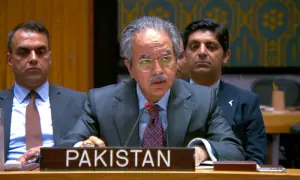
WASHINGTON: Pakistan’s envoy to the United Nations said on Monday that India’s key objectives in Afghanistan were “solely driven by the singular goal of destabilising Pakistan”. He made these remarks during a UN Security Council meeting on Afghanistan while responding to remarks by Afghanistan’s Permanent Representative to UN Nasir Ahmad Faiq. Earlier in the session, Pakistan’s Permanent Representative to UN Ambassador Asim Iftikhar Ahmad detailed the use of Afghan soil by terrorists and its impact on Pakistan, calling for the Afghan Taliban to take action against militants. He also spoke about Pakistan’s counter-terrorism measures. Faiq also commented on Pakistan’s counter-terrorism operations, in response to which Ambassador Ahmad said: “Pakistan’s actions, including those conducted in March, were directed solely against the terrorist and military support infrastructure that is operating from Afghanistan. And it is in no way directed against the brotherly people of Afghanistan.” ‘Verifiable, non-reversible action’ Ambassador Ahmad earlier told the UNSC that Islamabad’s demand from the Afghan Taliban was simple and clear: “verifiable and non-reversible action“ against terrorist groups operating from Afghan territory. “Regrettably, this demand remains unmet,” he said. And while the window for course correction was narrowing, it remained open, he added. “We hope the Taliban realise this in earnest and cooperate with the international community for the long-term peace and development of Afghanistan and, above all, in the best interest of all Afghans,” he said. There has been a resurgence in terrorism in Pakistan since the Afghan Taliban returned to power in Kabul in 2021. For its part, Islamabad has repeatedly urged the Taliban administration to dismantle terrorist sanctuaries on Afghan soil, particularly those linked to the banned Tehreek-i-Taliban Pakistan (TTP). But, officials say those appeals have gone unheedeed, while the Afghan Taliban reject these allegations. During the UNSC meeting, Ambassador Asim noted that it had been nearly half a decade since the Taliban takeover of Afghanistan in 2021. “It was hoped that this would end the bloodshed and Afghanistan would be at peace with itself and its neighbours,” he said. The envoy added that with the end of the civil war, it was “anticipated that the Taliban would take positive steps to transform into a responsible governing authority by adhering to their international obligations and commitments, and that they would lead Afghanistan into an era of stability and progress, provide the long-awaited relief to all Afghans and live in harmony with immediate neighbours”. “For decades, terrorism has been a major problem in Afghanistan, with implications not just for Afghanistan, but the immediate neighbourhood and beyond. Afghanistan has a history of being a safe haven for terrorist groups, including those used as proxies by our adversaries to target Pakistan and other countries,” he highlighted. It was “our expectation that the Taliban would take concrete and verifiable actions against terrorist groups such as the TTP, Balochistan Liberation Army (BLA) and its Majeed Brigade, Islamic State-Khorasan, East Turkestan Islamic Movement and their affiliates that are operating with impunity on Afghan soil”. “Regrettably, they have failed to undertake action, showing complete disregard for the legitimate security concerns of Pakistan and other countries,” the ambassador said. He added that, besides “independent analysis and reports of the Analytical Support and Sanctions Monitoring Team, which clearly outline the terrorism situation in Afghanistan and the ground realities, along with the recent exponential rise in terrorist attacks in Pakistan, these developments serve as glaring reminders of the precarious situation and the continuing threats posed to international peace and security”. “As a direct result of the freedom with which these terrorist groups operate in Afghanistan, Pakistan has borne the brunt of their attacks, as well as the Taliban’s growing nexus with these terrorist groups. “And once again, a significant number of Afghans are found to be involved in terrorism inside Pakistan,” he added. He said these terrorist groups had access to advanced weapons and sophisticated equipment, including drones. “Much of this can be traced back to the multi-billion dollar worth of arms and ammunition left behind by foreign forces — which was meant for use by the previous Afghan national government,” he said. Moreover, during counter-terrorism operations by Pakistan, there have been more than 290 cases of seizures of such weapons, which are used for terrorism and suicide bombings in the western parts of Pakistan, and which have exacted a heavy toll of human life and material losses, he told the UNSC. In 2025 alone, Pakistan reported more than 5,300 terrorist incidents and lost more than 1,200 lives to terrorism emanating from Afghanistan, he said. In this connection, he recalled that a vehicle-borne IED attack by the TTP on a police post in Khyber Pakhtunkhwa on May 9 resulted in the martyrdom of 15 police officers. “Our investigations revealed that the attack was planned by terrorists in Afghanistan.” Ambassador Ahmad said: “It is deplorable that the Taliban have reverted back to their old tactics of providing safe havens to terrorist groups and chosen the perilous path of complicity, backed by an outside actor, the historic spoiler and instigator of chaos — that has moved fast as an opportunist to wage a proxy war against Pakistan. “Let me make it clear: Pakistan will defend itself against whosoever attempts to harm our sovereignty, territorial integrity and national security.” He continued that Pakistan had always expressed openness for dialogue. “Numerous diplomatic efforts were made to counsel the Taliban. We thank friendly countries for their genuine mediation efforts, particularly Qatar, Turkiye, Saudi Arabia and most recently, China, to find amicable solutions. Yet the Taliban’s continued intransigence and even refusal to publicly denounce and condemn terrorist groups such as the TTP and BLA is deeply disturbing — it is evidence enough of their complicity and active support for these groups. Pakistan will not sit idle while suffering from terrorist acts. We will respond in self-defence, as and when needed and always in conformity with international law and International Humanitarian Law,” he said. Referring to a recent report by the UN secretary general, he said it “seems to largely externalise the responsibility for Afghanistan’s multifaceted challenges”. “The fatalities of terrorists and their supporters as a result of counter-terrorism operations are mentioned within the ambit of ‘civilian casualties’, posing serious questions on the credibility of UNAMA’s reporting from Afghanistan and the nature of their engagement with the Taliban. UNAMA is swift in reporting incidents of cross-border actions and casualties but fails to provide the overall context — which is the grave terrorist threat emanating from Afghanistan and its cross-border impact directed at Pakistan that is harming Pakistan and killing innocent Pakistanis,” he elaborated. He further said that the report also did not provide information on the destabilising accumulation of small arms and light weapons inside Afghanistan. “Nor does it adequately shed light on Afghanistan’s illicit economy, with its complex web of money laundering and terror financing networks, including hundi and hawala networks. Instead, the report resorts to shifting the blame on external dynamics, with little regard for the Taliban’s own policies that have brought Afghanistan to the brink of disaster,” he said. The envoy stressed that “we must not lose sight of the fact that it is the Taliban’s reckless style of governance and flawed ideologies of extremism, suppression and radicalisation that have brought upon Afghanistan the calamities it faces today”. “The Humanitarian Needs and Response Plan for 2026, we are told, is underfunded at 14 per cent — again a direct result of Taliban’s unwillingness to prioritise the welfare of Afghans over their own interest and authoritarian control,” he pointed out. Noting that several references had been made to the Pak-Aghan border closure in the report, he said: “Let me clarify that the closure of border between Pakistan and Afghanistan does not, from Pakistan’s perspective, affect the movement of humanitarian supplies. “Pakistan has been processing and facilitating the passage of humanitarian goods and material. However, the Afghan Taliban regime refuses to let them pass and keeps the border closed on its side, even to receive such life-saving cargoes, which obviously is to the detriment of the Afghan people.” He went on to say that the worsening human rights situation in Afghanistan “aligned with Taliban’s failings and deceitful narrative to meet the demands of the international community”. “Women and girls are denied their fundamental human rights and dignity, with discriminatory and abusive practices — a clear violation of their international obligations as well as of Islamic laws, traditions and tenets of the Muslim faith. The Afghan people are being held hostage to these inhumane restrictions, oppression and selfish behaviour,” he said. He said that Pakistan took numerous steps to support Afghanistan, including humanitarian relief efforts, political engagement, providing incentives to boost bilateral trade, offering transit concessions, issuing student and medical visas, conducting high-level visits to Kabul and participating in various regional cooperation initiatives to help Afghanistan succeed in its quest to find its rightful place in the international community. For over four decades, he continued, Pakistan welcomed millions of Afghan refugees “despite limitations and insufficient international support, dealing with huge caseloads of illegal Afghans, including those without documentation, posing a serious threat to our security”. But these were never meant to stay indefinitely, he added. The ambassador called on the UN secretary general to “clearly outline the status of third country resettlement cases of Afghans in a transparent manner — cases that are pending for years, despite being a tiny fraction of what Pakistan had to deal with, in the face of national security threats that no country would tolerate”. “While we provide all possible facilitation, the international community must step up and shoulder its responsibility. Shifting the blame of Afghanistan’s woes to the inflow of Afghan returnees will not solve the problem,” he said. Ambassador Ahmad further said, “We look forward to the next steps of the UN-led Doha Process and action plan for its Mosaic approach, to address Afghanistan’s multifaceted challenges comprehensively, with well-defined objectives and a realistic roadmap as the only viable pathway for normalisation”. Pakistan and Afghanistan, he said, were bound by geography, deep-rooted ties, civilisational links dating back centuries, and fraternal bonds of faith, culture and ethnicity. “No country has suffered more from the consequences of conflict and instability in Afghanistan than Pakistan. So we understand, and we also know, that no country stands to benefit more from peace, prosperity and stability in Afghanistan than Pakistan. “Pakistan’s demand from the Taliban is simple and clear: verifiable and non-reversible action against terrorists. Regrettably, this demand remains unmet. The window for course correction is narrowing but is still open. We hope the Taliban realise this in earnest and cooperate with the international community for the long-term peace and development of Afghanistan and, above all, in the best interest of all Afghans,” he said, concluding his address.
Sources said there is evidence suggesting such actors may be leveraging communications and airspace-related networks across multiple Asian countries, including Pakistan and Myanmar
Comments
ISLAMABAD: Federal Investigation Agency Director General Dr Usman Anwar on Monday said that offloading was a “lawful, preventive, and protective measure” used only where credible risk indicators exist. “The objective is to facilitate lawful travel while protecting the country’s citizens, safeguarding human lives, countering organised criminal networks, and preserving the country’s international reputation,” the FIA chief said while talking to reporters here. Dr Anwar said the FIA has intensified intelligence-led passenger screening at international airports, bringing illegal migration through Malawi to “zero” and cutting irregular flows to the EU by 64 per cent in early 2026. He said the measures target human smuggling, trafficking and visa abuse, and are meant to protect people from “exploitation, detention, deportation, trafficking, and loss of life on dangerous migration routes,” not to restrict genuine travel. He said his agency has identified Belarus, Cyprus, Central Asian states and certain Eastern European transit corridors as routes “increasingly exploited by organised human smuggling networks” for onward illegal migration to Europe, he said. Malawi also emerged as a high-risk transit hub in 2025. Criminal facilitators, the DG said, lure vulnerable people with false promises of jobs, education, settlement and legal migration. The FIA’s Annual Risk Analysis Report 2025 listed Southeast Asian cyber-trafficking, organised migrant smuggling networks, and transit migration through Eastern Europe and Central Asia as critical threats. It also noted a rising trend of migration and deportation to Central Asian countries among young residents of Khyber Pakhtunkhwa, besides hotspot districts of Punjab. Published in Dawn, June 9th, 2026
The COVID-19 pandemic and the geopolitical conflicts to follow exposed severe weaknesses in global supply networks, prompting governments, caught off guard and complacent, to pour money into critical sectors like semiconductors, critical minerals, and pharmaceuticals to prevent future shortages and reduce dependence on geopolitical rivals. Consequently, governments across the globe have increasingly been doling out state subsidies to local firms in a bid to secure supply chains, accelerate the transition to green energy, and protect domestic manufacturing…
Syria’s new government is weighing containment, military incorporation, and security pressure as it seeks to dismantle independent armed networks.
New York City was the backdrop of this year’s IEEE Honors Ceremony, held on 24 April. The event celebrates engineering pioneers who have developed technologies that have changed how people connect and learn about the world. This year’s celebrants included the engineers behind innovations such as text-to-donate technology, AI-powered diagnostic tools, and the graphics processing unit, among many others. Prior to the Honors Ceremony, IEEE hosted a forum on 23 April for a select group of early-career achievers to exchange ideas and experiences with laureates and awardees, speakers, and IEEE leaders. Attendees from around the world, working in a variety of technical areas, shared their journeys and explored the intersections of technologies, disciplines, and missions. The event culminated in Friday evening’s black tie Honors Ceremony, where IEEE celebrated medal laureates, including Jensen Huang, who received IEEE’s highest recognition, the IEEE Medal of Honor. Huang is a cofounder of Nvidia and its chief executive. “IEEE has always been a home to those who see the future before others see it,” Mary Ellen Randall, IEEE president and CEO, said in her welcome speech. Video highlights and photos from the event are available on the IEEE Awards website. Exploring mission-driven tech and AI in art Friday morning began with a conversation between Randall and Marian Croak, the recipient of this year’s IEEE Founders Medal. Croak was honored for “leadership in communication networks, including acceleration of digital equity, responsible artificial intelligence, and the promotion of diversity and inclusion.” Croak, who serves as vice president of engineering at Google, headquartered in Mountain View, Calif., pioneered Voice over Internet Protocol (VoIP) technologies. When a person speaks into a telephone, VoIP converts their voice into digital signals that are transmitted over the Internet rather than traditional phone lines. Her work enabled audio and video conferencing. She also developed text-to-donate technology to raise money for those affected by Hurricane Katrina, which devastated New Orleans in 2005. The technology enables customers to donate money to a charity via their mobile service provider, which then bills them. “Empathy has always been a driving force in the engineering that I’ve done,” she said. She shared advice on how to stay creative: “Get out of the office. Go to an art museum, exercise, or play with children.” Croak said her grandchildren inspire her. An inside look at microchips During Friday evening’s Honors Ceremony cocktail hour, attendees explored the history of microchips at the IEEE Global Museum’s Microchips That Shook the World exhibit. The Global Museum, an IEEE History and Heritage program, develops traveling and digital exhibits focused on the history of technology. The museum’s mission is to promote awareness of how technological progress unfolds over generations and how engineers and researchers build on past achievements to benefit humanity. Drawing from IEEE Spectrum’s Chip Hall of Fame, the Microchips That Shook the World exhibit conveys the roles integrated circuits play in fields such as signal processing, audio engineering, and telecommunications. Co-curators Stephen Cass, Spectrum’s special projects editor, and Daniel Mitchell, the IEEE senior historian, served as onsite docents for guests. The Commodore 64, one of the artifacts on display, brought up many treasured childhood memories for guests who used the home computer. The exhibit also featured a preview of IEEE’s immersive video project “Inside the Microchip,” which delves beneath the silicon surface of the Nvidia NV20 microchip thanks to forensic photography and sophisticated computer-generated renders. The video, which will be released later this year, aims to teach preuniversity students about the technology. Microchips that Shook the World is possible thanks to donations from semiconductor company ASML, the Bill and Dianne Mensch Foundation, and the IEEE Electron Devices and IEEE Electronics Packaging societies The daytime program also spotlighted AI’s use in the visual arts. Kathleen Kramer, the 2025 IEEE president, interviewed artist Refik Anadol, who is scheduled to open an AI art museum on 20 June in Los Angeles. Dataland’s exhibits are powered by an open-access model developed by Anadol’s studio. For the museum’s first exhibition, “Machine Dreams: Rainforest,” the model collected visual data about the natural world from the Smithsonian National Museum of Natural History, London’s Natural History Museum, and the Cornell Lab of Ornithology, with their permission. The information, including up to a half billion images, will form the basis for a variety of AI-produced art, Anadol said. Anadol said he was inspired to mix AI with art by the movie Blade Runner. He said he believes “machines can become collaborators,” as “data is a form of pigment.” Data also plays an important role in the work of artist and author Giorgia Lupi. The artist is a partner at design firm Pentagram. Lupi said she uses data to tell stories, including chronicling her struggles with a chronic illness. “Data is an abstraction of our reality,” she said. One of her recent projects, “A Data Love Letter to the Subway,” was shown last year in the Dey Street Passageway in New York City. The video was made using data from the Metropolitan Transportation Authority about each train line, including timetables, ridership, and people’s travel habits. Based on the information Lupi gathered, she documented how commuters traveling on different subway lines encountered one another without realizing it. By exploring data on this year’s IEEE award recipients, she collaborated with IEEE to create an animated video illustrating the shared pathways and collaborations among the honorees. It debuted at the Honors Ceremony. Honoring engineering giants The Honors Ceremony, held at Cipriani 42nd Street, recognized more than 20 laureates and innovators. More than 92 million selfies are taken worldwide every day, PhotoAiD estimates. A selfie wouldn’t be possible without Eric Fossum’s invention of the CMOS image sensor. Developed at NASA’s Jet Propulsion Laboratory, in Pasadena, Calif., the “camera on a chip” was intended for use in space, but it is now found in smartphones, medical devices, and vehicles. Fossum, an IEEE Life Fellow, received the IEEE Jun-ichi Nishizawa Medal, which recognizes outstanding contributions to materials and device science and technology. “Engineering is a pursuit of what must be possible. [IEEE is] the spirit, the conscience, of our profession.” —Jensen Huang, founder and CEO of Nvidia The medal, he said, “is at the top of the IEEE staircase of being recognized by your peers.” The IEEE Holonyak Medal for Semiconductor Optoelectronic Technologies went to Steven P. DenBaars, a professor of materials and electrical and computer engineering at the University of California, Santa Barbara. DenBaars was honored for his work in semiconductors, which laid the foundation for high-resolution LED and laser displays, modern solid-state lighting, and more. “This work has always been a team effort...I’m excited and curious about the role gallium nitride micro LEDs will play in optical communications,” he said in his acceptance speech. The ceremony ended with the Medal of Honor presentation to Huang, who received a standing ovation. He was recognized for his “leadership in the development of graphics processing units and their application to scientific computing and artificial intelligence.” The IEEE honorary member donated his cash prize to IEEE TryEngineering, which provides teachers with a library of lesson plans and offers educational summer camps. The Jen-Hsun and Lori Huang Foundation matched his gift, and the additional donation is destined to fund scholarships for new graduates. “Engineering is a pursuit of what must be possible. [IEEE is] the spirit, the conscience, of our profession,” Huang said.
Parents, not networks, should decide what kinds of programming their children watch, which is why ratings exist. But a rating system that withholds material facts about its content is no longer a reliable filter — it is a blindfold. Congress passed the Telecommunications Act of 1996 based on this very premise. The law pressed the […]
[IPS] Srinagar, India -- A new report has found that billions of dollars linked to illegal deforestation are flowing through global supply chains, with secrecy around land ownership and company records helping timber, soy, and beef products enter international markets unchecked.
Military campaigns by external powers, combined with psychological warfare against authoritarian regimes, can be highly effective in weakening morale, encouraging dissent, and creating instability. However, if poorly calibrated, it may also generate excessive excitement and emotional overreaction among the population, ultimately exposing opposition networks to the regime’s security apparatus. In highly totalitarian systems, emotional mobilization […]
Nairobi police dismantle drug networks in Kibra with a successful sting operation, arresting key suspects and seizing a large cache of narcotics and paraphernalia.
You do the research, read lists of reviews, compare the filtration stages, and shell out a significant sum for the most promising, tech-savvy water purifier in the market. Then, just two months into installation, the machine starts throwing a series of confusing, flashing signals. The premium buying experience instantly evaporates, replaced by the sheer frustration of tracking down customer care and waiting at home for a technician to show up.In India’s competitive consumer durables sector, this exact friction point has transformed the landscape of water purifiers. The ultimate battle is no longer just about who can build and sell the best machine; it is increasingly about who can maintain trust after the hole has been drilled in the customer's kitchen wall.While the water purifier market is traditionally viewed through the lens of one-time appliance sales, companies like Eureka Forbes, the legacy player behind AquaGuard, are increasingly betting on a far larger opportunity hidden beneath the surface: the recurring service economy built around filters, annual maintenance contracts (AMCs) and nationwide technician networks.According to internal projections by Anurag Kumar, Chief Growth Officer at Eureka Forbes, the water purifier service market alone is on track to cross Rs 9,000 crore by FY30, nearly matching the projected Rs 10,000 crore size of the product market itself.131582773Also read: Beyond the room: Why India Inc's luxury hospitality bet is becoming an experience businessBreaking down the mathFor decades, the consumer durable playbook was simple: manufacture, distribute, sell, repeat. But water purification is far different from selling a television or a refrigerator; it is an active, evolving health product bound to the fluctuating quality of local municipal and groundwater supplies."The market for product categories for water purifiers is about Rs 3,800 crore today," Kumar says in an exclusive interview with ET Online. "I think you would add another, roughly about Rs 3,500 crore of service category as well to it."Citing independent industry reports, Kumar highlighted that by FY30, this parallel economy is set to explode. The product market will expand to over Rs 10,000 crore, while the service and aftermarket ecosystem will chase it tightly at more than Rs 9,000 crore, growing at a combined double-digit compound annual growth rate (CAGR) of 11% to 12%.This shifting weight from hardware to service fundamentally changes corporate strategies. For an industry dealing with an urban penetration rate of just 14% (and a mere 7% nationally), the recurring revenue from existing households forms a highly resilient cash-flow cushion that protects margins even during macro-economic slowdowns.131582808Service scale becomes the biggest moatThe Rs 9,000 crore service opportunity explains why tech-first aggregators and rental startups are rushing into the service category. However, scaling an on-demand service infrastructure across India’s complex geography is entirely different from coding an app.For legacy companies like Eureka Forbes, this operational network has become a major competitive advantage."After sales service can make or break a brand," says Kumar. "I think a lot of the trust that AquaGuard has today is really thanks to the fact that people have trust in our service... It's a very, very important integral part of our business and a very, very crucial moat that we continue to nurture."To defend this moat against new-age tech startups, Eureka Forbes operates at a scale that resembles a logistics company more than an appliance manufacturer. The company has deployed more than 8,000 technicians mapping out an operational footprint across 19,500 PIN codes.Also read: Apple expected to unveil new AI features at last developers conference with CEO Tim CookThe push to reduce maintenance costs"Once you sell a product, then you have it for life and there's some revenue which comes with it," Kumar says, referring to filter replacements, AMCs and servicing requirements.Interestingly, the biggest threat to this recurring service revenue is not new-age competitors, it has been consumer fatigue over high maintenance costs. Historically, the dread of paying steep annual fees to replace purifier filters has acted as a primary barrier keeping the remaining 86% of urban Indian households from adopting organised water purifiers.To beat this, Eureka Forbes pulled off a counter-intuitive strategic gear: they disrupted their own short-term revenue model to secure long-term market share.Last year, the company introduced a range of purifiers featuring "long-life" filters extending the replacement cycle from the traditional 12 months to a full two years."We did that because we fundamentally heard from consumers that there was also a barrier to the category around maintenance cost being high," Kumar reveals. "What two-year filters actually did was they actually lowered the maintenance cost because now you don't have to change filters every year. You have to change once every two years."Digitising a 1980s direct-sales DNAEureka Forbes, a company historically known for its door-to-door service, and making Aquaguard synonymous with water purifiers in India, faced a new piece of necessary upgrade with building digitisation. The multi-billion dollar service landscape required a complete digital overhaul of consumer interactions. The brand that built its empire in the 1980s on the soles of direct-sales agents knocking on suburban doors has had to pivot entirely to an on-demand, algorithmic infrastructure.An army of thousands of field technicians is only as efficient as the software directing them. For modern consumers who manage their entire lives via smartphone screens, a bland "technician will visit tomorrow" promise no longer cuts it."We've digitised that service," notes Kumar.The long-term playAs water contamination concerns spike across rapidly expanding urban clusters, the structural demand for pure drinking water will continue to climb, and so for water purifiers.However, as the hardware itself faces gradual commoditisation and intense price competition from newer market entrants, the center of gravity has largely shifted. Where the growth moves nextCapturing a dominant share of the service market is only half the blueprint. As Kumar maps out the strategic trajectory for Eureka Forbes over the next three to five years, the company's growth engine eyes two distinct tracks: aggressive geographic widening and targeted product diversification. Geographically, Kumar notes, the company is bypassing deep rural pockets for the time being to focus heavily on India’s rapidly urbanising Tier-2 and Tier-3 towns. Instead, the company is doubling down on smaller towns where they can immediately deploy their signature localised service infrastructure without stretching their logistics network too thin.Simultaneously, the brand is attempting to de-risk its reliance on the kitchen wall by expanding into adjacent consumer durables. Kumar outlined a product pipeline anchored in high-growth, premium categories, including robotic vacuum cleaners, air purifiers, and household water softeners. The underlying playbook here is pure cross-selling. By utilising the same 8,000-strong technician network to service these newer household appliances, Eureka Forbes is betting that its aftermarket footprint can drastically lower its customer acquisition costs; positioning the legacy firm to evolve from a single-product manufacturer into a broader home-health ecosystem player.