Dawn (Pakistan)진보 성향
정치
긍정적 BUDGET 2026-27: NEC trims uplift plans; Punjab takes biggest hit
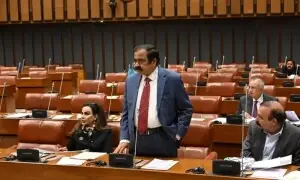
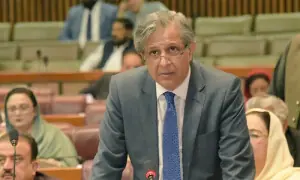
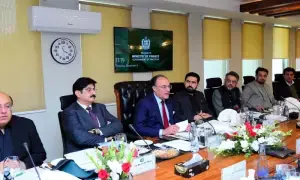
• Overall development outlay slashed by 25pc to Rs3.218tr • Federal PSDP reduced to Rs1tr, provincial ADPs to Rs2.218tr • No new projects except for interior, defence ministries • PM says strengthening defence is country’s biggest challenge • Ahsan says Pakistan lagged behind region due to weak investment in education, skills ISLAMABAD: Freezing provincial development plans at their actual utilisation this year, the National Economic Council (NEC) on Wednesday cut the federal and provincial development budget by one-fourth to Rs3.218 trillion for the next fiscal year from Rs4.264tr cleared by the Annual Plan Coordination Committee (APCC) last week. Of the Rs1.046tr total cut, the combined annual development plans (ADPs) of the four provinces were slashed by almost one-third (29.3pc) to Rs2.218tr — roughly their actual utilisation so far in the current fiscal year — compared to the Rs3.138tr provincial portfolio finalised by the APCC on June 1. Punjab’s development plan was chopped by almost half, or 49pc, the biggest cut among all stakeholders, while Balochistan remained unaffected and actually secured more. The development freeze was agreed upon by the major coalition partners — the PPP and PML-N — before the NEC and budget dates were finalised. To provide political face-saving to provincial governments, the federal government also agreed to bring down its Public Sector Development Programme (PSDP) by Rs126bn, or 11pc, to Rs1tr from Rs1.126tr recommended by the APCC, Planning Minister Ahsan Iqbal told reporters after the NEC meeting. The meeting was presided over by Prime Minister Shehbaz Sharif and attended by three provincial chief ministers. Punjab Chief Minister Maryam Nawaz could not attend because of her recent surgery. The minister said provincial governments had argued that it would be difficult for them to defend ADP cuts if the Centre’s PSDP remained intact. Mr Iqbal said the Punjab chief minister had authorised the downward revision that restricted Punjab’s ADP for next year to Rs749bn from Rs1.455tr cleared by the APCC only a week ago. Coalition partner PPP was able to minimise the dent to Sindh’s ADP, which was contained at Rs706bn for next year — down 13.5pc, or Rs110bn — from last week’s Rs816bn, which was already lower than the current year’s revised ADP of Rs845bn. Khyber Pakhtunkhwa Chief Minister Sohail Afridi agreed to a revised ADP of Rs455bn — exactly the same as budgeted this year — instead of Rs564bn cleared by the APCC. Balochistan was the only province to retain its Rs308bn development programme for next year, almost Rs29bn higher than the amount budgeted for the current fiscal year. The separate development plans of federal state-owned entities remained unchanged at Rs451bn, putting the consolidated national development outlay at Rs3.669tr, down 22.2pc, or Rs1.046tr, from Rs4.715tr announced after the APCC meeting last week. The APCC is a forum of federal and provincial planning ministers that finalises development recommendations for the NEC’s approval. Informed sources said that with reappropriation of the development portfolio, around Rs800bn to Rs900bn could be repurposed for strategic needs such as water resources and national security. Responding to a question, the planning minister said the development programme would contain “no new project except for the ministries of interior and defence” and noted that the actual size of savings would depend on many variables, including actual tax collections and how these savings became available. For example, he said, the Diamer-Bhasha dam alone required Rs170bn but had been allocated Rs20bn. Total allocations for the water sector amounted to Rs103bn, he said. Strengthening defence Meanwhile, in a televised statement, Prime Minister Shehbaz Sharif said the “biggest challenge” the country faced was “to strengthen our defence”, particularly against terrorism. “The entire nation, especially KP and Balochistan, as well as the law enforcement agencies and armed forces, is making sacrifices in the fight against terrorism,” he said, adding that terrorism could only be eliminated if the country “put up a collective struggle against it”. The prime minister said the Centre and provinces had taken many decisions in the best interest of Pakistan, as consultations with the provinces on all matters were conducted with seriousness to see where more resources could be generated. PM Shehbaz said he had held a telephonic conversation with IMF Managing Director Kristalina Georgieva, who was extremely appreciative of Pakistan’s sincere efforts towards the IMF programme. He said that despite major challenges, Pakistan had achieved macroeconomic stability, but injecting growth was an extremely important process. “Advancing employment, production, exports and economic activity is our collective responsibility,” he said, adding that all governments had tried their best to stay on track with the IMF programme despite “some difficult stages”. Apparently hinting at the budget later this week, the prime minister stressed the need to inject incentives aimed at export growth and manufacturing capabilities into the economy to accelerate GDP growth. He noted that a common man would not concern himself with “macro-level stability” but wanted better employment opportunities, development in agricultural and industrial sectors, and growth in exports. ‘Development deficit’ Mr Iqbal said the NEC agreed that the time had come for the entire nation and all stakeholders to sit together and work for export growth to $100bn in a few years, as well as import substitution, like the country had worked for its nuclear mission. The huddle agreed to his suggestion for quarterly NEC meetings to review and make adjustments by reviving the council’s original mandate of coordinating financial, social and economic policies, as required under Article 156 of the Constitution, to overcome the “development deficit”. He said the NEC had turned over the years into a forum that merely stamped the development budget, although it was required under the Constitution to review the overall economic condition and advise both the Centre and the provinces in formulating plans “in respect of financial, commercial, social and economic policies” to ensure balanced development and regional equity. As a consequence, Pakistan had lagged behind regional competitors, he said. In the early 1990s, Pakistan, India, China and Bangladesh had almost similar per capita incomes — between $324 and $363 — but Pakistan fell behind, with its current per capita income at just $1,824 compared to $2,675 in India, $2,653 in Bangladesh and $14,000 in China, while Vietnam moved from $99 to $5,026 per capita. This was mainly because others invested aggressively in education, skills, population control, female workforce participation and export competitiveness, while Pakistan did not, he said. No country could deliver economic outcomes with 2.5pc population growth and less than 64pc literacy rate, Mr Iqbal said, adding that youth potential was being lost in Pakistan and inequality was rising. “How can we have development while spending 74pc of revenues on debt servicing?” he asked. The meeting decided to focus on public-private partnership in development at the next NEC meeting and on freeing the business environment of regulatory sludge. He said bureaucracy would be reoriented towards economic delivery from its existing role of maintaining law and order and revenue collection. He said the prime minister had approved 11 economic missions and directed the finalisation of key performance indicators in consultation with all stakeholders. Despite downward reductions in the development portfolio by almost a quarter, the minister said next year’s GDP growth target would stay at 4pc, to be aided by 3.6pc growth in agriculture, 4.5pc in industry and 4.2pc in services. Inflation, measured by the Consumer Price Index, was estimated at 8.2pc. The Rs1tr federal PSDP will also contain foreign assistance equivalent to Rs255bn, while the provincial Rs2.218tr portfolio will include Rs583bn in foreign aid, taking total foreign funding to Rs838bn — or 26pc of the total Rs3.218tr development outlay. Giving a break-up, the minister said the PSDP contained Rs602.5bn for infrastructure, including Rs116bn for energy, Rs76bn for water, Rs356bn for transport and communication and Rs55bn for physical planning and housing. Another Rs181bn has been earmarked for the social sector, including Rs74bn for education and higher education, Rs22bn for health, Rs63bn for MNA schemes and Rs21bn for other social sectors. Likewise, Rs63bn has been allocated for coalition partners’ schemes. In addition, Rs89bn has been set aside for special areas, including AJK and GB, Rs56bn for the merged districts of KP, Rs41bn for science and technology and Rs13bn for governance. Another Rs12.6bn would be used for production sectors, including Rs4.6bn for food and agriculture and Rs8bn for industries, while the remaining Rs5bn has been allocated for miscellaneous areas. Published in Dawn, June 11th, 2026