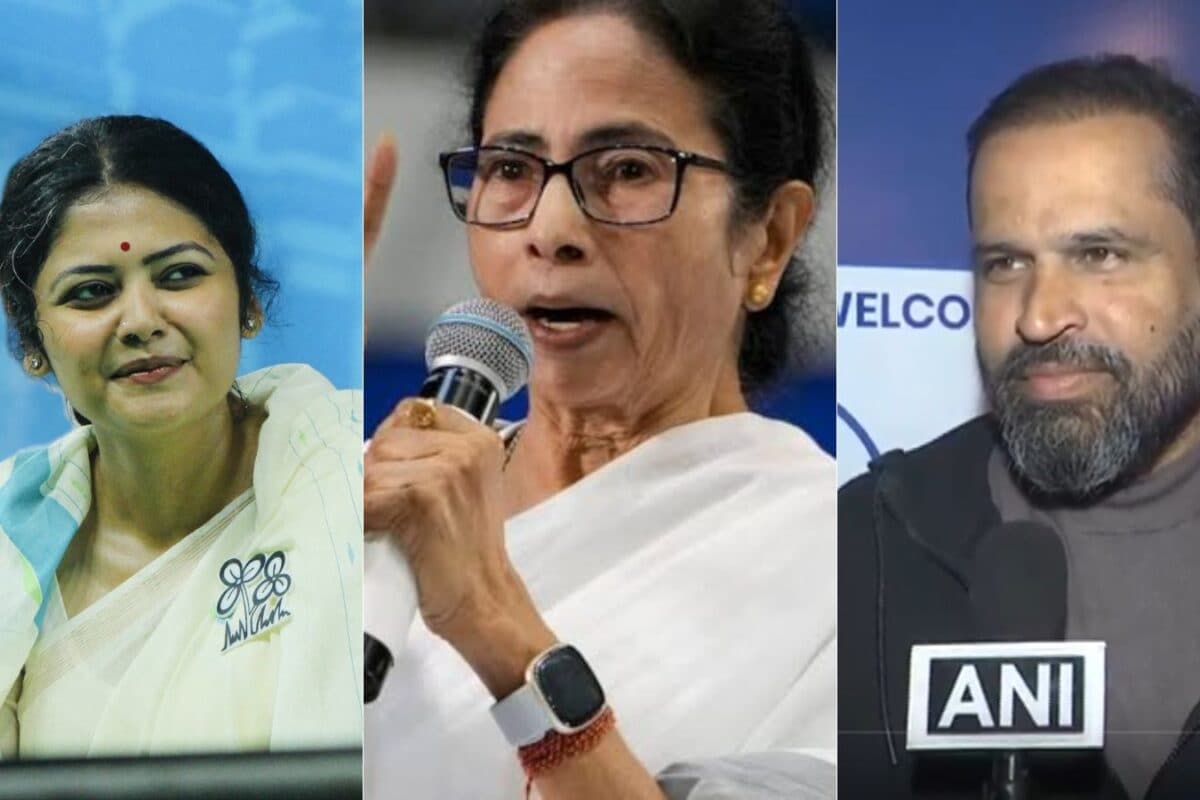
From Saayoni Ghosh To Yusuf Pathan, Why Mamata's Experiment To Turn Stars Into MPs Backfired
For years, Mamata relied on star power to broaden the TMC's appeal, bringing popular faces from cinema, television and sports into politics.

๐ฎ๐ณ ์ธ๋ ยท "TELEVISION" ยท ์ด 10๊ฑด
ํํฐ ๋ณด๊ธฐํ์ฌ ์ง์
48.3
0 = ๋ถ์ ์ฐ์ธ
50 = ์ค๋ฆฝ
100 = ๊ธ์ ์ฐ์ธ
์ต๊ทผ 7์ผ ๊ธฐ์ค 5,189๊ฑด์ ๋ถ์ํ ๊ฒฐ๊ณผ, ๋ด์ค ์ฌ๋ฆฌ์ง์๋ 48.3(๊ท ํ)์ ๋๋ค. ๊ธ์ 536๊ฑด(10.3%)ยท์ค๋ฆฝ 3,487๊ฑด(67.2%)ยท๋ถ์ 1,166๊ฑด(22.5%)์ด๋ฉฐ, ์ค๋ฆฝ ๋น์ค์ด ๋๋ ทํ๊ฒ ๋์ต๋๋ค. ์ฑํฅ ์ง์๋ ์ข ํฉ 14.2(์ค๋ ๊ท ํ)์ ๋๋ค.
For years, Mamata relied on star power to broaden the TMC's appeal, bringing popular faces from cinema, television and sports into politics.

Indian television โbroadcaster Zee Entertainment said โon Wednesday it would raise 23 โbillion rupees ($241.43 million) to fund its strategic and business initiatives.Here are some key details:* The company, which โdid not โ disclose โ a medium for the raise, said the board will โdeliberate further on options for raising funds* The fundraise comes โdays after the broadcaster struck a deal with FIFA to broadcast the 2026 World โCup in India, ending uncertainty over โ the tournament's โavailability in one of โthe last major โmarkets where rights had remained โ unsold.* The deal covers 39 FIFA events โover eight years through 2034 and โalso includes the next World Cup in 2030. Financial terms were not disclosed.* The company has expanded its presence in sports broadcasting by launching a dedicated portfolio of โsports channels.* The company previously invested in new businesses, including micro-drama app Bullet โand visual-effects โstudio PhantomFX, as โ it seeks to expand beyond traditional television broadcasting.* Zee Entertainment reported a loss for the March quarter โon May 19, as margins were pressured by higher expenses and tighter advertising budgets following the Middle East crisis.
You do the research, read lists of reviews, compare the filtration stages, and shell out a significant sum for the most promising, tech-savvy water purifier in the market. Then, just two months into installation, the machine starts throwing a series of confusing, flashing signals. The premium buying experience instantly evaporates, replaced by the sheer frustration of tracking down customer care and waiting at home for a technician to show up.In Indiaโs competitive consumer durables sector, this exact friction point has transformed the landscape of water purifiers. The ultimate battle is no longer just about who can build and sell the best machine; it is increasingly about who can maintain trust after the hole has been drilled in the customer's kitchen wall.While the water purifier market is traditionally viewed through the lens of one-time appliance sales, companies like Eureka Forbes, the legacy player behind AquaGuard, are increasingly betting on a far larger opportunity hidden beneath the surface: the recurring service economy built around filters, annual maintenance contracts (AMCs) and nationwide technician networks.According to internal projections by Anurag Kumar, Chief Growth Officer at Eureka Forbes, the water purifier service market alone is on track to cross Rs 9,000 crore by FY30, nearly matching the projected Rs 10,000 crore size of the product market itself.131582773Also read: Beyond the room: Why India Inc's luxury hospitality bet is becoming an experience businessBreaking down the mathFor decades, the consumer durable playbook was simple: manufacture, distribute, sell, repeat. But water purification is far different from selling a television or a refrigerator; it is an active, evolving health product bound to the fluctuating quality of local municipal and groundwater supplies."The market for product categories for water purifiers is about Rs 3,800 crore today," Kumar says in an exclusive interview with ET Online. "I think you would add another, roughly about Rs 3,500 crore of service category as well to it."Citing independent industry reports, Kumar highlighted that by FY30, this parallel economy is set to explode. The product market will expand to over Rs 10,000 crore, while the service and aftermarket ecosystem will chase it tightly at more than Rs 9,000 crore, growing at a combined double-digit compound annual growth rate (CAGR) of 11% to 12%.This shifting weight from hardware to service fundamentally changes corporate strategies. For an industry dealing with an urban penetration rate of just 14% (and a mere 7% nationally), the recurring revenue from existing households forms a highly resilient cash-flow cushion that protects margins even during macro-economic slowdowns.131582808Service scale becomes the biggest moatThe Rs 9,000 crore service opportunity explains why tech-first aggregators and rental startups are rushing into the service category. However, scaling an on-demand service infrastructure across Indiaโs complex geography is entirely different from coding an app.For legacy companies like Eureka Forbes, this operational network has become a major competitive advantage."After sales service can make or break a brand," says Kumar. "I think a lot of the trust that AquaGuard has today is really thanks to the fact that people have trust in our service... It's a very, very important integral part of our business and a very, very crucial moat that we continue to nurture."To defend this moat against new-age tech startups, Eureka Forbes operates at a scale that resembles a logistics company more than an appliance manufacturer. The company has deployed more than 8,000 technicians mapping out an operational footprint across 19,500 PIN codes.Also read: Apple expected to unveil new AI features at last developers conference with CEO Tim CookThe push to reduce maintenance costs"Once you sell a product, then you have it for life and there's some revenue which comes with it," Kumar says, referring to filter replacements, AMCs and servicing requirements.Interestingly, the biggest threat to this recurring service revenue is not new-age competitors, it has been consumer fatigue over high maintenance costs. Historically, the dread of paying steep annual fees to replace purifier filters has acted as a primary barrier keeping the remaining 86% of urban Indian households from adopting organised water purifiers.To beat this, Eureka Forbes pulled off a counter-intuitive strategic gear: they disrupted their own short-term revenue model to secure long-term market share.Last year, the company introduced a range of purifiers featuring "long-life" filters extending the replacement cycle from the traditional 12 months to a full two years."We did that because we fundamentally heard from consumers that there was also a barrier to the category around maintenance cost being high," Kumar reveals. "What two-year filters actually did was they actually lowered the maintenance cost because now you don't have to change filters every year. You have to change once every two years."Digitising a 1980s direct-sales DNAEureka Forbes, a company historically known for its door-to-door service, and making Aquaguard synonymous with water purifiers in India, faced a new piece of necessary upgrade with building digitisation. The multi-billion dollar service landscape required a complete digital overhaul of consumer interactions. The brand that built its empire in the 1980s on the soles of direct-sales agents knocking on suburban doors has had to pivot entirely to an on-demand, algorithmic infrastructure.An army of thousands of field technicians is only as efficient as the software directing them. For modern consumers who manage their entire lives via smartphone screens, a bland "technician will visit tomorrow" promise no longer cuts it."We've digitised that service," notes Kumar.The long-term playAs water contamination concerns spike across rapidly expanding urban clusters, the structural demand for pure drinking water will continue to climb, and so for water purifiers.However, as the hardware itself faces gradual commoditisation and intense price competition from newer market entrants, the center of gravity has largely shifted. Where the growth moves nextCapturing a dominant share of the service market is only half the blueprint. As Kumar maps out the strategic trajectory for Eureka Forbes over the next three to five years, the company's growth engine eyes two distinct tracks: aggressive geographic widening and targeted product diversification. Geographically, Kumar notes, the company is bypassing deep rural pockets for the time being to focus heavily on Indiaโs rapidly urbanising Tier-2 and Tier-3 towns. Instead, the company is doubling down on smaller towns where they can immediately deploy their signature localised service infrastructure without stretching their logistics network too thin.Simultaneously, the brand is attempting to de-risk its reliance on the kitchen wall by expanding into adjacent consumer durables. Kumar outlined a product pipeline anchored in high-growth, premium categories, including robotic vacuum cleaners, air purifiers, and household water softeners. The underlying playbook here is pure cross-selling. By utilising the same 8,000-strong technician network to service these newer household appliances, Eureka Forbes is betting that its aftermarket footprint can drastically lower its customer acquisition costs; positioning the legacy firm to evolve from a single-product manufacturer into a broader home-health ecosystem player.
India's booming micro-drama industry is giving rise to a new category of performers calling themselves "vertical actors", as short-form storytelling platforms emerge as an alternative to television and streaming services.Actors, producers, and app founders told ET that emotionally charged performances, stronger roles, rapid audience recognition, and the ability to build dedicated fan bases are drawing talent to the format.Established vertical actors typically work on at least three series a month, earning Rs 1-3.5 lakh per project, giving financial security in addition to the recognition, according to producers. Industry executives expect the trend to create bona fide "vertical stars" whose fame is built largely through micro-dramas consumed on mobile phones in portrait mode.One of the key aspects that differentiates a vertical actor from performers in other storytelling formats is the pace, according to micro-drama directors and actors.โVertical actors are defined by their ability to work at a fast pace,โ said Samay Bhattacharya, a director who has helmed four micro-drama series. โThey have to understand characters quickly and deliver spontaneous performances under tight production schedules.โTypically, a micro-drama series comprising 50 episodesโeach less than two minutes longโis shot at a brisk pace in fewer than 10 days.โI compare acting across different forms of storytelling to driving,โ said actor Karanvir Bohra, a major draw in the Indian micro-drama space. โFilms are first gear, while television and web series are second and third gear. Then comes content creation in fourth gear. Finally, vertical acting or storytelling is the highest gear. It demands the best performance and impact in the shortest possible time.โVertical actors said the format has provided them with much-needed recognition despite spending decades in the industry.โThe use of close-ups, melodramatic performances, strong cliffhangers, diverse plots and relatively better roles than television in vertical content has brought significant recognition to actors like me,โ said actor Piyush Sahdev. โDespite working for more than 25 years across mediums, today I am easily recognised for my micro-drama series The Secret Khiladi.โโMicro-dramas are reviving the careers of many actors. The careers of actors such as Asmit Patel, Omkar Kapoor and Kunal Kapoor have been revitalised,โ said Vicky Bahri, producer and founder & CEO of KLIP, a micro-drama app. โIn the future, I foresee bona fide โvertical starsโ known for their micro-drama work, given the high viewership numbers.โVertical actors also view micro-dramas as a way to build an audience base for their work in longer storytelling formats.โMicro-drama content reaches pan-India audiences,โ said actor Rajniesh Duggal, known for his debut film 1920. โBy working as a vertical actor, I am building my own audience base. This very audience will come to watch my films in theatres. This is one of my chief motivations."
DUBAI: Israel launched airstrikes early Monday targeting central and western Iran in response to missile fire from Tehran, attacks that threatened to drag the wider Middle East back into a regional war.Iranian state television reported the sound of explosions being heard in Isfahan, Karaj, Tabriz and Tehran, without immediately elaborating. A witness in Tehran described hearing at least one large blast somewhere to the west of the country's capital city. Iran closed the airspace around Tehran's Imam Khomeini International Airport, the country's main airfield, after the Israeli attack.Iranian officials offered no details on what had been struck, nor any damage information. Iran's paramilitary Revolutionary Guard said that Israel used air-launched ballistic missiles in its attack Monday morning, without elaborating.The Israeli military at dawn in Iran issued a short statement as the strikes started: "A short while ago, the Israeli Air Force struck military targets belonging to the Iranian terror regime in western and central Iran." It did not elaborate.Also read | Iran launches missiles at Israel for first time since Mideast truceThe White House did not respond to messages about the strikes and whether they were done in coordination with the U.S.For days, negotiations between Iran and the United States over the fragile ceasefire in the war had been stalled by the fighting between Israel and the Lebanese Shiite militia Hezbollah. Israel now occupies southern Lebanon and had moved into areas of the country it hadn't held in a quarter century - leading to fears about them further widening their campaign.On Sunday, Israel launched airstrikes in Beirut's southern suburbs. Iran retaliated with its own strike on Israel, which led to Monday morning's attack by Israel on Iran.U.S. President Donald Trump earlier told a Fox News Channel reporter that he wanted the Iranians to stop firing missiles and return to the negotiating table. He also said that Israel's strikes in Lebanon earlier Sunday were not coordinated with the U.S. and "I'm not happy about it."Also read | War, debt and cuts: The price of Israel's security pushA senior U.S. official said Trump had called Netanyahu to urge him not to retaliate immediately for the Iranian missile attack. The official, who spoke on condition of anonymity to describe a private phone call, said that Trump believed he had convinced Netanyahu to wait.Trump "got Bibi to hold off for the time being," the official said. The official would not offer any other details of the call, and there was no immediate comment from Netanyahu's office.
In an exciting turn of events, beloved television actress Jennifer Winget is reportedly gearing up for her wedding to entrepreneur William Ishmael, who resides in Singapore. Sources close to the couple say their relationship is thriving, especially after a romantic proposal during a recent getaway.
Supporters intercepted nearly every vehicle travelling on Kanakapura Road to distribute sweets, and in no house across the region, especially in Doddalahalli, where the new Chief Minister hails from, were televisions switched off
State television has criticised negotiations and portrayed talks as unsuccessful
Court says broadcasters cannot claim an โunfettered right to exploit spectrum for commercial purposesโ, adding that โexcessive or uneven commercial intrusion is a direct impairment of the right of consumers to a fair and reasonable viewing experienceโ
He calls upon producers and film personalities to invest in studios, dubbing theatres and recording facilities in the State; Bharat Bhushan takes over as Andhra Pradesh State Film, Television and Theatre Development Corporation