The Hindu National
진보 성향
기타
Ministry recommends capping of airports for privatisation
The recommendation was made last week in response to queries raised by government departments represented on the Public Private Partnership Appraisal Committee

🇮🇳 인도 · "RECOMMEND" · 총 132건
필터 보기현재 지수
48.3
0 = 부정 우세
50 = 중립
100 = 긍정 우세
최근 7일 기준 6,056건을 분석한 결과, 뉴스 심리지수는 48.3(균형)입니다. 긍정 615건(10.2%)·중립 4,100건(67.7%)·부정 1,341건(22.1%)이며, 중립 비중이 뚜렷하게 높습니다. 성향 지수는 종합 14.1(중도 균형)입니다.
The recommendation was made last week in response to queries raised by government departments represented on the Public Private Partnership Appraisal Committee
The advisory council says it assembled a dataset on elections to LS seats from 2009 to 2024 to estimate a ‘statistical relationship’ between voter turnout, constituency size, and five compositional features of the constituency; the model results in increasing the size of the Lok Sabha to 824 seats and it is broadly in line with what the Centre had suggested in April, when it brought the Delimitation-related Bills but failed to pass them in Parliament

The concerns are not limited to former awardees. After the ministry announced the re-evaluation process, Asian Championships gold medallist decathlete Tejaswin Shankar, who has been recommended for the Arjuna Award, publicly criticised the delay. "This delay is not just de-motivating to athletes and coaches but also a sign of disrespect," he posted on X in April.

Shares of CMR Green Technologies fell nearly 8% from their post-listing highs on Thursday as investors booked profits after a strong market debut. The stock slipped to an intraday low of Rs 250 on the BSE, after listing at a 43% premium to its issue price of Rs 192.The Rs 630.62-crore IPO was subscribed 127.07 times overall, making it one of the most sought-after public issues of the year. Institutional investors drove the demand, with the qualified institutional buyer (QIB) portion subscribed 270.46 times. The non-institutional investor (NII) segment was booked 172.35 times, while the retail investor category attracted bids worth 27.08 times the shares reserved for itRead More: https://economictimes.indiatimes.com/markets/stocks/news/wipros-rs-15000-crore-buyback-opens-tomorrow-10-key-things-to-know-before-tendering-shares/wipro-buyback/slideshow/131625831.cmsShould you buy, sell or hold CMR Green shares?Shiavni Nyati, Head of Wealth at Swastika Investmart, said that while the impressive listing highlights positive market sentiment, investors should remember that the IPO was an Offer for Sale (OFS) only, meaning the company did not receive any fresh capital and existing shareholders reduced their stakes through the issue. Following such a sharp listing gain, some profit booking and short-term volatility are likely. Investors who received allotment may consider booking partial profits while continuing to hold the remaining shares for the medium to long term, given the company's exposure to the growing recycled metals industry. New investors should avoid chasing the stock at elevated levels and wait for a correction or consolidation before considering fresh entries. Overall, caution is warranted after the strong debut. Investors may maintain a stop loss at a cost of Rs 192 to protect gains, as a sustained move below this level could indicate weakening momentum, she added. Arihant Capital said the company's leadership in aluminium recycling, and its installed capacity of more than four times that of its nearest domestic competitor, augurs well. The brokerage also pointed to the company's dominant position in the automotive cast alloy segment, where it commands an estimated market share of 42-45%, and recommended subscribing to the IPO.SBI Securities said CMR enjoys significant scale advantages with an installed capacity of 4.7 lakh tonnes per annum and sees growth opportunities from expansion into wrought aluminium products and increasing demand for recycled metals. It also maintained a "Subscribe" rating.Deven Choksey Research noted that the company is well-positioned to benefit from long-term themes such as electric vehicle adoption, rising aluminium intensity in automobiles, decarbonisation and India's circular economy push. The brokerage recommended subscribing to the issue.Financially, CMR reported revenue of Rs 6,697 crore and net profit of Rs 155 crore in FY25. For the nine months ended December 2025, it posted revenue of Rs 6,291 crore and profit after tax of Rs 162.4 crore, indicating continued operational momentum.Also read: A $6 billion share sale wave in India signals deals perking upCMR Green Technologies, incorporated in 2006, is one of India's leading non-ferrous metal recyclers and operates in the secondary aluminium market. The company manufactures recycled aluminium alloys, zinc alloy ingots, aluminium billets and other recycled metal products that are used across automotive and industrial applications.(Disclaimer: Recommendations, suggestions, views and opinions given by the experts are their own. These do not represent the views of The Economic Times)
Shares of Aegis Vopak Terminals rallied as much as 6% to their day’s high of Rs 203 on the BSE on Wednesday after international brokerage firm Jefferies upgraded the stock to Buy and assigned a fresh target price of Rs 240, implying an upside of 25% from current market levels. While the brokerage has cut its target price from Rs 255, it believes the recent correction in Aegis Vopak Terminals (AVTL) has been excessive. The stock has fallen 16% since Middle East tensions escalated, compared with an 8% decline in the Nifty. While near-term risks persist, the brokerage expects LPG import volumes to normalise once geopolitical tensions ease.Jefferies said Aegis remains on track with its expansion plans, with management reiterating an aggregate capex target of $5 billion by FY30 and $1.2 billion by FY27. The company currently operates 1.7 million cubic metres of liquid storage capacity and 225,800 MT of LPG capacity across six ports and aims to expand its presence to 12 ports by 2030. Capacity additions at JNPT and Kandla ports are progressing as planned and are expected to increase liquid storage capacity by 25% and LPG capacity by 34%, respectively. Management said capacity expansion is being aligned with demand growth. The company is also expanding into ammonia storage, with a 36,000 MT facility under development at Pipavav port. Additionally, the Kandla-Gorakhpur pipeline is expected to be commissioned by September 2026, which could support higher LPG terminal throughput.“We estimate 4.7% CAGR in LPG demand over FY26-30E, driving 5.3% CAGR in imports. We believe AVTL is also well-placed to capture storage-led growth as the government plans to build an LPG storage reserve to cover 30 days of demand,” the brokerage said in a note. Jefferies has lowered its FY27 EBITDA estimate for Aegis Vopak Terminals (AVTL) by 22% to factor in the March 2026 quarter miss and the impact of Middle East tensions. However, it has largely retained its FY28 estimates, assuming geopolitical tensions ease over time.The brokerage has cut its target price to Rs 240 from Rs 255 earlier. The valuation is based on 22x March 2028 estimated EV/EBITDA, compared with 18x for JSW Infrastructure. Jefferies expects AVTL to deliver a 33% EBITDA CAGR between FY28 and FY30, versus 21% for JSW Infrastructure, while achieving broadly similar return ratios by FY28.Key downside risks highlighted by the brokerage include delays in the Kandla-Gorakhpur pipeline project, weaker-than-expected LPG imports or market share gains, and value-dilutive capacity expansion plans.Aegis Vopak shares are down 20% since the beginning of the year. (Disclaimer: Recommendations, suggestions, views and opinions given by the experts are their own. These do not represent the views of The Economic Times)
Fertiliser stocks witnessed strong buying interest on Wednesday, with shares of The Fertilisers and Chemicals Travancore (FACT) and Chambal Fertilisers & Chemicals surging up to 5% during the trading session. The rally followed reports that the Fertiliser Ministry has sought a significant increase in the subsidy budget for FY27.According to government sources cited by PTI and The Times of India, the Ministry has approached the Finance Ministry to double the fertiliser subsidy allocation to Rs 1.71 lakh crore, reflecting mounting concerns over escalating global fertiliser prices and rising import costs.The proposed hike comes amid disruptions linked to the ongoing West Asia conflict, which has pushed up international fertiliser prices and strained global supply chains. Officials have warned that if these challenges persist, India's fertiliser subsidy bill could exceed Rs 3 lakh crore during the current fiscal year.A prolonged disruption in shipping through the Strait of Hormuz, a critical trade route, could further inflate India's fertiliser import bill and complicate procurement efforts. At the same time, a shrinking global supply pool continues to exert upward pressure on prices.However, officials noted that the final subsidy requirement may ease somewhat as domestic fertiliser production continues to improve, helping offset part of the import burden.India currently provides substantial subsidies on key fertilisers to shield farmers from price volatility. Neem-coated urea is sold at Rs 242 per 45 kg bag, while di-ammonium phosphate (DAP) is priced at Rs 1,350 per 50 kg bag.The prospect of higher subsidy support and sustained demand optimism has put fertiliser stocks firmly in investors' focus, making the sector one of the standout performers in Wednesday's trade.Share price snapshotFertilisers and Chemicals Travancore (FACT): Shares of FACT surged 5% to Rs 920 during Wednesday's trade. The company currently has a market capitalisation of Rs 56,686 crore, while the stock's 52-week high stands at Rs 1,085.Chambal Fertilisers & Chemicals: The stock advanced 4% to Rs 473, drawing investor attention amid the sector-wide rally. The company commands a market capitalisation of Rs 18,220 crore, and its 52-week high stands at Rs 580.70.Technical indicatorsFACT: The stock's 14-day Relative Strength Index (RSI) is at 50.1. An RSI reading below 30 is generally considered oversold, while a reading above 70 indicates overbought conditions.Chambal Fertilisers & Chemicals: The stock's 14-day RSI stands at 49.2, suggesting neutral momentum. Typically, RSI levels below 30 signal oversold territory, whereas readings above 70 point to overbought conditions.(Disclaimer: Recommendations, suggestions, views and opinions given by the experts are their own. These do not represent the views of The Economic Times.)
Shares of NLC India fell over 3% on Wednesday despite strong demand for the government's Offer for Sale (OFS), which was oversubscribed on the first day. The offer opens for retail investors today.Non-retail investors bid for over 13.03 crore shares worth Rs 4,158 crore, as against a base offer size of 2.49 crore shares reserved for them. Shares of the Navratna PSU company tumbled more than 3% to trade at Rs 316.6 apiece on NSE.NLC India announced on Monday that the government aims to sell 2% of the company’s total paid-up equity capital, or 2.78 crore shares, as part of the base offer. The government also retained an oversubscription option to sell an additional 1% stake or 1.39 crore shares, taking the total potential offer size to 4.17 crore shares or 3% equity. At the floor price of Rs 303 per share, this would be worth around Rs 1,263.51 crore.In an exchange filing released on Tuesday, NLC India said that the government will exercise the oversubscription option to sell up to 1.39 crore shares, in addition to the 2.77 crore shares that were part of the base offer. 10% of the equity shares offered in the OFS, which stands at nearly 41.52 lakh, will be available for retail investors today, subject to receipt of valid offers, the company said.“Additionally, up to 25,000 equity shares may be offered to the eligible employees of the company…The eligible employees may apply for equity shares up to Rs 500,000. However, any bids by eligible employees will be considered for allocation, in the first instance, for an amount up to Rs 200,000 only,” it said.Also read: NLC India OFS over-subscribed 5 times, institutional buyers put in Rs 4,158 cr bidsNLC India, formerly known as Neyveli Lignite Corporation, is among India's leading mining and power generation companies. It operates lignite mines and thermal power stations while also expanding its renewable energy portfolio. The company has emerged as a beneficiary of India's rising power demand and the government's focus on energy security. In recent years, the company has diversified beyond lignite mining into solar and other renewable energy projects as part of its long-term growth strategy.NLC India shareholding patternThe Central government owned a 72.20% stake in NLC India, according to data on the company’s shareholding pattern as on March 31, 2026. A total of 22 mutual funds held around 9.5% stake in NLC India, while Life Insurance Corporation of India (LIC) and SBI Life Insurance each held around 2% stake.NLC India’s OFS comes as the government ramps up its disinvestment efforts. Recently, the government offloaded some of its stake in Coal India, NHPC and other PSU companies.NLC India share priceNLC India shares have fallen around 8% in one week and 3% in one month. The stock is overall up around 25% in 2026 so far. In the longer term, the shares of the PSU have delivered 33% returns over one year, 220% over three years and 396% over five years. The company currently has a market capitalisation of nearly Rs 44,303 crore.NLC India has maintained a track record of returning cash to shareholders through regular dividends. The company has declared 43 dividends since August 2000, and currently has a dividend yield of 1.6%, according to data on Trendlyne.(Disclaimer: Recommendations, suggestions, views and opinions given by the experts are their own. These do not represent the views of The Economic Times)
Shares of Afcons Infrastructure rallied as much as 9.4% to their day’s high of Rs 346.30 on the BSE on Wednesday after the company announced that it had received a letter of award from Vadhvan Port Project Ltd (VPPL) for the construction of a 10.14-km breakwater at the upcoming Vadhvan Port in Maharashtra.According to the company, the contract is valued at Rs 5,301 crore. Upon completion, the structure is expected to become the second-longest breakwater in the world. The project involves the construction of a 10.14-km-long breakwater as part of the Vadhvan Port development. Afcons said it received the Letter of Award on June 10.In a regulatory communication, the company highlighted its experience in executing marine infrastructure projects in India and overseas. Afcons has undertaken several marine projects internationally, including the Bulk Jetty at Port of Sohar in Oman, the New Owendo International Port in Gabon, and the Sulphur Jetty project in Kuwait.The company stated that the Bulk Jetty at Port of Sohar is located at one of the world's deepest ports. It also noted that the New Owendo International Port in Gabon was completed in 18 months and was recognised as the fastest completed port project in West Africa. The Sulphur Jetty project in Kuwait involved the execution of an EPC berth facility, including trestles, equipment and structural works.Afcons further said that it has been ranked by Engineering News-Record (ENR), USA, as the world's eighth-largest marine and port facilities contractor.The Vadhvan Port project is envisaged as India's largest public port and one of the world's largest container ports. According to the company, the port is expected to have a handling capacity of 23.2 million TEUs.Afcons Infra Q4 Afcons reported a net loss of Rs 89 crore in the fourth quarter of FY26 against a profit after tax of Rs 111 crore in the same period last year. The company said net profit was impacted by macroeconomic uncertainties and certain one-time factors.The company’s revenue from operations also dipped by 18% to Rs 2,777 crore from Rs 3,387 crore posted in the corresponding quarter of the previous fiscal year, Afcons said in its investor presentation.EBITDA came in at Rs 170 crore, marking a 59% drop from Rs 415 crore posted in the year-ago period. Margins also witnessed a sharp fall, down 6.1% from 12.2% in Q4FY25. For the full year, the company’s order book stood at Rs 32,496 crore, ‘ensuring visibility on its future revenue and profitability’, it said. Despite Wednesday’s surge, Afcons’ share price is down 12% in 2026 and about 23% in the last 1 year. (Disclaimer: Recommendations, suggestions, views and opinions given by the experts are their own. These do not represent the views of The Economic Times)
In a solid stock market debut, shares of CMR Green Technologies listed at 43% premium over IPO price on Wednesday. The stock opened at Rs 275.40 on the BSE as compared to its issue price of Rs 192. Meanwhile, the stock opened at Rs 268 on NSE, surging 40% from IPO price.Robust IPO subscriptionThe IPO was subscribed 127.07 times overall, making it one of the most sought-after public issues of the year. Institutional investors drove the demand, with the qualified institutional buyer (QIB) portion subscribed 270.46 times. The non-institutional investor (NII) segment was booked 172.35 times, while the retail investor category attracted bids worth 27.08 times the shares reserved for it.More than 33.7 lakh applications were received across categories, highlighting strong participation from both institutional and retail investors.Ahead of the IPO opening, the company had raised Rs 188.44 crore from anchor investors through the allocation of 98.14 lakh shares.About the companyCMR Green Technologies, incorporated in 2006, is one of India's leading non-ferrous metal recyclers and operates in the secondary aluminium market. The company manufactures recycled aluminium alloys, zinc alloy ingots, aluminium billets and other recycled metal products that are used across automotive and industrial applications.Its customer base includes several leading automobile manufacturers and component makers such as Honda Cars India, Bajaj Auto, Hero MotoCorp, Royal Enfield, Endurance Technologies, Maruti Suzuki and Jindal Stainless.The company is positioned to benefit from increasing demand for recycled metals as manufacturers globally focus on reducing carbon emissions and improving sustainability across supply chains. Aluminium recycling consumes significantly less energy than primary aluminium production, making recyclers increasingly important in the transition towards greener manufacturing.Financially, the company has shown steady growth. For the nine months ended December 2025, CMR Green Technologies reported revenue of Rs 6,291 crore and profit after tax of Rs 162.39 crore. For FY25, it reported revenue of Rs 6,696.66 crore and net profit of Rs 155.04 crore.(Disclaimer: Recommendations, suggestions, views and opinions given by the experts are their own. These do not represent the views of Economic Times)
PM Narendra Modi is now the longest serving Prime Minister of India surpassing former PM Jawaharlal Nehru.

Shares of Redington surged nearly 5% on Tuesday after Apple unveiled a completely rebuilt Siri at its Worldwide Developers Conference (WWDC) 2026, along with a host of features and OS updates.The company rolled out the next-generation Apple Intelligence features, AI-powered photo editing tools, enhanced child-safety capabilities and software updates across iPhone, iPad, Mac, Apple Watch and Vision Pro.Redington has been a key Apple distribution partner since 2007, handling the logistics, warehousing and distribution of Apple products to retailers and resellers across India, the Middle East, Turkey, Africa and South Asia.Redington shares sharply surged to an intraday high of Rs 241 apiece on NSE on Tuesday morning, snapping a two-session losing streak. Notably, Apple shares meanwhile closed around 2% lower after its annual conference.New Apple features unveiled at WWDC 2026In what was Tim Cook’s last WWDC as the Apple CEO, the company on Monday unveiled a much-awaited overhaul of Siri, introducing a more conversational, context-aware version of its digital assistant as the company seeks to catch up with AI rivals including ChatGPT, Gemini and Claude.The new model called 'Siri AI' will now come with a dedicated app, a redesigned interface and improved conversational abilities. According to Apple, it can understand a user's personal context, access broad world knowledge and even understand what is currently on a user's screen.Also read: Siri gets an AI makeover, its biggest upgrade since 2011 debutApple also unveiled the next generation of Apple Intelligence, built on updated Apple Foundation Models that power Siri, image generation, writing assistance and reasoning capabilities. It also significantly expanded its Visual Intelligence, bringing image understanding capabilities to more devices. On the iPhone, Siri can now analyse what users see through the Camera app and answer questions about objects, locations and food. The assistant can also perform actions such as splitting restaurant bills using Apple Cash.Why are Redington shares rising?Redington has a long-standing partnership with Apple, dating back to a 2007 distribution agreement for Apple products in India. Redington manages logistics, warehousing, and distribution to resellers and retailers across India, the Middle East, Turkey, Africa, and South Asia. It is one of Apple’s key official national distributors and supply-chain partners in India.Redington in May reported a consolidated net profit of Rs 391 crore for the January-March quarter of FY26. This is over 41% lower than the Rs 666 crore net profit reported in the corresponding quarter of the previous financial year. The firm’s revenue from operations, meanwhile, increased nearly 26% YoY to Rs 33,213 crore during the quarter under review.Also read: Siri AI, Apple Intelligence, child safety tools and more — Biggest announcements from AppleRedington share priceRedington shares have gained over 6% in one month but declined around 14% in 2026 so far. The stock is down 17% in one year. In the longer term, the shares of the tech company jumped 28% in three years and more than 74% in five years.The company currently has a market capitalisation of more than Rs 18,537 crore.(Disclaimer: Recommendations, suggestions, views and opinions given by the experts are their own. These do not represent the views of The Economic Times)
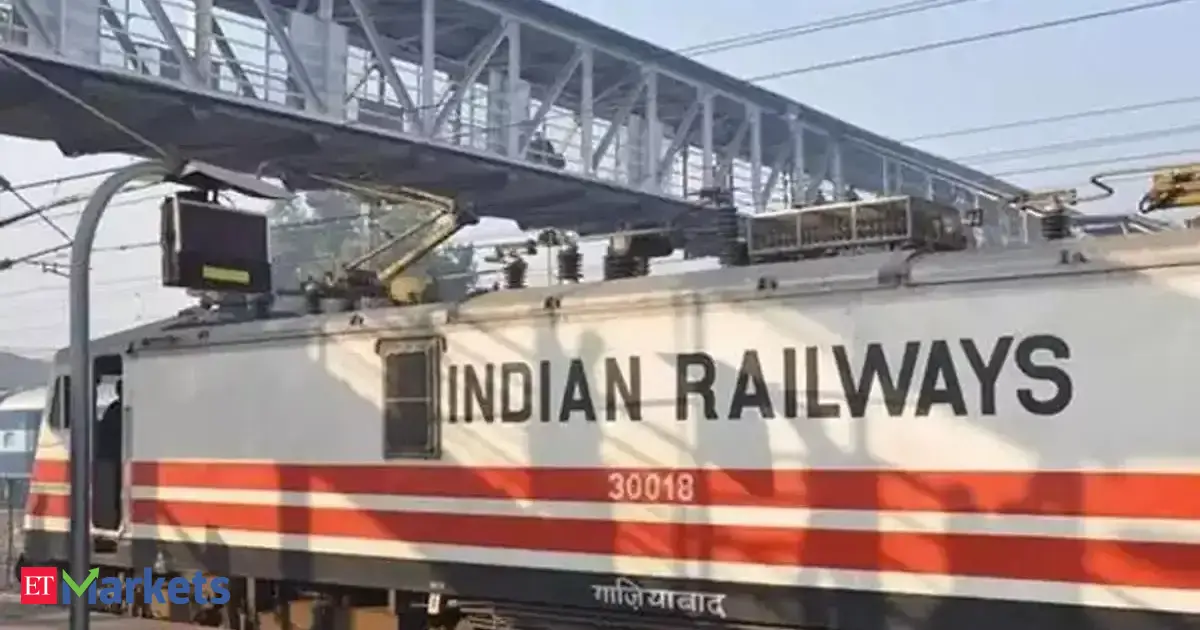
Shares of Rail Vikas Nigam Limited (RVNL) surged as much as 3.18% on Tuesday, touching an intraday high of Rs 235.50 after the company announced a fresh order win worth Rs 221.33 crore from South East Central Railway.In a regulatory filing, RVNL announced that it has secured a Letter of Acceptance (LoA) for a signalling and infrastructure upgrade project in the Bilaspur Division of South East Central Railway.The project involves the replacement of conventional Panel Interlocking systems with advanced Electronic Interlocking technology across multiple stations, including BSPR, KLPG, ABKP, MZH, HRV, PRDL, KTMA, BJRI, KJZ, MDGR, CHRM, GTK, KLTR, PLAU, and KBS. The scope of work also includes installation of indoor and outdoor signalling equipment, construction of OFC huts, development and electrification of S&T service buildings, and associated cabling works in adjoining railway sections.The contract has been awarded by South East Central Railway, a domestic entity, under the Engineering, Procurement, and Construction (EPC) model. The project is scheduled to be executed within 730 days.The total contract value stands at Rs 221.33 crore. RVNL clarified that neither the promoter group nor any group companies have any interest in the awarding entity, and the contract does not fall under related-party transactions.The latest order win further strengthens RVNL's robust order book and reinforces its position as a key player in India's railway infrastructure modernization drive. Investors cheered the development, driving the stock higher during Tuesday's trading session.Share Price Trend, Valuation & Technical OutlookDespite Tuesday's rally, RVNL's stock has been under significant selling pressure in recent months. The railway PSU has corrected nearly 25% over the past month, while investors have seen the stock decline by around 47% over the last one year, highlighting the sharp erosion in market value from its peak levels.The company currently commands a market capitalization of ₹47,586 crore. RVNL's shares have witnessed considerable volatility over the past year, with the stock hitting a 52-week high of ₹442.80 and a 52-week low of ₹227.01.From a valuation perspective, the stock trades at a Price-to-Earnings (P/E) ratio of 54.4 and a Price-to-Book (P/B) ratio of 4.85, indicating that investors continue to assign a premium valuation despite the recent correction.Also read: Wipro's Rs 15,000-crore buyback opens June 11; entitlement ratio and key details announcedOn the technical front, indicators suggest the stock may be approaching a critical zone. The 14-day Relative Strength Index (RSI) stands at 19, well below the 20-mark that is typically considered deeply oversold territory. Such readings often signal that selling may have become excessive and could pave the way for a technical rebound if buying interest returns.However, caution remains warranted. RVNL continues to exhibit a weak trend structure, with the stock currently trading below all eight of its key Simple Moving Averages (SMAs), a sign that bears still maintain control over the broader price trend.(Disclaimer: Recommendations, suggestions, views and opinions given by the experts are their own. These do not represent the views of Economic Times)
Quick commerce platform Zepto revealed in its updated draft red herring prospectus (DRHP) on Monday that the Enforcement Directorate (ED) had summoned its founders Aadit Palicha and Kaivalya Vohra in relation to the Foreign Exchange Management Act (FEMA) in April 2026.In its updated DRHP filed with SEBI for a $1 billion (Rs 9,500 crore) initial public offering, Zepto said that Palicha and Vohra were required to produce some documents with regard to foreign investments, audited balance sheets for the financial year 2020-21, shareholding patterns, details on loans and guarantees, income tax returns and bank accounts, along with other information.Complying with the summons, Vohra appeared before the ED on April 17 and April 22. Palicha appeared before the authority on April 20 and May 15 this year. "As on the date of this Updated Draft Red Herring Prospectus – I, they have provided relevant information and documents as requested by ED pursuant to the Summons, as well as follow-on information requested by the ED further to their interactions, including certain details in relation to our holding structure, the Scheme, and additional information in relation to our business such as business agreements and invoices," Zepto said.The quick commerce company said it has not yet received any further communication from ED. It assured that there will not be future inquiries or that these could escalate to investigations, legal proceedings or any possible penalties.Zepto IPOThe much-awaited IPO of Zepto will comprise a fresh issue of shares worth Rs 8,010 crore and an offer-for-sale (OFS) of nearly 11.35 crore shares by existing shareholders, according to the updated prospectus. The five-year-old company had filed its IPO papers confidentially with market regulator SEBI back in December 2025 and received the regulator's approval in May this year.Zepto is aiming to debut on stock markets in July, people familiar with the matter told The Economic Times. This would make the firm the third quick commerce player on Dalal Street, along with Blinkit parent Eternal and Instamart parent Swiggy.Also Read | Zepto files updated papers for Rs 9,500 crore IPO; aims July listingZepto earnings snapshotZepto reported a 75% year-on-year (YoY) jump in consolidated revenue for the fourth quarter of FY26 to Rs 7,498 crore, according to its updated DRHP. The Bengaluru-based company also narrowed its net loss to Rs 1,539 crore during the January-March quarter from Rs 1,832 crore a year earlier, the filing showed.Zepto processed 210 million orders during the quarter, i.e. over 2 million orders a day. It ended March 2026 with 1,139 dark stores, up from 1,029 a year earlier. Orders per store per day rose to 2,140 from 1,425 in the year-ago period, indicating higher throughput across its network.Also Read | Zepto Q4 revenue up 75% at Rs 7,498 crore, narrows loss to Rs 1,538 crore(Disclaimer: Recommendations, suggestions, views and opinions given by the experts are their own. These do not represent the views of The Economic Times)

As many as three Tata Group companies, including Tata Chemicals, Tata Elxsi and Tata Investment Corporation, have set June 10 (Wednesday) as the record date for their respective dividends cumulatively worth Rs 89.4, effectively making today the last day for investors to buy their shares to be eligible for the rewards.Under market regulator SEBI's T+1 settlement cycle, investors need to purchase a company's shares at least one trading day before the record date to ensure the shares are credited to their demat accounts in time, and they become eligible for the corporate action. This effectively makes today the last opportunity for investors to buy the shares so that they are credited to their accounts by the record date (June 10), making them eligible for the dividends.Tata Chemicals dividendTata Chemicals in May had announced a dividend of Rs 11 per share (110%) with a face value of Rs 10 each, subject to shareholders’ approval at the firm’s upcoming Annual General Meeting scheduled for June 26. The company has declared 30 dividends since June 2001, and currently has a dividend yield of more than 1.5%, according to data on Trendlyne.Tata Chemicals shares have fallen more than 3% in one week and 9% in one month. The shares have declined 24% in one year, 29% in three years and 5% in five years.Also read: Bonus issue alert! This smallcap company announced a 2:5 bonus issue. Do you own?Tata Elxsi dividendTata Elxsi announced a dividend of Rs 75 per share (750%) with a face value of Rs 10 each in April this year. This too is subject to shareholders’ approval at the company’s upcoming Annual General Meeting scheduled later this monthThe tech company has declared 27 dividends since June, 2001, and has a dividend yield of 1.76%, according to data on Trendlyne.Tata Elxsi shares have fallen over 1.5% in one week, 2% in one month and 19% in 2026 so far. The stock tumbled 34% in one year and 46% in three years, but it has gained over 13% in five years.Tata Investment Corporation dividendIn April, Tata Investment Corporation's board of directors recommended a dividend of Rs 3.40 per share (340%) with a face value of Rs 1 each. This dividend will be paid after the firm’s Annual General Meeting (AGM) scheduled for July 1.The company has declared 31 dividends since September, 2000 and has a dividend yield of 0.41%, adjusting for bonus and stock splits, according to data on Trendlyne.Tata Investment Corporation shares have fallen 4% in one week and 10% in one month. The stock declined more than 5% in one year, but gained 177% in three years and 462% in five years.Also read: Infosys, Adani Enterprises, Trent among 44 stocks going ex-date for dividends, stock splits, bonus issues this week. Do you own any?(Disclaimer: Recommendations, suggestions, views and opinions given by the experts are their own. These do not represent the views of The Economic Times)
Shares of Vodafone Idea and Bharti Airtel gained up to 4% on Tuesday after the Bombay High Court quashed the government's one-time spectrum charge (OTSC) demands, holding that all actions taken pursuant to the disputed demands would also stand annulled.Vodafone Idea shares jumped 4% to Rs 14.90, while Airtel share price gained over a percent to Rs 1,836 on the BSE. The ruling provides a combined relief of around Rs 20,000 crore to the two telecom operators. According to ET Now, Vodafone Idea has secured relief of Rs 11,000 crore, while Bharti Airtel has received relief of Rs 9,000 crore.A division bench comprising Justices Manish Pitale and Shreeram Shirsat set aside the demand notices issued by the Centre for recovery of OTSC. The court observed that the government had failed to demonstrate any legal authority empowering it to take such a decision or issue the resulting demand notices.The bench also directed that bank guarantees furnished by the telecom companies be returned. In addition, all demand notices and related orders concerning the one-time spectrum charge have been struck down. At the same time, the court clarified that the matter continues to remain pending before the Supreme Court.The bench noted that the government, while citing public interest, had acted beyond the scope of the contractual and licensing arrangements entered into with the telecom operators. It further observed that the Centre had not identified any source of power authorising the impugned decisions.The dispute traces its origins to a November 2012 Union Cabinet decision under which a one-time spectrum charge was to be levied on spectrum holdings exceeding 6.2 MHz from July 2008 onwards. Following that decision, demand notices were issued to Bharti Airtel and Vodafone Idea specifying the amounts payable towards OTSC.According to a PIB release, telecom operators holding spectrum up to 4.4 MHz (GSM) were exempted from any one-time charge. For spectrum holdings beyond 4.4 MHz (GSM), the government decided that a one-time charge would be imposed prospectively based on prices discovered in the 2012 spectrum auction.Airtel and Vodafone Idea challenged the decision before the Bombay High Court in January 2013, arguing that the government lacked the authority under the Telegraph Act to impose a one-time spectrum charge, particularly with retrospective effect. At the time, the court granted interim protection to the companies and directed that no coercive action be taken while the matter was being heard.In its judgment delivered on Monday, the High Court said the government could not claim that the spectrum's status as a scarce and finite natural resource entitled it to unilaterally depart from the terms of its contracts with telecom operators."The government obviously cannot claim statutory power to act as per its own whim, notwithstanding the terms of the contract/licence executed as per the power available under the Act," the High Court stated.Sensex, Nifty today: Catch all the LIVE stock market action here(Disclaimer: Recommendations, suggestions, views and opinions given by the experts are their own. These do not represent the views of The Economic Times)
Stock market recommendations: Kalyan Jewellers India, and Interglobe Aviation (IndiGo) are sell calls by Somil Mehta, Head of Retail Research at Mirae Asset ShareKhan for June 9, 2026. He recommends buying Fortis Healthcare.
South Korean technology stocks staged a strong rebound on Tuesday, mirroring gains on Wall Street, as investors returned to artificial intelligence-related counters following a steep three-day selloff that dragged the KOSPI down more than 15% during the period.Semiconductor heavyweights led the recovery. SK Hynix rose 8%, Samsung Electronics gained 4%, while Seoul Semiconductor surged more than 14%. At the day’s high, Kospi rose 5% to 7,848 or 364 points higher. The rebound followed a positive session in the United States, where chipmakers helped lift broader markets. The S&P 500 advanced 0.3% on Monday, while the technology-focused Nasdaq Composite climbed 0.86%, recovering some of the losses suffered during last week's sharp decline in technology stocks.Investor sentiment also received support from growing excitement around a potential new wave of high-profile AI-related listings. OpenAI recently disclosed that it had confidentially filed for an initial public offering, following a similar step by Anthropic. The development comes just days before SpaceX shares are expected to start trading.The recovery follows a brutal session for South Korean equities on Monday, when the benchmark KOSPI slumped 9% as investors abruptly pulled back from the market's AI-driven rally. The decline highlighted the extent to which the index had become reliant on a small number of semiconductor companies.The benchmark index is now roughly 12.7% below the record high it reached last week. Semiconductor giants bore the brunt of the selloff, with Samsung Electronics dropping more than 6% and SK Hynix falling over 4% on Monday.As investors rushed to book profits, concerns over market concentration became increasingly evident. Much of the KOSPI's rally had been fuelled by a handful of AI-linked stocks, leaving the broader market exposed to a shift in investor sentiment.Samsung Electronics and SK Hynix together account for nearly half of the KOSPI's total weighting and have generated around two-thirds of the benchmark's gains so far this year. Even after the recent correction, the two stocks remain higher by 138% and 196%, respectively, on a year-to-date basis.Despite the sharp pullback, the KOSPI remains the world's top-performing stock indexe in 2026. Driven largely by the surge in semiconductor shares linked to the artificial intelligence boom, the index is still up an impressive 79% this year.Demand for AI infrastructure has accelerated dramatically over the past year as technology companies around the world race to develop advanced AI models and expand computing capacity. That trend has sparked strong demand for high-bandwidth memory chips, prompting investors to pour money into South Korean chipmakers that occupy a critical position in the global AI supply chain.Sensex, Nifty today: Catch all the LIVE stock market action here(Disclaimer: Recommendations, suggestions, views and opinions given by the experts are their own. These do not represent the views of The Economic Times)
Apple has officially unveiled Siri AI, its biggest overhaul of Siri since the voice assistant first launched in 2011.Announced at WWDC 2026, Siri AI is powered by Apple Intelligence and brings a more conversational interface, personal context awareness, visual intelligence and the ability to take actions across apps. Apple says the new assistant can answer questions from the web, understand what's on your screen, surface information from messages, emails and photos, and help users write, edit and complete tasks.Also Read: Apple WWDC 2026: Siri gets an AI makeover, its biggest upgrade since 2011 debutHere's everything you need to know about Siri AI, including supported devices, how to access it and when it will be available.What is Siri AI?Siri AI is a completely rebuilt version of Siri powered by the next generation of Apple Intelligence.Unlike the old Siri, which primarily handled voice commands and basic queries, Siri AI can understand personal context, maintain conversations, answer follow-up questions and take actions across apps.For example, users can ask Siri to:Find a restaurant recommendation sent by a friend in MessagesPull up a hotel booking confirmation from an old emailFind photos from a recent tripDraft emails and messagesEdit and share photosAnswer questions about content currently displayed on screenSearch the web for up-to-date information on virtually any topicApple says Siri AI combines personal information, onscreen awareness and web knowledge to provide more useful and contextual responses.How to access Siri AIApple has introduced several new ways to access Siri AI across devices.On iPhoneUsers can access Siri AI by:Saying "Hey Siri"Pressing the side buttonSwiping down from the Dynamic Island to start a conversationUsing the new dedicated Siri appThe dedicated Siri app allows users to revisit previous conversations and continue chats across devices.On MacSiri AI is integrated directly into Spotlight.Users can search for answers, ask questions and access Siri AI from anywhere in macOS. Siri is also integrated into system context menus, allowing users to control-click files, images or text and ask questions about them.On iPadSiri AI is integrated into Spotlight and Visual Intelligence features, including screenshot-based interactions.On Apple WatchUsers can start conversations directly from their wrist, while Smart Stack can suggest continuing previous Siri conversations.What is the new Siri app?One of the biggest additions is a dedicated Siri app.The app stores conversation history using iCloud syncing, allowing users to start a conversation on one device and continue it on another.For example, users can begin chatting with Siri on a Mac and pick up the same conversation later on an iPhone, iPad, Apple Watch or Apple Vision Pro.Siri AI gets Visual IntelligenceApple has significantly expanded Visual Intelligence.On iPhone, Siri AI is integrated directly into the Camera app through a new Siri mode. Users can point the camera at objects and ask questions about what they see.The feature can:Identify objects and placesProvide information about foodOffer nutritional insightsHelp split restaurant bills using Apple CashAnswer questions about visual contentVisual Intelligence is also coming to iPad, Mac and Apple Vision Pro for the first time.Which devices support Siri AI?Apple Intelligence and Siri AI will only be available on supported hardware.Supported iPhonesiPhone 16 series and neweriPhone 15 ProiPhone 15 Pro MaxSupported iPadsiPad mini with A17 ProiPads powered by M1 chips or newerSupported MacsMac models with M1 chips or newerSupported Apple Watch modelsApple Watch Series 10 and newerApple Watch Ultra 2 and newerApple Watch SE 3 (when paired with a compatible iPhone)Notably, while iOS 27 supports iPhone 11 and newer devices, Siri AI itself requires Apple Intelligence-compatible hardware.Also Read: As Apple's WWDC conference kicks off, investors want to know if AI will save SiriWhen will Siri AI be available?Apple says Siri AI is available for developer testing starting now through the Apple Developer Program.A public beta will launch later this year as part of iOS 27, iPadOS 27, macOS 27, watchOS 27 and visionOS 27.Initially, Siri AI will be available in English, with support for additional languages rolling out later.
The continued rise in leverage among retail and high-net-worth investors through derivatives and margin trading facilities (MTFs) remains a key concern for the market, S Naren, Executive Director and CIO of ICICI Prudential AMC said at ICICI Securities India Investor Conference 2026.While there has been significant discussion around the sustainability of mutual fund inflows and SIP contributions, Naren believes leverage in the derivatives market poses a much bigger risk than any moderation in mutual fund investments.Also Read | Sensex down over 10K points from Dec peak. Should investors buy the dip, hold positions, or wait on sidelines? "The level of leverage in the derivatives market and the amount of margin trading funding taken from brokers have continued to increase. That is a concern because leverage among retail and HNI investors is rising," he said.According to Naren, even if SIP inflows witness a marginal slowdown, it is unlikely to pose a significant challenge as mutual fund investors are typically long-term participants who invest without leverage. In contrast, derivative traders often operate with borrowed money, increasing risks during periods of market volatility.He noted that margin trading facility exposure is currently at its highest-ever level, highlighting the growing appetite for leveraged market participation.Against this backdrop, Naren sees an interesting contrarian opportunity emerging in segments that have witnessed relentless foreign institutional investor (FII) selling over the last 20 months."If you look for something contrarian today, it would be stocks where FIIs have been persistent sellers over the last 20 months," he said.Among these, private sector banks stand out as one of the most attractive investment opportunities for long-term investors, according to Naren.He believes private banks could emerge as the best-performing sector over the next three years. One key reason is the significant reduction in foreign ownership resulting from sustained FII selling.Also Read | Four mutual funds restrict large inflows into gold ETFs and FoFs; Rs 25 crore cap imposed "FIIs used to have nearly 40% of their India portfolios allocated to private banks. Whenever they wanted to reduce exposure to India, private banks became the natural source of liquidity," Naren explained.As a result, FIIs have consistently sold private banking stocks over the last 20 months, creating a valuation opportunity for long-term investors willing to take a contrarian view.Beyond equities, Naren remains optimistic about India's debt markets following recent policy measures aimed at improving foreign investor participation.According to him, two critical factors that influence foreign investment in debt markets—currency stability and taxation—have both moved decisively in India's favour."In debt, there are two factors: currency and taxation. Both have turned very positive, which significantly improves India's attractiveness," he said.Naren believes these developments improve India's chances of gaining inclusion in global bond indices such as the Bloomberg Global Aggregate Bond Index and have contributed to a highly optimistic mood in the domestic debt market.He pointed out that bond yields have moved well below policy rates in several segments, particularly in three-year corporate bonds, creating attractive investment opportunities.However, Naren cautioned that the global fixed-income environment today is very different from what prevailed during the 2013 taper tantrum period.At that time, interest rates across much of the developed world were close to zero, making India's bond yields highly attractive to international investors. Today, investors can earn meaningful returns even in developed-market government bonds."US 30-year government bonds are yielding around 5%, and even Japanese government bond yields are at levels not seen for decades," he said.As a result, the yield differential between India and developed markets has narrowed significantly compared with 2013.Also Read | Gold and silver ETFs slip up to 8% amid Israel attack and crude oil spike. What should investors do? While India has strengthened its macroeconomic position considerably over the past decade, global investors now have a wider range of attractive fixed-income options available to them.Naren also highlighted the relatively small size of foreign portfolio investor exposure to Indian debt compared with equities.According to him, FPI debt investments remain only a fraction of FPI equity allocations. In contrast, foreign investors had built substantial equity positions in India during a period when domestic valuations traded at significant premiums to other emerging markets.He noted that Indian equities became exceptionally expensive after 2023 as domestic investors increasingly channelled savings into equities rather than debt."Valuations in India reached levels that were several times higher than markets like China. In such an environment, FIIs logically chose to reduce equity exposure," he said.At the same time, India has historically adopted a cautious approach towards opening its debt markets to foreign investors.Naren believes this measured approach has helped preserve financial stability while gradually increasing foreign participation in government securities.With improving debt market fundamentals, supportive policy measures, and attractive opportunities emerging in sectors overlooked by foreign investors, Naren sees both fixed income and select equity segments offering compelling opportunities for long-term investors.Commenting on the recent correction in Kospi, Naren said that it is a healthy correction but even now I don't think on market cap terms it is cheap.(Disclaimer: Recommendations, suggestions, views and opinions given by the experts are their own. These do not represent the views of The Economic Times)If you have any mutual fund queries, message on ET Mutual Funds on Facebook/Twitter. We will get it answered by our panel of experts. Do share your questions on ETMFqueries@timesinternet.in alongwith your age, risk profile, and Twitter handle.
Shares of Rajesh Exports (REL) tumbled 5% to hit the lower circuit at Rs 94.50 on Monday, marking the third consecutive session of sharp losses after market regulator Sebi accused the company of orchestrating an elaborate financial fraud involving alleged revenue inflation of Rs 15.15 lakh crore over the years, personal gold trades purportedly passed off as corporate sales, and investments of Rs 1,035 crore in gold mines.In its findings, Sebi alleged accounting irregularities, diversion of company funds into personal accounts, and a pattern of conduct aimed at misleading investors. The regulator also flagged lapses by the company's auditors and said both Rajesh Exports and its auditors failed to fully cooperate with the investigation.In its 109-page interim order dated June 3, Sebi said its investigation and forensic examination revealed prima facie evidence suggesting that nearly 97-99% of the company's reported revenue may have been inflated. The regulator described the alleged discrepancies as "egregious and unheard of".Pending further directions, Sebi has barred Rajesh Mehta from buying, selling or otherwise dealing in securities of Rajesh Exports. The regulator has also directed the company to fully cooperate with investigators and ensure true and fair disclosure of its financial statements and related-party transactions."The acts of REL constitute a deliberate device, scheme and artifice to mislead and defraud investors dealing in the shares of REL by portraying an inflated and misleading picture of its operational scale, revenue and financial health," Sebi said in its order.The case stems from a shareholder complaint received in March 2024 that raised concerns over substantial trade receivables reflected in the company's accounts. Following a preliminary review, Sebi initiated a detailed investigation covering the period from April 2020 to March 2024 and appointed BDO India Services as the forensic auditor.Besides restricting Rajesh Mehta from dealing in the company's securities, Sebi has directed Rajesh Exports to furnish all pending information sought by investigators within 30 days. The regulator has also ordered the appointment of a new forensic auditor to conduct a more comprehensive review of the company's books and transactions.Rajesh Exports has denied the allegations. In a press release issued on Thursday, the company said the revenues reported in its financial statements were accurate and contended that Sebi's conclusions were based on a misunderstanding between revenue and EBITDA figures at Swiss refiner Valcambi SA, an indirect subsidiary of the company.(Disclaimer: Recommendations, suggestions, views and opinions given by the experts are their own. These do not represent the views of The Economic Times)