Space Runs in the Family
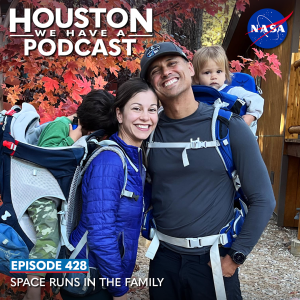
From Earth orbit to the Moon and Mars, explore the world of human spaceflight with NASA each week on the official podcast of the Johnson Space Center in Houston, Texas. Listen to in-depth conversations with the astronauts, scientists and engineers who make it possible.
On episode 428, NASA astronaut Anil Menon discusses his journey ahead of his first spaceflight to the International Space Station aboard Soyuz MS-29. This episode was recorded in March 2, 2026.
Transcript
Nilufar Ramji
Houston We Have a Podcast. Welcome to the official podcast of the NASA Johnson Space Center, Episode 428: Space Runs in the Family. I’m Nilufar Ramji, and I’ll be your host today. On this podcast, we bring in the experts, scientists, engineers, and astronauts, all to let you know what’s going on in the world of human space flight and more.
Today we’re talking to NASA astronaut Anil Menon as he prepares for his space flight to the International Space Station as a member of the Soyuz MS-29 and Expedition 74 and 75 crew. Anil was selected as a NASA astronaut in 2021 and graduated with the 23rd astronaut class in 2024. He’s an emergency medicine physician, mechanical engineer, and a colonel in the United States Space Force. Before joining NASA, he served as SpaceX’s first flight surgeon, helping launch the first Crew Dragon spacecraft to the orbiting laboratory.
Now, Anil will be on the spacecraft, this time a Soyuz. He’s been training for a mission that will take into low earth orbit for months of research operations and international collaboration. We’ll explore what it’s like to prepare for a first flight and what he’ll be doing on the International Space Station, and how his unique background shapes his approach to living and working in space.
Let’s get ready to launch.
[Music]
Anil, thank you so much for being on Houston We Have a Podcast today.
Anil Menon
It is my pleasure. I’m excited to be on here.
Nilufar Ramji
So, we’ve had a lot happening since the last couple times we’ve chatted. We had you for astronaut graduation in episode 325 and then you supported our Ask an Astronaut on our anniversary episode, which was episode 392. So, let’s take a step back and take a chance to revisit your origin story and what led you to this moment.
Anil Menon
Yeah, happy to jump into that. I’m one of those people that always wanted to fly to space, be an astronaut. I think it happened as early as six years old, maybe, or around eight. I went to the Minnesota State Science Museum. They had an IMAX there. It was one of the circular ones that they called an omni-theater, and they had a movie called The Dream is Alive. And there was people working on the space shuttle, and I thought, “Wow, that’s so cool, that’s what I want to do.” And so I really dreamed about it, and I loved science fiction, and I got into science.
But it seemed like a long shot dream, and I also found a love for medicine, and so for a while there I kind of focused on medicine and really enjoyed it, and then reconnected with that dream in college, and at some point started working towards anything that would put me and take my career towards the space direction. And so that’s how I ended up on this path.
Nilufar Ramji
That’s really exciting. You’ve done everything from you just need to fly in space now, essentially career, right? That’s where it’s left. So you mentioned Minnesota, so you grew up in Minneapolis, and I wanted to know a little bit more about what sparked your first interest in space. Can you go into that?
Anil Menon
Yeah, well, Minneapolis is a great place to spark that interest in exploration and adventure. As a kid, we spent all our time leaving Minneapolis, the city, and going up north, as we called it, to the Boundary Waters, to the lakes, and you just explore nature and the world around you. And so it wasn’t a far step to go from that to thinking like what more can I explore and what more is out there, and it really sparks that that awe of nature of earth of everything around you, and, and that’s what kind of gave me that roots and desire.
Nilufar Ramji
So, is that why you pursued degrees in neurobiology, mechanical engineering, and medicine? You got the taste of everything, and you kind of wanted to mix that up. How does that all kind of come together?
Anil Menon
Yeah, I did like doing it. My dad was a computer engineer or programmer, and he used to have like computers around, and I think I started coding basic at a young age. Interestingly, side note, now you don’t have to do that anymore. My eight year old, yeah, but I guess you learn the next thing that is that is a tool you can use. My son’s eight years old, and I got him set up on one of the coding apps, so Codex, and had him writing his own games within an hour, and it was really cool, but like-
Nilufar Ramji
In an hour?
Anil Menon
-so fast that they could play from Tic Tac Toe to like a skiing game. Uh, and it’s so easy, but I think what they’re learning at that stage is, how do you create prompts, and how do you interact with the computer, and what, what is it doing behind the scenes? So, there’s a lot of learning still there, but I think the skills are a bit different.
And I diverge from your question very fast, but to go back to it, I got interested in that type of thing, and really like doing it. But I really like medicine, because I wanted to help people, and I was looking for volunteer opportunities all the time, and working with students with asthma in college, and then did some vaccine work after college in India. And so I went to medical school, really, and got into emergency medicine, because it was such a hands-on generalist skill that you could have an immediate impact on someone’s life, but I still love that engineering and science aspect of it. And so I wanted to do both of them, and there was avenues at that point. This is around the 2009 time point where you were seeing these medicine and engineering merge and software or mechanical engineering and devices, and so there was a pathway there. And I thought, why not just tie it all together and do some space as well. Surely it’ll work out! If you build it, they will come. And so I found a way to do that by coming down here, working at NASA, and it ended up being incredibly useful.
When I went to work at SpaceX, I was doing medicine, but I needed to talk to the engineers, and I needed to be an engineer myself, and so being there with that skill set allowed me to succeed. So, it’s always hard to tell the groundwork you lay early on, how it plays out down the road.
Nilufar Ramji
Yeah, how life kind of comes together. So, astronaut was always the goal.
Anil Menon
Astronaut was always the goal…
Nilufar Ramji
Working in space.
Anil Menon
Yeah, no, I mean, I, I think I, yes, it was a goal. Yes, it was a long shot goal, I thought, and I did find things that I thrived at and loved doing. So, I did those things. I think, I think at some point I applied four times, and the last time I didn’t get it, I thought that was probably the last time I would get a shot at interviewing and everything, and it was then that I thought, well, what would I do, and I spent a lot of time like being really sure that the next steps I took were ones I really wanted to do. And it was still space medicine, it was still work at SpaceX, and have an impact on the industry, and positively impact people that way. So that you know that was a goal too, and so I think I was completely happy with that. It just so happened that they opened up a selection, I thought, well, like I don’t want to be at the end of my life and say didn’t apply to that one, so I went for it, and here I am.
Nilufar Ramji
All I keep hearing in my head right now as you talk is never give up, always try and pursue things that you want to do.
Anil Menon
Absolutely, if there’s any message from my life, that’s the one.
Nilufar Ramji
That’s it. Tell me a little bit about some of the lessons from emergency medicine or engineering or aerospace medicine that you would carry into your upcoming space flight.
Anil Menon
I think from emergency medicine it is… there’s a couple. One’s like running a team during an emergency, and the skills that work really well there. And so during a code of someone’s having a heart attack and emergency medicine, you get to practice these things, unfortunately, over and over again, and the things that come through that kind of intuitive after a while are how to be calm in that situation, how to talk to other people that you know they’re headed in the right direction, so closed loop communication, they give you feedback that they’re doing the thing, you’re sure you move on, you cross check and kind of loop back to those things. Procedural skills, really knowing them so well that in those crisis situations they, you don’t have to read about them or think about them. So those are some of the things that we enroll assignments, a big one too. If you’re working with a team and you’re tackling something fast paced and changing. And so I think those things now come naturally through emergency medicine, and I see myself applying them, and we’re doing emer scenarios on a space station sim, and hopefully there’s no emergencies in space, but if there is, I think those things come out.
Nilufar Ramji
I’m going to switch gears for a second and talk a little bit about the fact that you live with another astronaut or an astronaut candidate, your wife, Anna-
Anil Menon
Yeah!
Nilufar Ramji
-was selected as part of the newest astronaut class, and we loved getting to know her on episode 402 Tell us a little bit about how you reacted when you heard the news that there was going to be another astronaut in the house. Oh, another NASA astronaut, I should specify.
Anil Menon
Yeah, I was so excited for her. I think going into it again, it was.. I think we both viewed it as, as a long shot goal. And but she did her best and applied, and we thought we certainly weren’t banking on it. We knew that calls would come out at some point. You get kind of a feel for that, and she kept getting a call from a number that just showed up as like 1111 and-
Nilufar Ramji
Oh, spam!
Anil Menon
Yeah. So she ignored it twice, and then I noticed she like walked off, and I was sitting on the couch with the kids, and came back, and she said “I got the call!”, and she was so excited, and I think I picked her up and hugged her, and it was, it was a great moment, because we were both excited.
Nilufar Ramji
Did the kids understand? I have toddlers, so I just.. I don’t know how the kids reacted when they heard the news, or see her reaction coming.
Anil Menon
They were so excited about it, because she was working at, she was working at SpaceX at the time, and we were juggling a lot of moving parts and living in different places, and oddly enough, yesterday we were at dinner, and one of the kids said, and this is, you know, a year or more later, was like, “I’m so glad you passed the test, Mama, and we got to stay in Houston.” I think, yeah, I think they perceived it as like, as like a test, and she had to make it through the gauntlet, and if we didn’t make it, maybe we would have had to go live somewhere else or something.
Nilufar Ramji
Kids pick up on the most interesting, nuanced thing.
Anil Menon
That’s right. Yeah.
Nilufar Ramji
Your wife flew on the SpaceX Polaris Dawn mission and even performed a spacewalk. So, how did her experience influence your perspective as you prepare for your first flight?
Anil Menon
Yeah, it definitely had an impact, maybe in ways that seem inverse of what you would normally think, so I, during her mission, got to be a family member, and I think I learned what it was like to be a family member and someone who supports someone to fly to space, so I think that’s a profound influence on the way that I’m approaching this mission, is just thinking about some of the impacts to others. So as a family member it was way more stressful for me than it was, I think, for her, like talking about it afterwards. And so when I’m thinking about my launch from Kazakhstan, there’s a handful of people you can invite with you, and they’re all people who I think would be very supportive of Anna, not necessarily like there to watch my launch. And so little things like that I’m definitely taking into account to make sure to support the bigger team and people around me.
Nilufar Ramji
Do you guys, is you know, I’m picturing dinner table conversation at night, is it sharing tips and tricks, or you guys talking about how different the training is right now versus you training- her training to become an astronaut versus you training for your mission? What’s dinner table conversation like in the Menon household?
Anil Menon
Yeah, usually it revolves around whatever the kids want to talk about, so that’s either K-pop Demon Hunters or maybe Mark Rober’s science and engineering projects, yeah. But if it’s just me and her, I think we have really complimentary perspectives on things. We’re good at different things, and it’s always helped. So, she was a biomedical engineer at NASA, and I was a flight doctor, and while we were here, we kind of leveraged our different skills, and then at SpaceX we leveraged our different skills, and then here we also leverage our different skills. So one of the things we’ll talk about is kind of just just help each other with with those things. Yeah, I think I’m good at the brainstorming, looking for new avenues of things, and she’s a good people person, good at thinking about the details in certain situations. And so we’ll look at this, maybe the same project, like say training for NBL runs, and we attack it from different angles, and she’s got the mission control experience, so that that helps, and it’s good to talk to her about technical ISS things, so that does happen.
Nilufar Ramji
So there’s good like divergent conversations that are taking place, but then do you ever have a rule where you’re like, okay, tonight we’re not talking shop, we’re gonna talk about something else. How do you separate that? Because I personally, my spouse does not work at NASA, but I can’t stop talking about space flight. So, how do you, or like, forget about space flight tonight? Let’s talk about charcuterie boards.
Anil Menon
Yeah, I don’t think we- a charcuterie board sounds good, though. That’s more of a yeah, that’s more of a show and teller. But no, I think I don’t think we, I don’t think it’s a big problem to us. Well, you know, we got married 13 years ago, or we started dating 13 years ago, we got married nine years ago, but someone gave us this book, it was like his needs, her needs, and it was more or less about like find to strengthen your relationship, find avenues where you’re doing the same thing, so you don’t have to be in the same job, but like, if one person likes to play tennis, maybe figure out how to play tennis and do it together, and you just have more overlap. And I think it’s kind of cool to have, in our case, overlap at work, because we spend a lot of time.
Nilufar Ramji
Overlap in space.
Anil Menon
Yes.
Nilufar Ramji
I like it. So, speaking of space, there might be a time that we come to where both of you are flying on your own separate missions at the same time. Have you ever talked about what life would be like in that, in that environment?
Anil Menon
Yeah, the kid, the kids would have to be older. I think the only context we talk about that, because I assume during an ISS mission they would try to avoid it, just because we’d have to figure out the nanny coverage would get really complicated, but the context that we dream about it would be I often told her, like, if there was an opportunity to fly to Mars I’d totally love to do it. There’s some serious challenges with that. It’s three years, potentially kind of risky.
Nilufar Ramji
Comm delays, all the things.
Anil Menon
And so then we thought, well, well, we’ll have to both do it together, and or take the kids.
Nilufar Ramji
The Menons are going to Mars. That would be a great podcast episode.
Anil Menon
Yeah, get us both going.
Nilufar Ramji
I love that.
Anil Menon
So far, though, my son has told us that he was not interested in flying in space, because the question before that was, like, how much oxygen can you store? He doesn’t think we can store enough oxygen to make him comfortable with flying to space.
Nilufar Ramji
I hear that. I like watching y’all up from down, down here in my little knot hole.
Anil Menon
Yeah.
Nilufar Ramji
So you’re preparing for- Let’s go back to today, and you’re preparing for your first flight. Let’s get a little preview of a day in the life. Tell me about how your training flow is going right now, and what your day looks like on on a given basis.
Anil Menon
Yeah. So this week is a good example. I have our crew members from the Soyuz mission in town, Piotr Dubrov and Anna Kakina, and they’re here, and since they’re here, we’re doing joint training together. And so some of that training is on these ISS mock-ups and not NASA Johnson Space Center, which realistic life-size mock-ups, and what they’ll do is give us an emergency, like a fire, and we’ll respond to it like we’ve trained together. Sometimes that means leaving this simulated space station. So tomorrow we have one such training, we’ll meet up a half hour beforehand, pregame together, tackle the training, and then after the training, we’ll do a debrief and talk about it.
Some of the other, this week, other things going on is just like a good random cross section. I’ll be part of an experiment called Cardio Breath, where I put on a suit that measures heart rate and breathing, and then do some exercise, and that data is collected and stored. And then in some other training I’ll prep for the robotic arm and how to do an IROSA install EVA. There’s some potential that we add an extra solar panel to the space station during the time that I’m up there, and so I’m prepping for that, and so I’ll use the simulated robotic arm, and so- and I’ll take some Russian classes in there as well, and so that’s kind of how it looks like big picture.
Nilufar Ramji
Never a dull moment,
Anil Menon
Never a dull moment. Yes, from- it’s one training to another training to simulation practice.
Nilufar Ramji
Okay. Well, tell me a little bit about the most challenging part about this mission-specific training. You know, we have crews that are going up on Dragon, crews going up on Soyuz. So, tell me a little bit about how Soyuz is different.
Anil Menon
Yeah, the Soyuz is it’s a very effective vehicle, I’d say one of the- you know, comes to mind as a challenging training that I had in it, and it’s just a very specific story. We did what was called water survival training, and so training of the Soyuz were to land in the ocean or a lake or a river. And it has done that before, and that’s why they have this training, a long time ago. And so we land in that water, and we’re in space suits, and it’s so small, it’s like a phone booth, almost, with three people in it. And so you got to get out of your suit, which requires two other people to help you, and kind of crunch up into the corner, it’s like a game of Twister, maybe in a phone booth.
Nilufar Ramji
Wow. Twister in a phone booth!
Anil Menon
Yes, and then once you get that off, you have to put on five layers of cold clothing, because when you get into the water, you need to stay warm. And so to stay warm you need all these layers of clothing, and the last one is a rubber suit, basically, and so your temperature slowly climbs because you’re exerting energy to do this, and then you’re heating up, and so my core body temperature at the very end, after took two hours to do this simple thing, which was take off the suit and put on some clothes, and then get into the water, and in two hours my core body temperature went to 102 and I had lost four pounds of body weight in just water alone because of sweating off. So that’s a challenging-
Nilufar Ramji
My face right now. If people could see… I’m in shock!
Anil Menon
Yeah, it was crazy. It was also fun, but, but yeah.
Nilufar Ramji
I want to do a podcast episode on this now. Wow, so you’re putting on five layers of clothes on top of basically a wetsuit.
Anil Menon
Oh, the wet suits on the outside, so it’s a.. it’s over the five layers. You’re wearing five layers, and the five layers are like you would see someone wearing this in Alaska in the snowy winter, like they’re extreme, like a onesie, snow pants, jumper, flannel, underwear…
Nilufar Ramji
I would love to see images of this-
Anil Menon
Sweater…
Nilufar Ramji
-but I don’t wish you landing in water for this reason. I hope you have a nominal launch and return. Okay, and then let’s talk about mental health.
Anil Menon
Yeah!
Nilufar Ramji
How are you preparing to be away from family friends for all these months?
Anil Menon
Yeah, we have the great luxury of working with clinical psychologists and psychiatrists. So, we have behavioral health and performance- the person assigned to me, Anna Morgenthaler, and she practice clinically out there, and I’ve taken it pretty seriously. So they’re available, and I think it’s super important. And so, I’ve reached out, and we set up a monthly cadence. She meets up with Anna and I, and we kind of talk about what’s what do we value, how do we maintain those values, how do we keep a connection? How do we interact with the kids? And I think between Anna and I, we get to practice it a little when I’m in Russia and training, and she’s here. Time zones, and then found different tools to do that, thanks to BHP, from just asynchronous texting and journaling to actual apps out there that kind of ask you questions and are interesting to figuring out how to call and communicate better.
The kids is a challenging one. Yeah, I’ve found like you can’t just Facetime with them, they’ll Facetime with you for about five seconds.
Anil Menon
And then you’ll see the ceiling or their forehead?
Nilufar Ramji
Exactly. So with them I’m trying my hand at projects. I’ve actually wound up reading Harry Potter, saving it, and then my wife will play it to my daughter at night, and then with my son…
Nilufar Ramji
That’s so sweet!
Anil Menon
Yeah, we’re trying to make it through, maybe we’ll make it through by the time I get back from space. My son, we’re building a robot with Legos and motors and things like that.
Nilufar Ramji
That’s really fun. I went on a work trip recently, and my son called me from the monitor and kept asking for my name, and then he said, “Please, just don’t go away ever again.” So I’m like, I don’t know how you prepare the kids, because I, we try and explain, you know, “I’m going away for a long work trip. I’ll be gone for this many days. When it’s Friday again, you’ll see me.” How do you do that for an eight to nine month mission?
Anil Menon
I’ll tell you when I get back!
Nilufar Ramji
Another podcast episode.
Anil Menon
We’re racking them up now! Yeah, that’s right.
Nilufar Ramji
And speaking of, you know, just being away, I’m sure you’ve talked to other crews, other astronauts that have been away and been in space. So, can you tell us a little bit of any advice you’ve received? Any interesting tips to being on station?
Anil Menon
Yeah, there- I talk to just about anyone who’s willing to talk to me and give me advice and tips on station, and there is a tremendous amount of oral history or ideas and processes generated by folks that they are willing to pass on. And it goes from everything from photographs, so you know, if you’ve a lot of people have seen Don Pettit’s photos. But there’s a lot of great people, Xena recently came back, but she has equally phenomenal photos, and Matt Dominic was on, you know, Twitter a lot with, with, or X, I should say, with a lot of his, his photos, so you know, I’ve asked every one of those people, like, how to practice, and they’ve given me suggestions, and things like that. From that to just like daily routine, exercise, some of the challenges they face, some of navigating some of the crew challenges. Or for this EVA, potentially coming up with IROSA. I’ve scheduled a time to chat with Woody Hoburg, who did one like this like not too long ago. So I think just finding everything that I see coming or want to do, and then reach out, and thankfully everyone’s just so willing to share their time and experience.
Nilufar Ramji
That’s awesome. Let’s look ahead to the summer when you get to the space station. What will your mission involve once you arrive?
Anil Menon
Yeah, so I launch on July 14. When we get up there, we will- things always change, so the, you know, that’s one thing about space flight I’ve learned over the past 10 years. So, assuming things kind of stay on track, what I’m looking forward to is a lot of the science that’s going to go up there from some of the experiments I’ve personally gotten interested in set up.
I’m interested in space medicine, and so I signed up for a lumbar puncture experiment, where they’ve done this – they did this before I launched to set a baseline, and then they’ll do it after I land to see if it’s gone up a bit. There’s some thought that because the fluids are moving to your head that you’re increasing the pressure, and that pressure is causing something like what we see in mountains, called acute mountain sickness. And so that can cause things from vision impacts to headaches and different things. And so glad I can participate in that.
There’ll be the robotic operations, like capturing two vehicles. And spacewalks, the solar arrays that I’m talking about, and so arrays are getting more interesting as we’re like, as a world, and all the companies talking about putting data centers in space, and those things need power, and so it’s not too different from space station. We’ll put on some extra solar rays up there and get some extra power. So those are some of the interesting things that are going on.
Nilufar Ramji
Do you know anything more about some of the other science experiments that you’ll be doing that are coming up potentially with you and other cargo missions.
Anil Menon
One of the cool things that I know was already up there was a means of just growing plants up there, and Chris Williams noticed this, and he had some downtime, and so one of the things they let us do on space station is some of our own experiments in science or those suggested by people, and so it’s kind of a grab bag of cool science, and people have used it in different ways. So I’m super excited to carry on a little bit of what Chris has started, and so that’d be being able to grow some things in space. And especially with some of the ideas of doing more exploration, having a moon base, those are things we’re gonna have to figure out, is how to have sustainable-
Nilufar Ramji
Do you have a green thumb?
Anil Menon
-food source. I do, actually. Yeah, I grew up with, like, a garden, my mom loved it, and so. Right now I’m just starting up a vegetable garden again at my house after being gone in the winter of Houston, destroying what I had. But we going to reboot it just in time to launch to space and try to automate it a little bit.
Nilufar Ramji
Your family will enjoy it while you’re up in orbit. This tastes great. Thank you so much. Awesome. And then a looking down at our home planet, what view are you most excited to see?
Anil Menon
I am super excited to see, probably the aurora. So the photos look beautiful when you’ve seen them from space, and, but my wife and I had this plan to go see them together with the kids, and she launched a space, and then she got some pretty awesome views of the aurora from space, so I was a little bit jealous, so I encourage, so we were like, oh, we need to do something to celebrate you having this, and we went to Finland to Lapland, and we all saw the aurora together, which ends up being, you have to get really lucky for that to happen, even on the ground, you know, time because you could just get bad weather. But we got a good couple days of weather and saw it, but it’ll be really cool to see it from space again. If I get another opportunity.
Nilufar Ramji
Can’t wait to see those pictures. And so, what’s one personal item you’re taking up with you?
Anil Menon
One personal item that I’m going to take up with me is a little stuffy of a black German Shepherd that we had, she passed away sadly, but she was really important in our lives to my kids and wife and I, and so I’m excited to honor her and bring, bring that up there. I’m gonna talk to you this week the our crew members, and see if we can add that on to one of the zero g indicators, so that’ll be cool.
Nilufar Ramji
That’s really cool. Love, love that. When you come home, have you thought about the first meal you want to have, or a first ritual you want to do when you come back? Like…
Anil Menon
Yeah, we always make spaghetti on Sundays, largely because my son will eat it through the week, and I’ll send it to school with him. So, I think that has kind of become our thing. We have a couple traditions, that’s one of them. Waffles is another one that I will make. I actually make them in Russia when I’m doing training, I bring all the ingredients there that don’t have, so I have them. So, one of those two things is what I would do.
Nilufar Ramji
Waffles or Sunday spaghetti,
Anil Menon
Or gosh, I don’t know, like maybe sushi too. I’m pretty sure you can’t get that in space.
Nilufar Ramji
Well, we’ve heard about some crew members that have made their own version of sushi in space. Oh man, they’re very creative
Anil Menon
Oh man, I need to listen to that podcast or find that person and then talk to them. Obviously, I haven’t covered all my bases.
Nilufar Ramji
Awesome. Well, we wish you a wonderful flight, and we can’t wait to be following, following along in the mission. But thank you so much for being here.
Anil Menon
Thanks for talking to me, and thanks for listening.
Nilufar Ramji
Thanks for sticking around. I hope you learned something new today.
You can check out the latest from around the agency at nasa.gov and you can find more about our astronaut corps at nasa.gov/astronauts.
Our full collection of episodes and all of the other wonderful NASA podcasts can be found at nasa.gov/podcasts.
On social media we are on the NASA Johnson Space Center pages of Facebook, X, and Instagram. If you have any questions for us or suggestions for future episodes, email us at nasa-houstonpodcast@mail.nasa.gov.
This interview was recorded on March 2, 2026.
Our producer is Dane Turner. Audio engineers are Will Flato and Daniel Tohill, and our social media is managed by Leah Cheshier and Kelcie Howren. Houston We Have a Podcast was created and is supervised by Gary Jordan. Special thanks to the astronaut schedulers and John Streeter for helping us plan and set up these interviews. And of course, thanks again to NASA astronaut Anil Menon for taking the time to come on the show.
Give us a rating and feedback on whatever platform you’re listening to us on, and tell us what you think of the podcast.
We’ll be back next week.
3… 2… 1… This is an official NASA podcast.
이 뉴스, 어떠셨어요?
탭 한 번으로 반응 · 로그인 불필요