KP approaches FCC, challenges years-long extension of 7th NFC Award after Fata merger
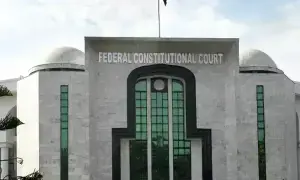
ISLAMABAD: With a staggering Rs964 billion claim on the Federal Consolidated Fund (FCF), the Khyber Pakhtunkhwa government has filed a constitutional petition in the Federal Constitutional Court (FCC), challenging the continued extension of the 7th National Finance Commission (NFC) Award despite the merger of the erstwhile Federally Administered Tribal Areas into the province in 2018, it emerged on Monday.
In its petition, the KP government asked the FCC to determine whether its share under the NFC should be increased to reflect its expanded size and responsibilities following the 25th Constitutional Amendment, which merged the Federally Administered Tribal Areas (Fata) into the province.
The petition argues that the merger significantly increased the province’s population, territorial expanse and development needs, warranting a corresponding increase in its share under the NFC Award.
It argued that despite this major constitutional change, its share under the NFC formula had not been updated to account for the merged districts.
“This violates the global principle of ‘finance follows functions’, resulting in an under-allocation of resources for the additional population of the merged districts in Khyber Pakhtunkhwa,” the petition said.
If the court decides in the province’s favour, it may, to a large extent, nullify criticism of the 18th Amendment. This petition goes beyond a provincial fiscal claim and asks the FCC to clarify whether, in light of Article 160, the federal government’s claim of a constitutional logjam is justified or amounts to a refusal to fulfil its constitutional role.
In its petition, KP maintained that the existing NFC formula agreed under the 7th NFC Award did not need to be reopened or altered for the purpose of its present claim. Rather, it argued that the formula should be applied to the province as it constitutionally existed after the 25th Amendment.
“The formula continues to be used, but the values inserted into that formula still reflect the pre-merger Khyber Pakhtunkhwa. This means that the population, geography and development indicators of the merged districts have not been included in the share of Khyber Pakhtunkhwa, despite the fact that they became part of the Province by constitutional amendment on May 31, 2018,” the petition said.
Through its petition, the KP government also sought a revision of its share in the horizontal distribution of the Provincial Divisible Pool with effect from the date of the merger.
“The province’s position is that this was not a discretionary grant, nor a political concession, but the automatic constitutional consequence of the 25th Amendment when read with the existing NFC formula.”
The petition also sought a declaration that KP’s entitlement was payable from the date the 25th Amendment came into force in 2018. The province argued that this did not involve retrospectivity.
Its case is that the relevant constitutional facts changed on May 31, 2018, and that the law already in force on that date — namely, the formula under the 2010 Order — automatically applied to those changed facts. The province has therefore sought recognition of an accrued constitutional entitlement, not the retrospective application of a later legal instrument.
Based on the calculation placed before the court, KP’s claim arising from the failure to update its horizontal share stands at Rs964 billion. The province maintains that this amount has instead flowed to other provinces because the post-merger constitutional reality was not reflected in the NFC distribution framework.
The petition argued that article 160 envisaged a “periodic, deliberative and evidence-based framework” for fiscal federalism through the NFC to be constituted at intervals not exceeding five years so that the distribution of national resources remains responsive to changing constitutional, demographic, fiscal and developmental realities.
“The continued reliance on arrangements rooted in the 7th NFC Award, without adequately reflecting the merger of FATA with Khyber Pakhtunkhwa, has created an unresolved constitutional and fiscal anomaly,” it said, adding that the case did not seek to undermine the federation or reduce the NFC to an adversarial contest among provinces.
On the contrary, the province approached the court precisely because the constitutional mechanism requires clarity, discipline and implementation in good faith. Fiscal federalism can function only if the agreed constitutional formula is applied to the federating units as they exist under the Constitution.
The province asked the court to determine important questions concerning the scope and spirit of Article 160, including:
Whether the Constitution requires equitable distribution of financial resources among the federation and provinces.
Whether such equitable distribution is a fundamental feature of Pakistan’s federal scheme.
Whether each NFC is constitutionally required to independently review and recommend the distribution of revenues, and
Whether an award founded on the recommendations of an earlier Commission can continue indefinitely without fresh recommendations by a subsequently constituted Commission.
The petition also sought clarity on the relationship between Article 160(4) and Article 160(6) of the Constitution, including whether the president’s power to amend an NFC Order is a power coupled with a duty when constitutional, demographic or fiscal circumstances materially change.
KP also asked the court to declare whether provincial shares are automatically adjusted by operation of law when the fundamental basis on which they were calculated changes, and whether the federal government and the president are constitutionally bound to give effect to such a change through an Amendment and Modification Order under Article 160(6). It argued that, in numerous instances since 1973, Article 160(6) had been invoked to give effect to changing demographic and other realities by updating the existing formula and revising provincial shares.
It also asked the FCC to declare that the president is constitutionally bound to promulgate, and that the federal government is constitutionally bound to advise the president to promulgate, an Amendment and Modification Order under Article 160(6) of the Constitution to give effect to the province’s revised share.
The province’s separate and independent position regarding the national commitment to the development and integration of the merged districts — including the commitment of Rs100 billion per annum from 2018, or an allocation equivalent to 3pc of the Divisible Pool — remains distinct.
“By seeking clarity on the duties of the federation, the president and the NFC framework, the petition aimed to restore constitutional discipline, fairness and good-faith implementation to one of the central mechanisms of Pakistan’s federal compact,” said Muzammil Aslam, advisor to the chief minister on finance, during a press conference.
This was in addition to the Rs100 billion-per-annum national commitment made in 2018 for the development and merger of the merged districts, which has not been fully implemented, he added. “As such, KP’s total claims go beyond Rs1.6 trillion.”
“At stake is not only Pakhtunkhwa’s share, but also the integrity of Article 160 itself: whether the NFC remains a periodic, evidence-based and responsive constitutional mechanism, or whether national resource distribution can continue on outdated assumptions after a province’s population, territory and responsibilities have been transformed,” Aslam said. ...
이 뉴스, 어떠셨어요?
탭 한 번으로 반응 · 로그인 불필요