The regional geo-strategic landscape in West Asia post the Iran war
이 뉴스, 어떠셨어요?
한 번의 탭으로 반응을 남겨요 · 로그인 불필요
Following months of all-out conflict that began on February 28, 2026, the United States and Iran have transitioned to a de-escalation phase. On June 17, Presidents Donald Trump and Masoud Pezeshkian signed a 14-point memorandum of understanding to end the war, establishing a 60-day ceasefire extension to negotiate the final terms of a deal. Pakistan served as a key mediator throughout the process.
Following the signing and despite a rocky start, the first round of high-level talks concluded in Bürgenstock, Switzerland on Monday, June 22, with the two sides agreeing on a roadmap towards a final deal within 60 days, along with communication lines to keep the Strait of Hormuz open and a deconfliction cell to end fighting in Lebanon.
Mediators Pakistan and Qatar described the outcome as reflecting encouraging progress, with technical talks set to continue through the rest of the week at Bürgenstock. Most observers and experts describe the overall process as a considerable (if still fragile) breakthrough in one of the most complicated conflict-resolution efforts of the 21st century.
However, the emergence of new logic gates of power redistribution, developing within both the shorter (regional) curve and the greater (global) curve, and entangled geopolitically, geo-strategically, and geo-economically across multiple dimensions, risks going unnoticed and undissected. This omission stems from the rupture between the conceptual and strategic power of the parties directly and indirectly involved in the conflict.
High stakes
War in the Middle East, as a recurring experiment in the geopolitical laboratory, is aimed at providing a new code for the exercise of power at the regional and global levels. No power centre has the capability to act unilaterally to gain a dominant position, nor can any axis of forces undermine the superposition of a single power (that is, the coexistence of several potential power configurations at once). This balance lends the system a degree of power fluidity and a reasonable rate of uncertainty descent before it settles into a new quantum geopolitical state, a newly fixed distribution of power. Under this code of geopolitical behaviour, any party can find itself in a state of wave-particle duality: at once a defined actor and an unresolved set of possibilities.
This means that, as a complex system born at the peak of inter-civilisational collision, this regional conflict cannot be resolved in a linear way, as a parade of endless wars and confrontation on a global scale. The war carries a high risk of returning, and ringing the bells ever harder, until an equilibrium of conceptual and strategic power is reached and wave-particle duality is accepted as the new lens of geostrategic and geopolitical analysis.
The post-Iran-war reality depicts an empowered Iran, a deeply dissatisfied Israel, and a United States caught in the twilight of the never-to-be-won war against Iran. That last point highlights a hidden layer of US concern: if the demonstrative attack on Iran has become a victory narrative for the Western world and domestic audiences, yet a failure in the eyes of allies and partners in the Middle East and South Asia, then what guarantees that the so-called bullet-proof peace deal will serve its purpose and preserve global leadership across the strategic interests it targets in West Asia?
The geo-strategic landscape of West Asia in the aftermath of the Iran war takes in the whole set of multidirectional states of the South Caucasus (Armenia, Georgia, and Azerbaijan), as well as Turkey, that make up a highly strategic intersection of Eastern Europe and Western Asia.
These states are hard to play as a united orchestra, yet eager to move towards non-traditional strategic alignment under British and US participation and conducting. The same holds for the Gulf states (Bahrain, Kuwait, Oman, Qatar, Saudi Arabia, and the United Arab Emirates [UAE]), which have learned the limits of US power to protect them during the war with Iran. All of these states, strongly disillusioned by the war in the Middle East, are to be re-classified and re-calibrated as the new geopolitical order emerges.
The opposing axes
At the very core of this constellation lie two opposing axes of geopolitical tension. The first is Israel, left alone with its anger and the prospect of retaliation across the whole Middle East, in a new round of strikes on its enemies that the Israeli warmongers anticipate after the legislative elections of October 2026. The second is Iran, which has managed to sustain and win the most important resource of this multi-layered conflict (time) and, with it, the ace of increasing geopolitical magnitude.
As a result of the war, each warring state is freed from the third party’s (US) dominance and is ready to unleash its arsenal of hybrid forces, allowing it to start building the new geo-strategic components of a future war. Two rival frameworks take shape.
The first is Israel’s axis of six states, or hexagon of alliances — a strategic framework designed to position Israel at the centre of a defence, economic, and geopolitical coalition countering both the Iranian-led Shia axis and an emerging Sunni axis. The second is Iran’s renewed axis of resistance (Lebanese Hezbollah, the Houthis, Palestinian factions, proxy forces in Syria), together with a stronger alignment with Pakistan, China, and Russia that represents a formidable Eurasian strategic bloc.
The Israel-India nexus
It is important to mention here that India is a crucial anchor partner for Israel, balancing economic, security, and technological ties within the hexagon of alliances. This may give India the false perception that it can regain enhanced strength to plot a new conflict with Pakistan, a country whose strikingly successful geopolitical and diplomatic leverage as a key mediator in the US-Iran peace process has, by contrast, left India with a sense of devastating failure and abandonment.
Nevertheless, there is strong indication that two frustrated countries, Israel and India, will strive to set up new provocations and to encircle new partners within an emerging hexagon of alliances (including Cyprus, which can flip into a useful trigger for a dramatic transformation of the geo-strategic scene and drag the South Caucasus into war). The aim is to contain their key rivals, Pakistan and Iran, who are set to gain more power and influence both in the Middle East and across West Asia and the Global South in general.
Pakistan, as a torch-bearer of peace, can play a significant role in nurturing a new strategic mindset, one capable of providing a sustainable deterrent diplomacy in the Middle East. By building a diversity of strategic alignments that secure the bonds and connectivity between South Asia, West Asia, and Central Asia, it can turn into a reliable geopolitical hub, one able to close the gaping gap between the conceptual and strategic power of the warring parties in the emerging multipolar order.
By carrying out a tremendous diplomatic breakthrough and giving way to the Islamabad Memorandum of Understanding, Pakistan has become the first and only country in the world, in the post-Iran-war era, able to distribute that power fluidity and reasonable rate of uncertainty descent before fostering a new quantum geopolitical state of things at the regional and global level.
Through its decisive alignment with this new code of geopolitical behaviour, Pakistan can foster the strategic concept of wave-particle duality and demonstrate a leading position in designing a more peaceful posture for the emerging multipolar world.
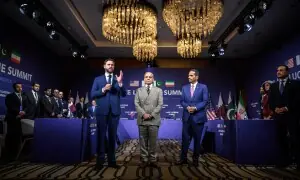
Header image: US Vice President JD Vance (L) speaks next to Prime Minister Shehbaz Sharif (C) and Qatar’s Prime Minister and Minister for Foreign Affairs Sheikh Mohammed bin Abdulrahman bin Jassim Al-Thani at the start of a quadrilateral meeting between the United States, Iran, Pakistan and Qatar at the Burgenstock luxury hotel complex overlooking Lake Lucerne, Switzerland, on June 21, 2026, as part of high-level talks aimed at advancing a deal to end the Middle East conflict. — AFP ...