Does Soccer Still Explain the World?
Forget the $10,000 tickets and the travel bans and the fact that the last three
World Cups have been hosted in Russia, Qatar, and Donald Trump’s United
States—FIFA President Gianni Infantino is a romantic. “Football, or
soccer, as it is called here, is the world’s universal language,” Infantino said in March. “It’s about hope. It’s about
joy. It’s about happiness. It’s about coming together. It’s about uniting the
world.”
Fair enough. Of course, Infantino said those
words at a meeting of Trump’s preposterous Board of Peace—an organization ostensibly created to solve world problems but
whose funds are totally controlled by its chairman (none other than Trump himself). He said them
shortly before announcing that his organization would spend $50 million
building soccer stadiums in war-torn Gaza and concluded his remarks by donning
a Trump-branded red “USA” hat.
The World Cup has always been political—its
second iteration, after all, was hosted in Benito Mussolini’s Italy. But has it
ever been more political? Infantino invented the farcical “FIFA Peace Prize” for Trump to assuage his
bruised ego after he lost the real one and has joined the president at his
inauguration, on state visits overseas, and repeatedly in the Oval Office. He
has dutifully gone along with the president’s
xenophobic travel bans and said nothing as players and officials have been detained and questioned for hours, invasively searched, and even banned from entering the nation entirely.
Trump may have declared victory in the Iran war shortly after
the beginning of the tournament—though the war would soon restart—but the Iranian
national team wasn’t allowed to stay in the country overnight—it was not even
allowed to linger for an hour after playing a game in punishing heat. Football
may be about hope and joy and happiness, but it’s also very much about money and
power.
Russian oligarchs are out—sorry, Roman Abramovich—but American ones are
in. Half of the 20 English Premier League teams are owned by residents of the 2026 World Cup’s
principal host nation, many of them hedge funds. Saudi Arabia, Qatar, and the
United Arab Emirates all have their own teams in England and France; Qatar’s Paris
Saint-Germain has won the European Champions League two years in a row. The
rise of petrostate ownership means that oil prices and Middle East conflict can
dictate transfer policy and often raise uncomfortable questions. What does it
mean when Newcastle United—owned by Saudi Arabia—participates in a Pride event? And what does
it tell us when a state-owned Saudi club massively overpays for a Brazilian striker
from a Russian team owned by oil and gas giant Gazprom? And then, of course, there’s the 2026 World
Cup, which is occurring in the shadow of Donald Trump’s second, decidedly more
sinister and xenophobic administration. Want to understand the world? Soccer is
not a bad place to look.
That, at least ostensibly, is the premise of
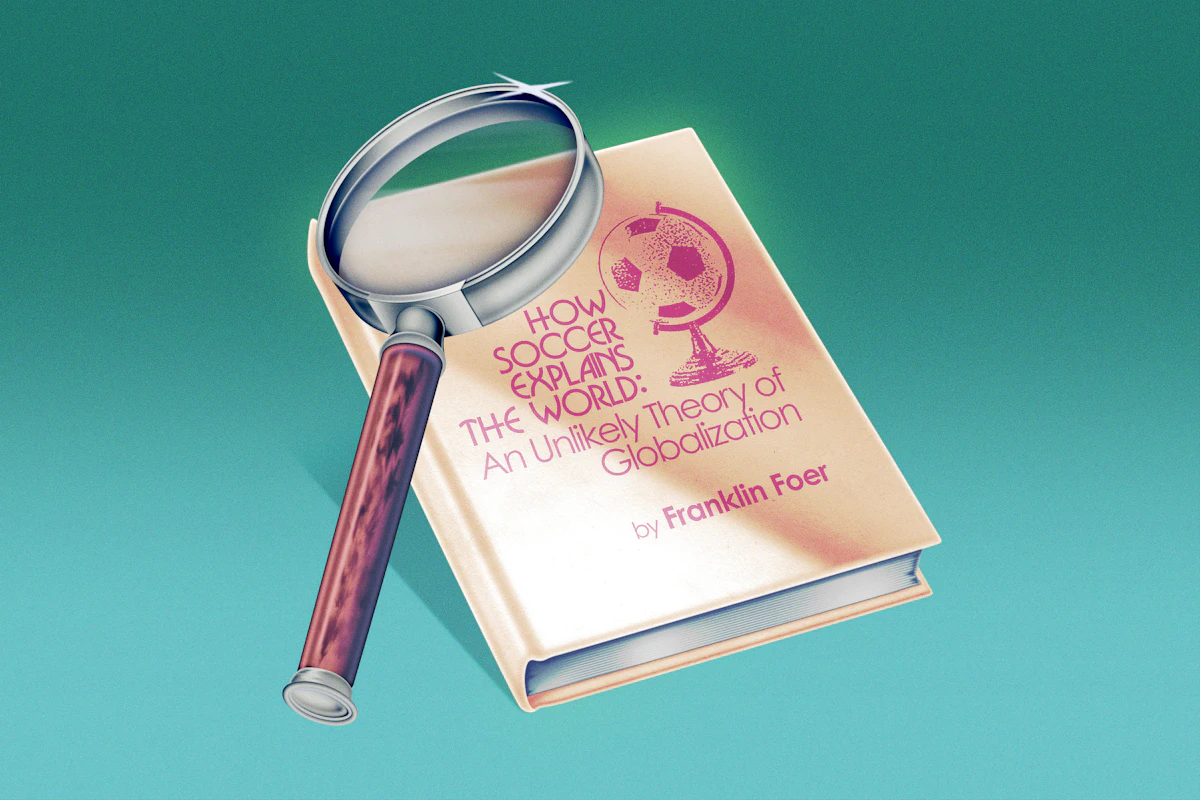
Franklin Foer’s 2004 book, How Soccer Explains the World, which was
rereleased with a new foreword earlier this year in advance of the 2026 World
Cup. It’s a bold and—for an American, at least—presumptuous title, but it’s
also a somewhat misleading one. How Soccer Explains the World is really
three books in one. It’s a travelogue, in which Foer, a former editor of this magazine, travels the globe to glean
lessons from fans and social scientists. It’s a plea to Americans like
himself—educated, erudite, indoor kids—to open themselves up to the magic of
the world’s game. And it is an attempt to stitch together his reporting into a
larger theory about how soccer points to the future of a globalized,
interconnected world; he notes the persistence of tribalism, nationalism, and
antisemitism and the fact that globalization not only creates its own winners
or losers but provides its own incentive structure for corruption. There are
parts of this book that very much anticipate a world—and a sport—dominated by
oligarchy and greed.
Yet travel books—and books about sports, for
that matter—are inevitably time capsules and Foer’s feels like one somewhat out
of step with his own time, let alone ours. Published a year after the start of
the Iraq War, Foer’s rosy look at globalization was already passé as the U.S.
took on a more aggressive, hostile, and xenophobic posture to the rest of the
world. It arrived at a pivotal moment in the rise of U.S. soccer but also one
for the economic trends he describes. It was still possible to be hopeful, albeit
faintly so, about globalization in 2004. In 2026, it looks considerably
different.
The fact that the world’s most popular sport
is a reflection of the world is neither a novel nor a particularly interesting
observation on its own. Writers have been drawing political conclusions from
the sport for roughly as long as it has been played, and the canon of soccer
literature is full of works solely or partially devoted to its politics,
notably Ryszard Kapuściński’s 1969 The Soccer War, about a conflict
between El Salvador and Honduras that started during a World Cup qualifier, and
Eduardo Galeano’s 1995 Soccer in Sun and Shadow, a poetic history of the
sport.
Soccer in Sun and Shadow and How Soccer Explains the World are mainstays on bookstore
tables during every World Cup and are both regularly featured on the dozens of
lists of books to read before every tournament. They’re strange bedfellows.
Indeed, How Soccer Explains the World feels in many ways like a response
to Galeano’s book, which decried the commercialization and homogeneity of the
post–Cold War, globalized, unipolar world.
“These are days of obligatory uniformity, in
soccer and everything else,” writes Eduardo Galeano in his canonical 1995 book. “Never has the world been so unequal in the
opportunities it offers and so equalizing in the habits it imposes: in this end
of century, whoever does not die of hunger dies of boredom.” The 1994 World
Cup, the first held in the United States, looms over Galeano’s book.
Today—especially in contrast to the 2026 tournament—that tournament is largely
remembered as a big, beautiful party in which the U.S., newly dominant on the
global stage, welcomed the world.
For Galeano, soccer is a perfect entry point
to a world dominated by U.S. hegemony—culturally, politically, and
economically—as well as a vehicle for elucidating Latin American politics. If
some of his commentary is inevitably dated, his larger argument—that the sport
is inherently polluted by money—still resonates. “The history of soccer is a
sad voyage from beauty to duty,” he writes. “When the sport became an industry,
the beauty that blossoms from the joy of play got torn out by its very roots.”
How Soccer Explains the World accepts the premise—which in 2004 was hard to deny—that globalization
was the world’s dominant force and that soccer “seemed much further along in
the process of globalization than any other economy on the planet.” Foer,
moreover, writes that he expected to find “the power of mega-brands like the
clubs Manchester United and Real Madrid, backed by Nike and Adidas … prying
fans away from their old allegiances” but instead found something different:
Fans, players, and clubs were retaining aspects of their local or national
cultures while, in many ways, using globalization to benefit in their own way.
Soccer, particularly European soccer, in the
early 2000s was in the midst of a remarkable cross-cultural transformation, in
which top European clubs
routinely featured players from across Europe, South America, and Africa and in
which playing styles that once characterized local teams or nationalities were jumping borders and fusing with each other. The era of Dutch “total football” was over. A new era had arrived,
in which a Portuguese coach managed a North London team owned by a Russian
oligarch with a striker from Cote D’Ivoire. Foer was clearly intoxicated by
this transformation. (It was hard not to be—this was the era when I fell in
love with the sport in upstate New York, where I attended a high school where I
was, to the best of my knowledge, one of two fans of European soccer.) As the
book progresses, it increasingly becomes an argument for globalization as
soccer or soccer as globalization: that by heralding a more interconnected
world, the sport can bring freedom, prosperity, and even peace where it is
currently absent.
Foer, to his credit, is a reporter—and a very
good one—more than a polemicist. And more than two decades on, the most
interesting thing about How Soccer Explains the World is the tension
between being a travelogue and an airport book. In the former category, it is
almost uniformly excellent: Foer is curious and incisive, with a great eye for
character and detail. As an outsider—an American and a Jew—he is able to move
seamlessly between fans of Glasgow’s Catholic team—Celtic—and its Protestant
outfit—Rangers—in a chapter about the persistence of sectarian rivalry in a
society that had otherwise “eradicated discrimination in the public sphere.”
That chapter mixes first-person reporting
among ultras—or hooligans—that is funny and self-effacing with social science
and reporting to advance a fairly sophisticated argument. The bitterness and
fractiousness of the rivalry, he argues, stem in part from globalization. In
Scotland, public discrimination was swept away when American and Japanese firms
took over Glasgow’s steel mills and shipyards after the oil shocks of 1973,
opening up economic opportunity where it had previously been closed off based
on religious affiliation. But in Scotland, discrimination had been ended by
globalization rather than a “civil rights movement to sweep away
anti-Catholicism,” which meant that it was never truly reckoned with—which is
one reason why the Old Firm, even in 2026, is one of Europe’s (and arguably the
world’s) most intense rivalries.
Of course, Foer also acknowledges the biggest
reason for the persistence of that animosity, which is its significance in
Northern Ireland, where tensions between Catholics and Protestants are not a
pageant to be played out in the soccer field. It’s an acknowledgment he doesn’t
shy away from, but it’s one that troubles any rosy picture of globalization.
Discrimination and sectarian tension have shown themselves to easily adapt
to—and in many cases transcend—economic forces.
Many of Foer’s dispatches resist pat
conclusions even as Foer puts his thumb on the scale. In a section on the
persistent corruption in Brazilian soccer, he argues that nepotism and cronyism
have made the sport’s insular culture immune to the benefits of globalization.
One on Iranian women’s quest for equality—the movement against the state’s ban
on women attending soccer games was then in full force—suggests that a growing
hunger for Western brands, thanks in part to pitch-side advertisements during
the World Cup, would lead to a movement for economic and cultural liberalism.
Chapters on the Balkan Wars and the rise of Silvio Berlusconi point to the
sport’s ability to be co-opted by nationalism, oligarchy, and corruption. These
forces are everywhere you look in How Soccer Explains the World and, in
most cases, they show astonishing malleability in a globalized world.
There is, especially in retrospect, also a
sense that a devotion to a flawed thesis means Foer is missing the bigger
story. The era he is writing about was already over in 2004. In the wake of the
September 11 attacks, the world was calcifying; the good feelings that—at least
in the United States—followed the end of the Cold War were long gone. Roman
Abramovich, the Russian oligarch, bought Chelsea in 2003, heralding a new era
of financialization and oligarchic control. There was, even then, a strong sense
that globalization was being used by oligarchs and elites to entrench their
control, that liberalism, free trade, and cultural exchange were not antidotes
to tribalism or sectarianism, and that the rosy post–Cold War projections of
rising tides lifting all boats were already wrong. Soccer certainly explains
that world too.
The relative absence of the September 11
attacks is one of the more curious features of How Soccer Explains the World.
It isn’t until the very end of the book, in a chapter on the American culture
wars, that Foer directly acknowledges the fact that the world was rapidly being
remade. After 9/11, he writes “two camps in American politics have clearly
emerged.” One, he writes, embraces globalization and global institutions like
the U.N. and the WTO, opposes the Iraq War, and shares “cultural values with
Europeans.” They “consider themselves to be part of a cosmopolitan culture that
transcends national boundaries.” The other believes in “American
exceptionalism,” believes the U.S. should ignore international bodies, and
believes Europeans are “degraded.” To these people, soccer “isn’t exactly
pernicious but it’s a symbol of the U.S. junking its tradition to ‘get with the
rest of the world’s program.’”
The division largely tracks, though Foer—like
many American white soccer fans—largely handwaves or ignores the sizable number
of Latino fans of the sport who were present in the U.S. at the time. At least as far as white American culture in the early 2000s was concerned, soccer was
European. Some people thought it was good, and some thought it was bad.
How Soccer Explains the World wasn’t just aimed at the former. It was aimed at the millions of liberal,
cosmopolitan Americans who weren’t interested in the sport. Its publication
should be considered a seminal moment in the off-field history of the rise of
U.S. soccer. How Soccer Explains the World was the first popular,
serious book about the sport written for Americans by an American.
What does soccer tell us now? Our world, to be
fair, is rather different now than it was in 2004. How Soccer Explains the
World was published before Obama, the global financial collapse, and the
rise of global autocracy. It was published before Messi, the (near) fall of
FIFA, and the emergence of petrostate and hedge fund ownership. Foer
acknowledges as much in an excellent new preface included in an edition
published for the 2026 World Cup, as he discusses Saudi Arabia’s purchase of
Newcastle United, private equity goon Todd Boehly’s purchase of Chelsea, and
the explosion of transfer fees.
When Foer acknowledges that he failed to
anticipate “the day when foreign governments would own English soccer clubs,”
it’s hard to blame him. Even if one criticized Abramovich’s purchase of Chelsea
in 2003, as many did, few saw the explosion of transfer fees and the expansion
of state-owned clubs coming. Soccer was ahead of the curve, then as now, but
it’s a lousy crystal ball.
Foer insists, somewhat defensively, that
soccer tells us the same thing it did in 2004. “The thesis of the book,” he
writes, “was that the global game of soccer was a leading indicator of the
future. Soccer was globalization—and capitalism—in its most advanced form. And
the nature of both phenomena is their ever-accelerating velocity, their endless
churn.”
If that is self-serving, it’s also fair.
That’s more or less what the reporting in How Soccer Explains the World
shows, even if the conclusions Foer draws are often different. Sniffing at the
term “late-stage capitalism”—to be fair, it’s not a favorite of mine, either—Foer
argues soccer tells a different story. “The logic of business can always be
pushed further, into realms once thought off-limits.”
Is that a thesis for an airport book?
Certainly not in 2004. But it’s hard to argue with now. ...
이 뉴스, 어떠셨어요?
탭 한 번으로 반응 · 로그인 불필요