NASA Space Telescope Maps Magnetic Fields of ‘Lighthouse’ Pulsar
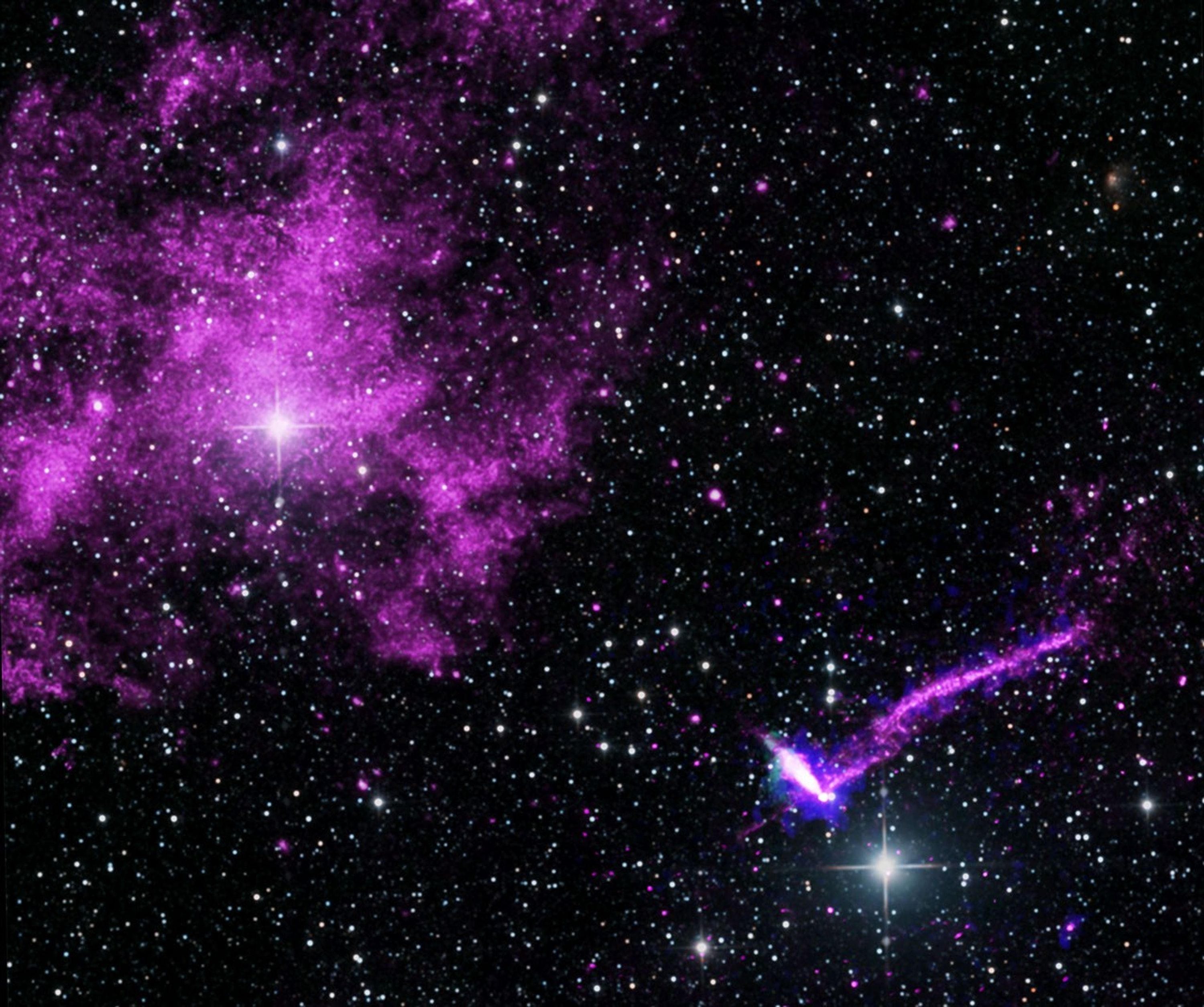
For the first time, scientists have used NASA’s IXPE (Imaging X-ray Polarimetry Explorer) to directly measure the magnetic fields of PSR J1101−6101, a pulsar located within what is often referred to as the Lighthouse Nebula. The results provide new insight into the structure of some of the most extreme objects in the cosmos, as NASA continues to explore the secrets of how the universe works. A paper describing the results published Thursday in the Astrophysical Journal.
Fast facts
- A pulsar is a type of neutron star with a strong magnetic field that spins incredibly fast. The pulsar at the center of the Lighthouse Nebula is rotating 16 times per second.
- Neutron stars are the leftover cores of massive stars, formed at the end of their life cycles, that possess more mass than the Sun. They are condensed down to the size of a city, making them natural laboratories for studying extreme physics.
- Polarization is a property of light that describes the direction of its electric field vibrations. The polarization degree is a measurement of how aligned those vibrations are with each other.
In June 2025, IXPE spent nearly 18 days focused on the Lighthouse Nebula.
Astronomers studied two narrow X-ray offshoots extending from the pulsar to better understand how electrons at nearly the speed of light interact with this energetic system. The longer offshoot is known as the “filament,” and the shorter one is the “trail.”
When high-energy particles from the pulsar collide with the gas of interstellar space, they form a bow shock, like the bow wave formed at the front of a speeding boat. Most particles become trapped behind this bow shock, forming the turbulent trail behind the pulsar.
Researchers have suspected since 2008 that the highest-energy particles escape through this bow shock into interstellar space, flowing along the galaxy’s magnetic field lines to create the nebula’s long, thin filament.
“We wanted to test that theory,” said Jack Dinsmore, undergraduate student at Stanford University, who led the study. “The ‘smoking gun’ would come by measuring the polarization of the light, which indicates the magnetic field direction. If the magnetic field points along the filament, that confirms that the filament’s particles are flowing along the field.”
One challenge with these measurements is that the Lighthouse Nebula is relatively faint. To address this, IXPE scientists developed advanced analysis methods that use every bit of data, avoiding simplifying steps that could limit information. With these new tools and the new observations of the Lighthouse, the science team successfully measured the filament’s polarization. These techniques also gave a polarization measurement of the trail, and the pulsar’s emission signal.
Their analysis confirmed with more than 99% confidence that the magnetic field does indeed align with the particles’ flow.
While the parallel direction confirms models for the particle’s motion, the polarization degree was high enough to raise new questions.
“Many of the models for filaments assume strong magnetic turbulence,” said Roger Romani, a Stanford University professor who co-authored this paper. “The high polarization degree we measured indicates lower turbulence than such models require.”
The IXPE observations also showed that the magnetic field responsible for X-ray emission had to be parallel to the trail. However, the authors collected radio frequency observations showing a magnetic field pointing almost exactly perpendicular.
“The striking divergence in magnetic field orientations observed between radio and X-ray wavelengths provides compelling evidence for the highly structured nature of these objects,” said Niccolò Bucciantini of the Italian National Institute for Astrophysics and co-author of the study. “This marks the first clear indication that particles of different energies occupy distinct regions within the system, hinting at the presence of multiple, and potentially very different, acceleration mechanisms at work.”
More about IXPE
The IXPE mission, which continues to provide unprecedented data enabling groundbreaking discoveries about celestial objects across the universe, is a joint NASA and Italian Space Agency mission with partners and science collaborators in 12 countries. It is led by NASA’s Marshall Space Flight Center in Huntsville, Alabama, and BAE Systems, Inc. manages spacecraft operations together with the University of Colorado’s Laboratory for Atmospheric and Space Physics in Boulder.
Learn more about IXPE’s ongoing mission here:
이 뉴스, 어떠셨어요?
한 번의 탭으로 반응을 남겨요 · 로그인 불필요