Khamenei funeral signals Iran's defiance and new regional order
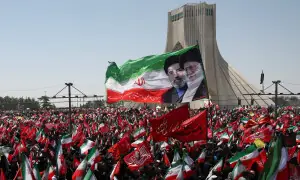
The funeral of late Iranian Supreme Leader Ayatollah Ali Khamenei was more than a national farewell. The sea of mourners in Tehran sent a message to the United States and Israel that their attempt to break the country had failed.
Rather than looking weakened by the war that began with US and Israeli strikes on February 28, Iran presented itself as defiant, unified and determined to shape what comes next.
That defiance and ability to survive now underpins Iran’s negotiating strategy, regional officials, diplomats and analysts say, depicting the funeral as the moment Tehran sought to transform endurance into leverage.
Not ‘a diamond for a lollipop’
The war, they say, has underlined Iran’s leverage over the Strait of Hormuz and enabled it to demand that any deal on its nuclear programme begins with recognition that its control over the vital oil chokepoint is a reality that must be accepted.
A 60-day ceasefire was intended by Washington to revive diplomacy on stopping Iran developing a nuclear arsenal, but has instead opened a different contest.
In this contest, Iran’s location rather than its uranium is its most powerful asset, with Tehran seeking to convert wartime gains into permanent strategic advantage by securing acceptance of its dominant position around the strait.
Although huge revenues might be earned from charging fees for vessels using the strait, Tehran sees Hormuz less as an economic asset than as a source of political legitimacy, said Alex Vatanka of the US-based Middle East Institute.
“The symbolic part is more important for the Iranians than revenues,” Vatanka said.
“They want some kind of symbolic acceptance that the Strait is Iran’s. It’s about accepting Iran as the sovereign power over the Strait.”
Citing a Persian saying, Vatanka added: “Why give away a diamond for a lollipop?” According to Tehran’s calculation, Hormuz is the diamond. Sanctions relief and frozen assets are the lollipop.
A graphic shared by Iran’s newly created Persian Gulf Strait Authority on May 20, 2026 shows what the authority said will be a “controlled maritime zone” at the Strait of Hormuz, in this screenshot from social media. — Persian Gulf Strait Authority via X/Handout via Reuters
‘Divine blessing’
Iran’s leadership has echoed this position.
“The Strait of Hormuz is our greatest power tool; we must properly protect this divine blessing,” said Parliament Speaker Mohammad Bagher Ghalibaf, adding that Iran would “under no circumstances relinquish its rights” there.
Iran is deliberately slowing negotiations to lock in what it sees as the war’s dividends before returning to the nuclear question, regional sources and diplomats say.
For Tehran — which denies seeking a nuclear bomb — uranium can wait, but consolidating its position on Hormuz cannot, said Alan Eyre, a former US diplomat with expertise on Iran.
“Iran is perfectly happy to play for time and just drag negotiations out,” Eyre believed. “It wants control of Hormuz and is holding talks to institutionalise that control.”
That could mean embedding its influence through transit arrangements, coordination mechanisms or charges for services along the corridor that carries a fifth of global oil and liquefied natural gas (LNG) supplies, while Gulf states wait to see whether Washington can or is able to reverse the new reality.
Tehran believes US President Donald Trump — constrained by domestic politics and wary of another confrontation before midterm elections to Congress in November — is under more pressure to secure a deal than Iran is to make concessions.
“The Iranians know that President Trump wants to get out; he wants to move on,” Eyre said. “They know they can squeeze him because time is on their side.”
Aaron David Miller, a former US Middle East negotiator, said Washington’s military campaign had failed to break Iran’s leverage, leaving US diplomacy with a flawed ceasefire whose implementation has become a battleground in its own right.
Tehran, he said, has little reason to engage seriously on its nuclear programme until it is confident the new reality around Hormuz has been accepted and meaningful progress made on unlocking billions of dollars in frozen assets held abroad.
“The 60-day clock was always a fantasy,” Miller said.
“The Iranians are not going to move to the nuclear file until they’re relatively confident they’ve achieved this new status quo. They want to make sure that Trump understands, and that the world understands, that there’s no going back to February 27.”
Iran won’t give up Hormuz
Iran is exploiting what Miller calls the key reality of the post-war order — neither US military power nor the threat of a US naval blockade fundamentally altered its position on the Strait of Hormuz.
“They’re not going to give it up,” he said.
Ebtesam Al-Ketbi, president of the Emirates Policy Centre, said that, by halting the war without resolving the issues that caused it, Washington may have helped elevate Hormuz from being a pressure point into a lasting source of leverage for Tehran.
Gulf officials worry that by showing Iran’s ability to shape events around the strait, the war created an advantage that Tehran will be reluctant to surrender even in exchange for sanctions relief or progress on the nuclear file.
“They are twisting the arms of the Americans and everybody,” Al Ketbi said. “Now that they have found this Hormuz treasure, they will not leave it.”
Washington is likely to have to accept the reopening of the strait under conditions largely dictated by Tehran, analysts say.
“No one’s going to win, but Iran will lose less than the United States will,” Eyre said.
Mourners wave a flag bearing the portraits of Iran’s current Supreme Leader Mojtaba Khamenei (L) and his his slain father Ali Khamenei during a funeral procession for Iran’s slain supreme leader Ali Khamenei and members of his family in Tehran on July 6, 2026. — AFP ...
이 뉴스, 어떠셨어요?
한 번의 탭으로 반응을 남겨요 · 로그인 불필요