NASA’s Perseverance Rover Reads Record of Ancient Mars Impacts
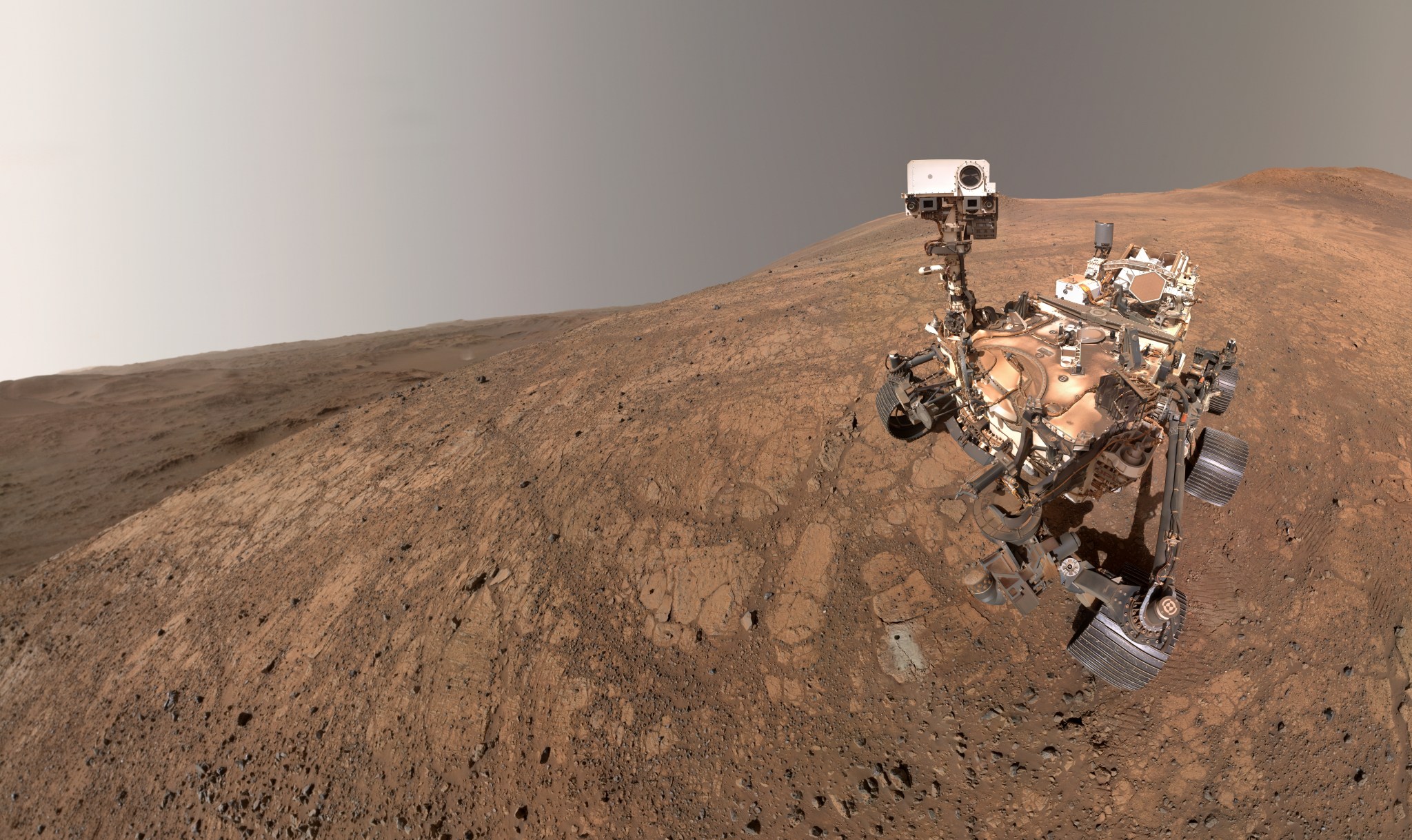
NASA’s Perseverance Mars rover has uncovered evidence that a 245-foot-thick (75-meter-thick) stack of ancient rock on the rim of Jezero Crater was built by repeated asteroid impacts. Referred to as the “Broom Point member” by the rover’s science team, this sequence of layered bedrock is likely more than 3.9 billion years old, making it among the oldest terrain ever examined by a Mars rover.
Released Wednesday in the Journal of Geophysical Research: Planets, the findings offer a window into one of the most tumultuous chapters in the history of the solar system.
“Since leaving Jezero, Perseverance has been exploring a brand-new frontier, both geographically and geologically — a chapter of Martian time that predates the crater itself,” said Ken Farley, Perseverance deputy project scientist at Caltech in Pasadena, California. “On Earth, our earliest geologic history has been fundamentally broken up, deformed, and erased by plate tectonics. Because Mars lacks plate tectonics to recycle its crust, this ancient record remains intact, giving us a rare glimpse into a geological time period that doesn’t exist on our own planet.”
Reading between layers
After ascending the western rim of Jezero Crater in late 2024, Perseverance began examining surrounding locations with its science instruments. Their data at Broom Point revealed six distinct rock types, including breccias — rocks composed of angular fragments — alternating with layers of fine-grained, pulverized rock dust. Rock fragments within the breccias are pocked with gas-bubble cavities, indicating they were once molten.
The presence of tiny, dark, glassy beads within the layers offered an important clue about how these rocks formed. While volcanoes can produce similar glassy droplets, they rarely occur in such high abundance, pointing to asteroid impacts, instead, as the primary architect. In fact, the largest beads rival those flung out by the dinosaur-killing Chicxulub asteroid’s impact on Earth.
The repetition of these distinct rock types multiple times throughout this thick sequence of rock indicates that high-energy impact events happened again and again across this region of early Mars.
“The different rock layers are a record of variable-sized impacts occurring at different distances from where this rock sequence was accumulating,” said Alex Jones, a Ph.D. student in planetary geology at Imperial College London and lead author of the paper. “Some large impacts took place very far away, some small impacts nearby. Their debris all ended up landing here, constructing this thick section of rock.”
How these layers formed may suggest an interaction with water or ice. Several of the layers look like they may have been formed by fast, ground-hugging debris flows. On Earth, these powerful, fluidlike surges can occur when molten rock hits water or ice that instantly flashes into steam.
Cosmic one-two punch
Some of Broom Point’s layers tilt at angles exceeding 80 degrees — nearly vertical — which is far too steep to be caused by the impact that created Jezero Crater.
Instead, scientists suspect a cosmic “one-two punch” shaped this landscape long ago. First, a colossal asteroid impact created the 1,200-mile-wide (1,900-kilometer-wide) Isidis Basin, one of the largest impact basins on Mars, upending and tilting the once-flat rock layers. Later, a second asteroid likely struck, forming Jezero Crater, which measures 28 miles (45 kilometers) across. This second impact fractured and uplifted the already-tilted rocks into the dramatic formations the rover sees today.
To pin down exactly when these events took place, the Perseverance team collected two core samples, dubbed “Bell Island” and “Main River.” If a future mission were to return them to Earth, laboratory dating could determine when and how often impacts were occurring on early Mars — and, by extension, the infant Earth, whose own early impact record has been erased by billions of years of plate tectonics.
“During this violent era, it wasn’t rain or snow falling from the sky, but an almost constant barrage of molten rock droplets and pulverized dust kicked up by asteroid impacts,” said Jones. “If we can pin down the ages of these layers, it would be like reading a cosmic weather report from 4 billion years ago.”
More about Perseverance
NASA’s Jet Propulsion Laboratory in Southern California, which is managed for the agency by Caltech, built and manages operations of the Perseverance rover on behalf of the agency’s Science Mission Directorate in Washington, as part of NASA’s Mars Exploration Program portfolio. Arizona State University leads the operations of the rover’s Mastcam-Z instrument, working in collaboration with Malin Space Science Systems in San Diego, on the design, fabrication, testing, and operation of the cameras. SuperCam is led by Los Alamos National Laboratory in New Mexico, where the instrument’s Body Unit was developed. The rover’s SHERLOC (Scanning Habitable Environments with Raman and Luminescence for Organics and Chemicals) instrument was built at NASA JPL, and its WATSON (Wide Angle Topographic Sensor for Operations and eNgineering) camera was built at Malin Space Science Systems.
For more information on NASA’s Perseverance, visit:
https://science.nasa.gov/mission/mars-2020-perseverance
News Media Contacts
DC Agle
Jet Propulsion Laboratory, Pasadena, Calif.
818-393-9011
agle@jpl.nasa.gov
Karen Fox / Alana Johnson
NASA Headquarters, Washington
240-285-5155 / 202-672-4780
karen.c.fox@nasa.gov / alana.r.johnson@nasa.gov
2026-045
이 뉴스, 어떠셨어요?
탭 한 번으로 반응 · 로그인 불필요