과학
기타
Advanced Health Research on Station Using Augmented, Virtual Reality Tools
NASA Science
조회 0
Public Domain
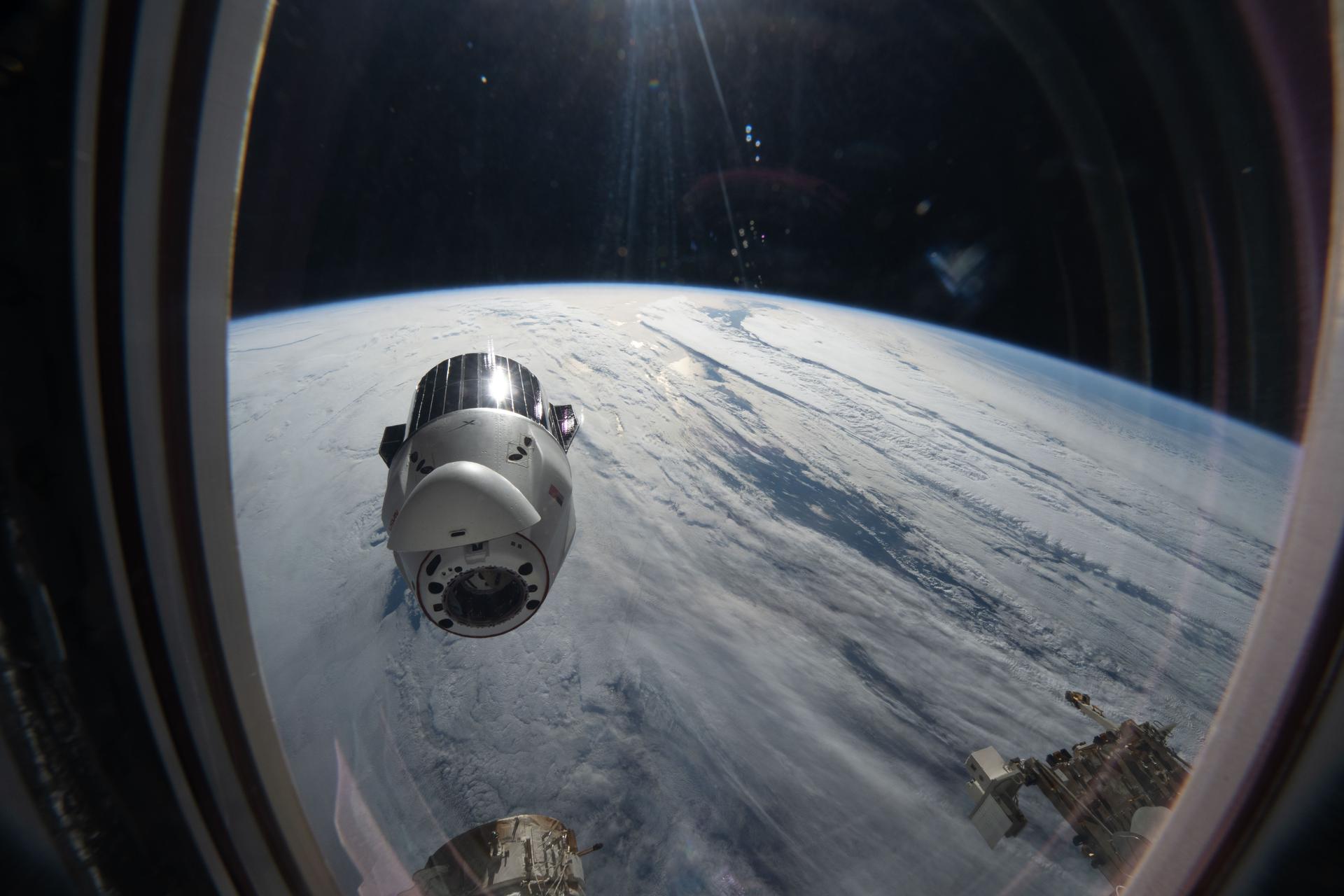
이 매체는 공공·자유 라이선스로 본문을 직접 표시합니다.A SpaceX Dragon cargo spacecraft backs away from the International Space Station moments after undocking from the Harmony module’s forward port on June 16, 2026. Dragon, packed with completed science experiments and cargo for retrieval and analysis on Earth, parachuted to a splashdown off the coast of southern California the following day.
Credit: NASA/Jessica Meir
Biomedical tests using augmented and virtual reality tools to advance space health dominated the research schedule aboard the International Space Station on Wednesday. The Expedition 74 crew is also turning its attention to a spacewalk at the end of the month following the departure of a U.S. cargo spacecraft.
NASA flight engineers Jessica Meir and Jack Hathaway began their shift in the Columbus laboratory module conducting vein scans with guidance from doctors on the ground. The duo took turns scanning each other with the EchoFinder-2 ultrasound device that collects health data using augmented reality and artificial intelligence tools. The medical hardware provided by ESA (European Space Agency) provides a screen using augmented reality to guide the operator’s probe motion and artificial intelligence software to detect the subject’s organs. The lightweight, easy-to-use gear may enable independent crew health monitoring on spacecraft travelling to the Moon, Mars, and beyond.
Afterward, Hathaway moved to the Harmony module and loaded bacteria samples into a portable DNA sequencer to read their genetic code. Scientists will use the knowledge to understand bacterial resistance to antibiotics in the space environment potentially affecting an astronaut’s ability to fight an infection.
Meir assisted NASA flight engineer Chris Williams who wore virtual reality goggles for a test measuring his ability to detect balance, movement, orientation in microgravity. The goggles recorded Williams’s eye movements as he responded to visual stimuli generated by computer software operated by Meir. The vestibular system investigation, just one part of the CIPHER suite of 14 human research experiments, is studying how astronauts neurologically adapt to weightlessness to improve crew training and safety.
ESA flight engineer Sophie Adenot helped her crewmates with the digital health science on Wednesday first setting up the EchoFinder-2 hardware, connecting it to a computer tablet, and installing a camera to track the vein study. Next, Adenot configured Harmony’s maintenance work area and retrieved a mini-cold bag to house the bacteria samples for the antibiotics study. Finally, she took pictures of the Moon to observe Earth’s light reflecting off the lunar surface.
All four astronauts gathered together at the end of their shift for a conference call with spacewalk experts on the ground. The quartet and the engineers discussed the tools and procedures necessary to repair a wrist joint on the Canadarm2 robotic arm during a spacewalk planned for June 30. NASA will soon announce the spacewalkers and provide a live televised briefing for more details before the end of the month.
Roscosmos flight engineer Andrey Fedyaev conducted another neurological study while wearing a virtual reality headset and responded to computerized stimuli as electrodes measured brain activity and tracked eye movement, testing his sense of direction, movement, and position. Station commander Sergey Kud-Sverchkov and flight engineer Sergei Mikaev, both from Roscosmos, started their shift in the Nauka science module checking the operation of components supporting the Elektron oxygen generator. Kud-Sverchkov then tested communications gear inside the Soyuz MS-28 crew spacecraft. Mikaev took a computer quiz documenting his mental state before terminating a 24-hour heart and blood pressure monitoring session.
A SpaceX Dragon cargo spacecraft is back on Earth following its undocking from the orbital outpost on Tuesday and splashdown in the Pacific Ocean at 5:11 a.m. PDT/8:11 a.m. EDT on Wednesday. Dragon returned sensitive scientific samples from investigations studying stem cell manufacturing, cartilage tissue printing, and more to treat a range of conditions from blood diseases, cancers, and cartilage injuries.
Learn more about station activities by following the space station blog, @space_stationon X, as well as the ISS Facebook and ISS Instagram accounts.
Get the latest from NASA delivered every week. Subscribe here.
The post Advanced Health Research on Station Using Augmented, Virtual Reality Tools appeared first on NASA Science.
이 뉴스, 독자들은 어떻게 느꼈나요?
첫 반응을 남겨보세요로그인하면 감정 반응에 참여할 수 있어요.
관련 뉴스
관련 뉴스 제보는 로그인 후 가능합니다.