Euclid View of Milky Way Heart Previews Core Survey by NASA’s Roman
이 뉴스, 어떠셨어요?
한 번의 탭으로 반응을 남겨요 · 로그인 불필요
6 Min Read
Euclid View of Milky Way Heart Previews Core Survey by NASA’s Roman
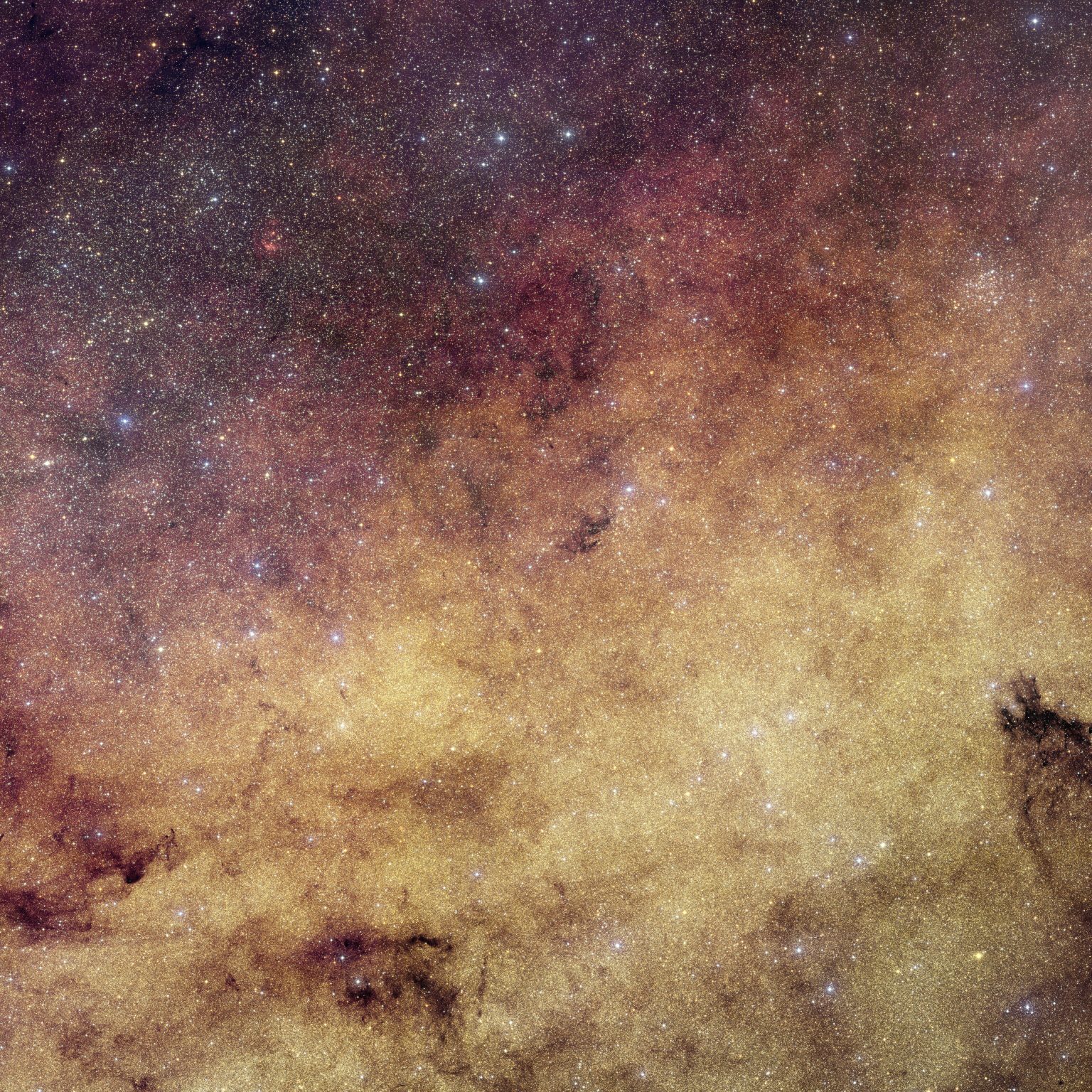
This image by ESA’s (European Space Agency) Euclid (with color added using ground-based images) provides an earlier snapshot of a region of our galaxy that NASA’s Nancy Grace Roman Space Telescope will repeatedly observe during the upcoming years.
Credits:
ESA/Euclid/Euclid Consortium/NASA, CFHT, image processing by J.-C. Cuillandre and E. Bertin (CEA Paris-Saclay)
This image by ESA’s (European Space Agency) Euclid (with color added using ground-based images) provides an earlier snapshot of a region of our galaxy that NASA’s Nancy Grace Roman Space Telescope will repeatedly observe during the upcoming years. Euclid spent one day taking a series of nine individual images near the heart of the Milky Way. Its wider image has resolution similar to Roman’s, though it’s also shallower and lacks some of the colors Roman will see. At the right of the frame, Euclid looks through the dense foreground of the Milky Way’s galactic plane, where thick molecular clouds appear as dark patches that obscure parts of the galactic bulge beyond. Toward the left, the view rises to higher galactic latitudes: the yellow glow of the bulge becomes clearer, with fewer and more isolated foreground clouds interrupting the starlight.
ESA/Euclid/Euclid Consortium/NASA, CFHT, image processing by J.-C. Cuillandre and E. Bertin (CEA Paris-Saclay)
A new look at the heart of our Milky Way galaxy by Euclid, an ESA (European Space Agency) mission with NASA contributions, overlaps with a region scientists will observe with NASA’s Nancy Grace Roman Space Telescope, launching later this summer. This sneak peek gives astronomers a major jumpstart on a core Roman survey, helping scientists learn more than they could from either telescope alone.
“This is the only time Euclid has paused its normal sky survey, which is mainly geared toward cosmology,” said Jason Rhodes, a senior research scientist at NASA’s Jet Propulsion Laboratory in Southern California. Rhodes serves as both the U.S. Euclid science lead and the NASA JPL Roman project scientist. “This takes a lot of work and planning, so it really has to be something with a high impact for science. Adding Euclid’s snapshot to Roman’s future survey will help us map our galaxy better and identify hard-to-find cosmic treasures like isolated black holes and rogue planets more easily.”
Euclid took one day out from its six-year prime mission to preview the area of sky that will be targeted by Roman’s Galactic Bulge Time-Domain Survey, which will provide one of the deepest views ever into the center of our galaxy. Though Euclid’s one-time observation is shallower and lacks some of the color detail Roman will see, it has similar resolution and covers a larger region — about 5 square degrees, or the sky area covered by about 25 full moons — since Roman’s survey area hadn’t yet been determined when the observation took place in March 2025.
This artist’s concept outlines the areas of the galactic core covered by Euclid (orange) and the future survey area of the Roman telescope (green). The Euclid observations more than cover Roman’s planned survey area because the Roman coverage wasn’t yet set in stone when Euclid imaged the area. The only exception is the portion right in the galactic center since Euclid’s visible light observations can’t pierce the thick dust in this region like Roman’s infrared vision will.
NASA’s Goddard Space Flight Center
Over the course of its five-year primary mission, Roman will repeatedly image a smaller region (1.7 square degrees, or roughly the sky area covered by 8.5 full moons) to watch how hundreds of millions of stars and other objects change over short time periods. Monitoring these changes will reveal hordes of new planets, along with many other cosmic objects and phenomena. Stitching Euclid’s observation onto the front end of Roman’s collection will essentially extend the survey by two years (since Roman’s galactic bulge observations are set to begin in spring 2027), making even more science possible.
Mining hidden gems
Roman will watch for tiny surges in starlight that herald a microlensing event. This light-bending phenomenon occurs when a massive object like a star, planet, or black hole — any object with sufficient gravity — closely aligns with a background star from our vantage point. Light from the distant star curves as it travels through the warped space-time caused by the nearer object’s mass.
This image from Euclid (with color added using ground-based images) zooms in on the center of our Milky Way galaxy. The region gets its golden tone from myriad old, cool stars that have yellowish hues. Stars in this region are heavily crowded, so observing in this direction increases the likelihood of catching microlensing events.
ESA/Euclid/Euclid Consortium/NASA, CFHT, image processing by J.-C. Cuillandre and E. Bertin (CEA Paris-Saclay)
If the alignment is especially close, the nearer object acts like a cosmic lens, focusing and magnifying light from the background star.
“Most often, the lensing object is another star,” said Matthew Penny, an assistant professor at Louisiana State University, and co-lead of Euclid’s exoplanet science working group who has spent more than a decade simulating both Euclid and Roman data. “But Roman will also be able to detect planets orbiting them, and all kinds of weird objects that are nearly impossible to find any other way.”
Among those strange objects are black holes left behind after the most massive stars die. Astronomers think there should be about 100 million of these stellar-mass black holes in the Milky Way, but so far they’ve almost exclusively detected the invisible objects when they interact with a companion star. Yet most are thought to wander the galaxy alone. Roman will find them even when there’s nothing nearby to reveal their presence.
While microlensing events created by planets are typically hours or days long, black holes pack in so much mass that they can bend light over a larger region of space, creating much longer signals. That means astronomers may need to observe them for years to see the objects move out of alignment.
“The extra two years provided by Euclid give astronomers more time to watch the lens and source star drift apart, making it easier to identify the lens and measure its mass,” said Himanshu Verma, a postdoctoral researcher at Louisiana State University who has been analyzing Euclid images to help scientists predict and better understand the microlensing events Roman is expected to observe.
This image from the Advanced Camera for Surveys instrument on NASA’s Hubble Space Telescope is part of a 1.1-square-degree survey of the center of the Milky Way. Hubble’s full survey, which is made up of more than 350 individual images taken across about 14 months, is smaller but higher resolution than ESA’s Euclid observations and both overlap with the area Roman will cover. By capturing preview images years before Roman begins its microlensing search, Hubble and Euclid provide early reference points that will help astronomers measure the motions of stars and better characterize the planets and other objects Roman discovers.
Adapted from Terry et al. 2026
While most planet-hunting methods are best at finding scorching worlds tightly hugging their host star, microlensing is better at detecting worlds in orbits larger than Earth’s. That includes planets that whirl around their stars farther away than Neptune orbits the Sun and ones that have been kicked out of their original star systems altogether, now destined to roam the galaxy all alone.
“When Roman finds them, astronomers will be able to cross-reference Euclid’s earlier observations to look for stars near the lensing object, so we can confirm whether a planet is truly rogue or just orbiting very far from its host star,” said David Bennett, a senior research scientist and microlensing expert at the University of Maryland, College Park and NASA’s Goddard Space Flight Center.
Milky Way mapping
Scientists will also pair Euclid data with Roman’s Galactic Plane Survey. This observation program will reveal our home galaxy in unprecedented detail over an area about 400 times larger than the galactic bulge survey. In one month of observations spread across two years, the Roman survey will unveil tens of billions of stars and explore previously uncharted structures.
It’s tricky to study our own galaxy because it’s like trying to map the human body from inside a cell; there’s a lot of stuff in the way. Combining Euclid’s observations with Roman’s will let astronomers watch stars slowly move across the sky. Since stars in different parts of the Milky Way tend to follow different paths, this will help astronomers figure out which part of the galaxy those stars are in.
“One of the most exciting aspects of the Euclid observations is that they give us the chance to test and improve Milky Way models,” Penny said.
Euclid’s one-day detour offers a scientific payout that will last for years and shows how much more can emerge when telescopes team up.
“We’ve shown that these two telescopes can work together to do science that surpasses what either was originally designed for,” Rhodes said. “In doing so, we’ve established a model for future coordinated observations that can unlock far more discoveries than either mission could make alone.”
To learn more about the Roman mission, visit:
https://www.nasa.gov/roman
Media contact:
Claire Andreoli
NASA’s Goddard Space Flight Center, Greenbelt, Md.
301-286-1940
About the Author
Ashley Balzer
Ashley is the lead science writer for NASA's Nancy Grace Roman Space Telescope.
Share
Details
Last Updated
Jun 24, 2026
Editor
Ashley Balzer
Contact
Ashley Balzer
ashley.m.balzer@nasa.gov
Location
Goddard Space Flight Center
Related Terms
Nancy Grace Roman Space Telescope
Black Holes
Exoplanets
Goddard Space Flight Center
Stars
Stellar-mass Black Holes
The Universe
Explore More
7 min read
Journey to Center of Milky Way With Upcoming NASA Roman Core Survey
Article
5 months ago
6 min read
Why NASA’s Roman Mission Will Study Milky Way’s Flickering Lights
Article
3 years ago
6 min read
NASA’s Roman Mission Preps to Unveil New Populations of Faraway Worlds
Article
4 weeks ago
Keep Exploring
Discover More Topics From NASA
Missions
Humans in Space
Climate Change
Solar System