The end of one-way communication
이 뉴스, 어떠셨어요?
한 번의 탭으로 반응을 남겨요 · 로그인 불필요
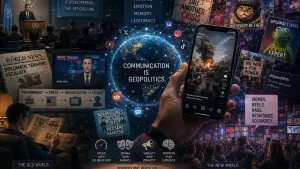
THERE was a time when geopolitics moved through formal rooms. A state issued a statement. A spokesperson read from a prepared text. A newspaper carried the official line the next morning. A television anchor interpreted the event for the evening audience. The world seemed to travel through a recognisable chain of authority: government, press, broadcaster, citizen. That world has not disappeared, but it has been radically dethroned. Today, geopolitical communication no longer waits for the press briefing.
It erupts through a phone screen, mutates into a meme, becomes a thirty-second reel, and is weaponised before official institutions have even finished drafting their response. In this new environment, communication is not merely the carrier of geopolitics. It is geopolitics. The struggle between nations is no longer only over territory, trade routes, military alliances, energy corridors or diplomatic blocs. It is also over perception, framing, emotion, memory and moral legitimacy. Traditional media has not become irrelevant, but it has lost its monopoly over first contact with reality.
For many people, especially younger audiences, the first encounter with a war, coup, election, protest, climate disaster or diplomatic crisis is no longer a newspaper headline or a state broadcaster. Younger audiences are increasingly consuming news through platforms such as TikTok, Instagram, Reddit and X, placing greater trust in information from social media than older adults. In the contemporary media environment, many newsrooms resemble theatres of geopolitical emotion. The anchor is not merely a presenter but a performer. The studio is not just a space of analysis but a stage of confrontation.
Every crisis becomes a spectacle. Every disagreement becomes a shouting match. Every adversary becomes a character. This has consequences. It simplifies complexity into combat, rewards certainty over nuance, and turns diplomacy into drama. In a tense geopolitical moment, communication can either cool the temperature or raise it. A headline can inflame. A viral clip can humiliate. A false claim can travel faster than a clarification.
The old diplomatic language was cautious, layered and slow. The new digital language demands speed, clarity, emotion and shareability.
This is especially critical in times of war or near-war. The battlefield is physical, but the narrative field is emotional. Governments communicate not only to inform citizens, but also to reassure allies, deter adversaries, influence neutral states, mobilise diaspora communities and shape global opinion.
Earlier, strategic communication was mostly vertical: the state spoke, the media transmitted, the public received. Today, it is networked, chaotic and participatory. One of the most fascinating developments in contemporary geopolitical communication is the rise of memes as a form of political language. At first glance, memes appear unserious. They are funny, crude, exaggerated, chaotic and often absurd. But that is precisely why they matter. Memes allow people to process events that are otherwise too terrifying, too distant or too morally overwhelming to absorb directly.
They compress rage, helplessness, irony and critique into a format that travels fast. In times of war, memes become coping mechanisms. In times of propaganda , they become counter-speech. In times of diplomatic absurdity, they become satire. In times of public grief, they become communal release. For younger generations, memes are often not a retreat from politics but an entry point into it. They allow people to say: we see the hypocrisy; we see the cruelty; we see the ridiculousness of powerful people manufacturing crises while ordinary people pay the price. A meme can expose the emotional truth of a geopolitical situation more sharply than a formal editorial.
It can puncture the inflated language of power, ridicule warmongering, mock double standards and create a sense of global solidarity among people who may never meet but recognise the same absurdity. This is where communication becomes unexpectedly democratic. Young people across the globe may respond to the same geopolitical crisis through the same meme template. The meme becomes a tiny republic of shared disbelief. It says: borders may divide us, but the stupidity of power is universally understood. Of course, memes can also distort, trivialise and dehumanise. They can flatten tragedy into entertainment. But dismissing them would be a mistake.
Memes are now part of the emotional infrastructure of international politics. They are how many people grieve, rage, resist and belong. The social media age has also created a new diplomatic terrain: platform diplomacy. Public diplomacy campaigns are built for Instagram. Hashtags become instruments of visibility. Short videos become tools of persuasion.
The old diplomatic language was cautious, layered and slow. The new digital language demands speed, clarity, emotion and shareability. A government that waits too long may lose the narrative; one that speaks too quickly may spread error or escalate tensions. In geopolitics, narrative is not decoration.
It is infrastructure. A country’s narrative shapes how others interpret its actions. The same policy can be seen as aggression, leadership, self-defence, humanitarian responsibility or strategic autonomy depending on the narrative around it. The most successful geopolitical communication does not merely defend a position. It builds a worldview.
In a fragmented world, narrative coherence becomes power. Countries that cannot explain themselves are explained by others. This is important for emerging powers seeking a larger global role. They must communicate not only capability but credibility, showing that their rise is constructive, collaborative and backed by institutions, innovation, culture and values.
The same platforms that democratise communication also intensify disorder. Social media can unite people across borders, but it can also flood the public sphere with fake images, manipulated videos, bot-driven narratives and coordinated disinformation. Artificial intelligence adds another danger through synthetic images, deepfake speeches, fabricated battlefield footage and AI-generated propaganda. This is why information integrity must become central to national security and diplomatic strategy. Media literacy, trusted verification networks, responsible platform governance, ethical journalism and transparent official communication are no longer soft issues.
They are geopolitical necessities. Yet the story is not only bleak. The most powerful communication in geopolitics is not always the loudest. Sometimes it is the sentence that leaves room for de-escalation. The communication paradigm has changed permanently. Authority no longer guarantees attention. In the age of reels, shorts, livestreams and memes, attention must be earned, trust must be built, and legitimacy must be protected. Above all, people are not passive audiences anymore.
They are interpreters, critics, amplifiers and co-authors of geopolitical meaning. The age of one-way messaging is over. The age of narrative ecosystems has begun. In the end, geopolitics is not only the story of states competing for power. It is the story of humanity trying to understand itself under pressure. And communication is where that story is written, one statement, one image, one broadcast, one reel, one meme, one silence at a time.—The Statesman (India)/ANN
Published in Dawn, June 22nd, 2026 ...