Israel's actions in Lebanon nearly 'derailed' US-Iran talks: DPM Dar
ONP Summary
US and Iranian delegations concluded the first round of negotiations in Burgenstock, Switzerland on June 21-22, mediated by Pakistan and Qatar, producing a joint agreement on a roadmap to conclude a comprehensive peace settlement within 60 days. The talks, conducted under an existing Memorandum of Understanding framework, aimed at ending regional military operations including those in Lebanon, though the negotiations were marked by escalating tensions including Trump's repeated threats and Iran's closure of a strategic waterway.
Progressive: Progressive-leaning outlets emphasize the constructive and encouraging nature of the agreement, highlighting the breakthrough and progress achieved despite the tense opening, framing the roadmap as a meaningful step toward resolving the conflict.
Moderate: Centrist outlets present the talks neutrally, focusing on the procedural outcome—the agreed roadmap and 60-day timeline—while acknowledging both the substantive diplomatic achievement and the contextual tensions surrounding negotiations.
Conservative: Conservative-leaning outlets emphasize the difficulties and escalating tensions overshadowing the talks, highlighting Trump's threats and Iran's provocative actions as complications that complicate the path to implementation.
이 뉴스, 어떠셨어요?
한 번의 탭으로 반응을 남겨요 · 로그인 불필요
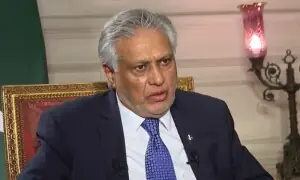
Deputy Prime Minister and Foreign Minister Ishaq Dar has said that Sunday’s US-Iran talks in Switzerland were nearly “derailed” due to Israel’s continued attacks on Lebanon, it emerged on Tuesday.
In an exclusive interview with Al Arabiya, which was recorded before the talks began, DPM Dar said, “The parlays starting in Switzerland could have started a few days earlier, but Israel’s attacks on Lebanon derailed and stopped everything.”
At the outset of the interview, DPM Dar recalled Pakistan’s diplomatic efforts since the start of the conflict on February 28, recalling the Pakistan-mediated ceasefire followed by the talks in Islamabad in April.
“Those parlays were the first time direct talks between the US and Iran after 47 years, and Pakistan was asked to be the witness,” DPM Dar said.
He said that Pakistan’s continued efforts after the Islamabad talks culminated in the signing of the Islamabad Memorandum of Understanding (MoU) on June 18.
“You see, during this period, Pakistan has been … very active. Not only were we mediating between the US and Iran, but we were also keeping our allies and friends in the region connected with us,” DPM Dar told Al Arabiya.
He continued: “In that process, we saw that a regional forum has been created which is Pakistan, Egypt, Saudi Arabia, and Turkiye and we were dealing side by side with Gulf countries and also international partners.”
Shifting his attention to the talks in Burgenstock, he called the summit “phase two” of the negotiation process.
“There are three technical groups. One is to deal with the nuclear issue, the second is about sanctions and frozen assets and third is Lebanon,” DPM Dar said.
Of Lebanon, DPM Dar observed that the issue had “erupted time and again” during the course of the peace process and added that the Switzerland talks were nearly “derailed” due to Israel’s attacks in Lebanon.
“For certain items, they have 30 days to conclude, but the bulk and overall conclusion of the final deal timeline is 60 days, and this can be mutually extendable,” he said.
He said the world was already beginning to see the dividends of the peace, citing reduced energy prices and resumption of traffic flow in the Strait of Hormuz.
DPM Dar maintained that the Strait of Hormuz should be restored to pre-conflict status, which “means no fee and no toll at all”.
At this, he also recalled his March visit to China, where he said both China and Pakistan agreed, as per a five-point plan, that there should be free movement in the strait.
“No permits, no toll, no additional charge, whatever you name it; it should be free movement and sea lanes should be freely moving [on] both sides,” Dar said, noting the energy crisis that resulted in the wake of the closure of the vital Strait.
“This is the global understanding,” he said, observing that for “at least 60 days, there will be free movement” within the waterway.
When asked if any guarantees existed to contain Israeli actions in Lebanon, Dar responded: “The facilitator or mediator’s role is to keep trying and making efforts. There were points where things looked like that won’t be concluded, but we never gave hope [..] independently, there are spoilers who never wanted this deal to happen, and the moment this deal was signed, we saw that there was heavy bombing in Lebanon.”
Dar held that wisdom must prevail, and urged the international community to “convince, persuade, and influence” Israel to halt attacks in Lebanon.
At this, he also spoke of plans to revive efforts to ensure implementation of Gaza’s 21-point peace plan.
More to follow. ...