Pakistan assails 17 Indian water projects, calls them ‘tools for hydro-hegemony’
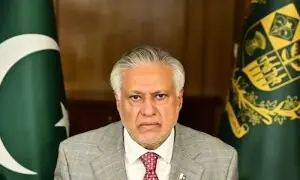
Deputy Prime Minister and Foreign Minister Ishaq Dar warned on Thursday of “at least 17” projects by India designed to drastically alter the Indus river system and lend it “tools for hydro-hegemony”.
The deputy prime minister, in a recorded keynote address at a seminar on trans-boundary water resources, said that responsible states act “within established legal frameworks” rather than abandoning them — referring to the Indus Waters Treaty (IWT) between Pakistan and India that has been unilaterally suspended by India since May of last year.
“The treaty envisages the peaceful resolution of disputes within its own framework,” he said, highlighting that it survived “three major conflicts and several other challenges” over the decades. He also noted that Pakistan had previously voiced concerns over “certain actions by India” under the treaty.
Dar stated that Pakistan had consistently upheld the values enshrined in the United Nations charter, and remained committed to its principles as well as UN resolutions.
“Consistent with the treaty’s provisions, we sought settlement through international mechanisms and respected decisions that even fell short of our expectations,” he said. “At no stage was the outright unilateral abrogation of the treaty considered a viable course of action by the other side.”
“It is important to underscore that our concerns are not merely based on Indian statements,” the deputy prime minister stressed, stating that India had “followed up its belligerent statements with illegal actions”.
These included projects to create reservoirs, expansion of existing structures and, “most alarmingly”, diversion projects on the Indus, Chenab and Ravi rivers.
“In total, at least 17 such projects that will drastically alter the river system as a whole, giving India the tools for hydro-hegemony that it so desires,” he said.
“River systems are not merely waterways — they are lifelines. They carry profound historical significance and serve as immediate sources of sustenance and survival,” the deputy prime minister noted.
India’s stated policy to intentionally deprive 240 million people of their rightful access to water represented a “catastrophe in the making of unparalleled magnitude”.
Dar stressed that water must never be viewed as an instrument of coercion, as it was “a shared resource, a common responsibility and ultimately a prerequisite for human dignity and sustainable development”.
He expressed the need for the future of trans-boundary water governance to be anchored in cooperation and respect for international law.
The deputy prime minister added that this issue should not be viewed as one confined to South Asia, pointing out that Europe offered compelling examples of how faithfully implementing trans-boundary water agreements enabled states to share water resources cooperatively.
Terming the sanctity of treaties “the bedrock of the international order”, he declared respect for treaty obligations to be not just a regional concern but a “global imperative”.
“Pakistan remains committed to resolving all issues through dialogue, diplomacy and the mechanism provided under international law,” he added. “Our position is guided not by confrontation, but by the conviction that lasting solutions can only emerge through cooperation and respect for mutually agreed obligations.”
Dar said that Pakistan was already disproportionately affected by climate change, pointing out that it remained among the most climate vulnerable countries in the world despite contributing less than one per cent of global greenhouse gas emissions.
He called for enhanced international cooperation and collaboration on water related issues, expressing the hope that the seminar’s discussions would underscore the importance of cooperation in the management of trans-boundary water resources.
“Let us reaffirm today that shared waters should unite nations rather than divide them, and that cooperation — not coercion — must remain the guiding principle of trans-boundary water governance,” he said.
More to follow ...
이 뉴스, 독자들은 어떻게 느꼈나요?
첫 반응을 남겨보세요로그인하면 감정 반응에 참여할 수 있어요.