Kenyan footprints shed light on prehistoric human cousin Paranthropus
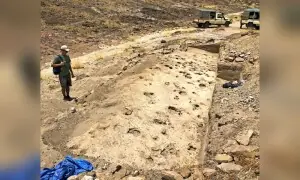
Footprints left on a muddy lakeshore in northern Kenya around 1.43 million years ago are providing new insight into the size and behaviour of a species in the human evolutionary lineage that was the last of its kind, known for extensive anatomical adaptations for eating tough vegetation.
The species, Paranthropus boisei, is known mostly from skull and tooth fossils. Now, researchers working along the eastern side of Kenya’s Lake Turkana have identified 21 footprints made by eight individuals of this species who appear to have been walking together on a mudflat.
They attributed the tracks to this species based on foot shape and gait, and concluded they probably were left by adult males, due to their size.
The footprints provide a glimpse into social dynamics in Paranthropus boisei, including the fact that males sometimes travelled across the landscape in groups, without females or children.
Species in the human evolutionary lineage are called hominins.
“In all, this is another amazing snapshot that gives us insights into how these hominins looked, how they walked and how they engaged with each other and with their environments,” said paleoanthropologist Kevin Hatala of Chatham University in Pittsburgh and the Max Planck Institute for Evolutionary Anthropology in Germany, lead author of the study published in the journal Proceedings of the National Academy of Sciences.
Footprints slightly older than these, described in a study published in 2024, showed that Paranthropus boisei inhabited this region alongside another hominin, called Homo erectus, that was more closely related to our species — perhaps a direct ancestor.
“Paranthropus boisei is most well known for their extremely robust skulls and very large teeth. From the neck down, we haven’t known a lot about their anatomy,” Hatala said.
Researcher Kevin Hatala examines fossil footprints dating to 1.43 million years ago, including 21 attributed to the hominin species Paranthropus boisei, in 2023 near Lake Turkana in northern Kenya, in 2023 alongside other members of the field work team, in this photograph released on July 27, 2026. —Handout via Reuters/File
The species had a crest atop the skull, like male gorillas, to anchor large chewing muscles, and had molars three times the size of ours. Its diet of tough foods may have included grasses, wetland plants called sedges, nuts and seeds.
Its body dimensions are less well understood. The footprints suggest a height of up to 6 feet (1.83 meters) and weight of around 165 pounds (74.84 kilogrammes), larger than previously estimated and rivalling Homo erectus in size.
“It had long been thought that they were smaller in body size than the contemporary Homo erectus, which is thought to have been very human-like in body size and shape. But perhaps Paranthropus boisei was also able to achieve human-like body sizes despite a cranial anatomy that seems to indicate a very different kind of diet,” Hatala said.
The researchers used volcanic ash in the surrounding rock to date the footprints. Alongside the hominin footprints were tracks of hippos, antelope, wading birds and other animals.
‘A bachelor male group’
The footprints indicate the eight individuals were moving perpendicularly to the shoreline, into and out of slightly deeper water, according to study co-author Kay Behrensmeyer, curator of vertebrate palaeontology at the Smithsonian’s National Museum of Natural History in Washington.
“We don’t know what they were actually doing there,” Behrensmeyer said.
Possibilities include acquiring food or water, making a security patrol or just strolling as buddies.
“Another possibility is that this represented a bachelor male group, similar to what we see in primates like gorillas that have a social structure in which one dominant male monopolises mating for themselves and drives other males away from the females. This can leave displaced males to group on their own,” Harvard University evolutionary biologist and study co-author Neil Roach said.
The footprints suggest their social structure allowed for males tolerating other males, at least in certain circumstances, Roach said.
Paranthropus boisei is believed to have died out around 1.2 million years ago, a time of climate change that may have affected food resources, making the species an evolutionary dead end.
Homo erectus and our species Homo sapiens belong to the genus Homo. A genus is a group of closely related species that share similar characteristics. For example, lions and tigers are from the same genus but represent different species.
Paranthropus boisei, which first appeared about 2.3 million years ago, was the last of three species of the genus Paranthropus, dating to about 2.7 million years ago. It is also thought to have been the last hominin species not part of the genus Homo. Our species first appeared about 300,000 years ago.
Competition from Homo erectus cannot be ruled out as a factor in the extinction of Paranthropus boisei. Homo erectus, with smaller teeth and weaker jaws, is thought to have eaten less tough vegetation and more meat, but some food resources may have overlapped.
“For example, maybe both species accessed similar food resources in lake margin environments, but then diverged in terms of the other components of their diets,” Hatala said. ...
이 뉴스, 어떠셨어요?
탭 한 번으로 반응 · 로그인 불필요
같은 사건, 다른 제목
보도 없음