SpaceX allocation fallout draws FSS probe
AI Summary
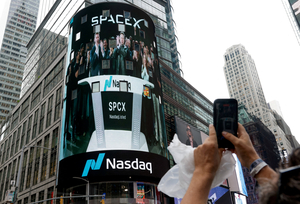
SpaceX went public on the NASDAQ on June 12 in the world's largest initial public offering. The initial offering raised $75 billion at $135 per share, but when underwriters exercised their greenshoe option, total fundraising expanded to $85.7 billion—nearly three times the previous record set by Saudi Aramco. The strong market reception reflected investor appetite for the aerospace company's dominance in rocket launches and satellite communications.
Progressive: Progressive-leaning outlets criticized the IPO as primarily benefiting wealthy and insider investors, characterizing the stock market as an exclusive wealth multiplier accessible only to the already-rich while ordinary retail participants faced severe allocation constraints.
Moderate: Centrist outlets reported the IPO's record-breaking scale and strong stock performance, noted that other major AI companies may pursue similar listings, and identified Trump administration regulatory policies as a key uncertainty factor affecting the technology sector.
Conservative: Conservative-leaning outlets celebrated the IPO as a historic market triumph, emphasizing the scale of capital raised, Wall Street institutional efficiency, Korean institutional investors' successful participation in allocations, and Musk's ambitious projection of $1 trillion in revenue within four years.
South Korea's Financial Supervisory Service is examining Mirae Asset Securities and several asset managers, including Korea Investment Management, over SpaceX-related investment products after they failed to secure IPO allocations despite marketing them as vehicles for gaining exposure to the highly anticipated listing.
According to industry sources Tuesday, the FSS initially launched an on-site inspection of Mirae Asset Securities before escalating it into a formal examination.
The probe also c ...
이 뉴스, 독자들은 어떻게 느꼈나요?
첫 반응을 남겨보세요로그인하면 감정 반응에 참여할 수 있어요.