My Brother Was Sentenced to 30 Years for Moving a Box of Zines
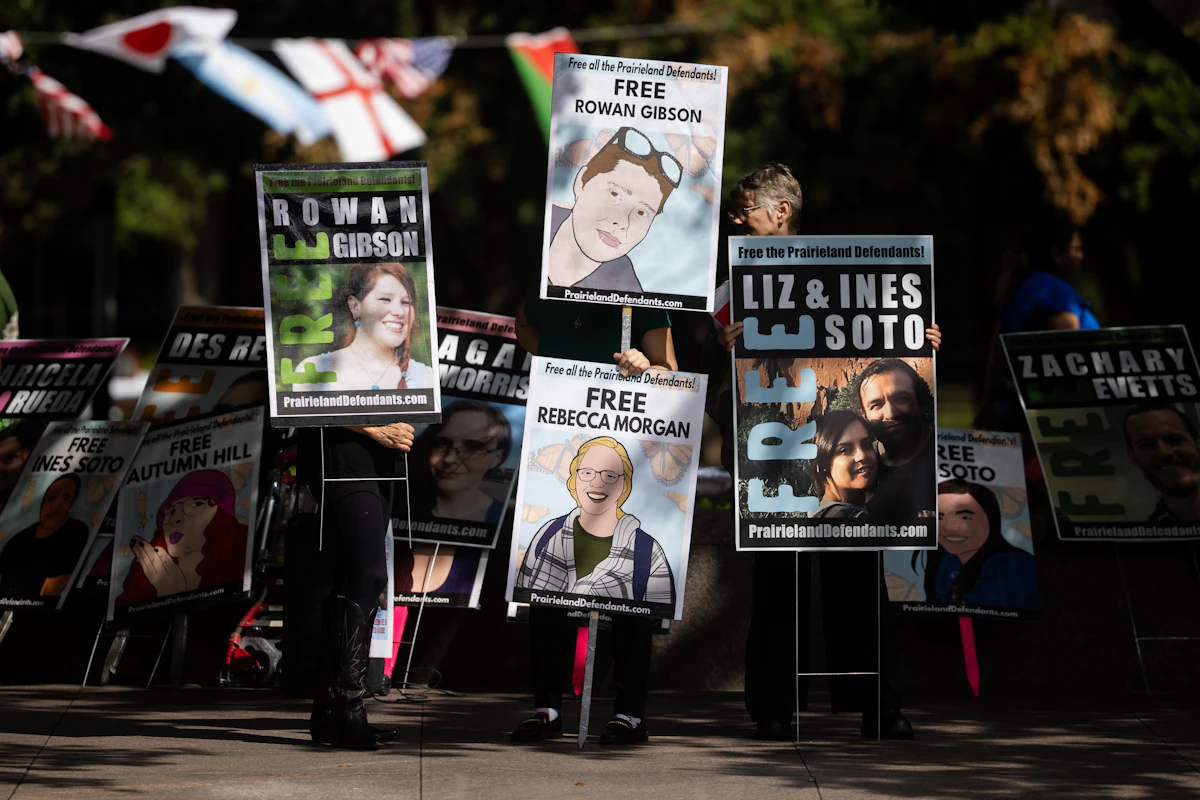
In June, Daniel Sanchez Estrada, a defendant in the historic Prairieland case, was sentenced to 30 years in federal prison, drawing international headlines and outrage. The artist and father was convicted of two federal offenses for allegedly moving a box of zines and other literature from the home he shared with another defendant, his wife, Maricela Rueda, following a July 4, 2025, noise demonstration at the Prairieland ICE Detention Center in Alvarado, Texas. Rueda faces 70 years in federal prison. “My feeling is that I was only arrested because I’m married to Mari Rueda,” Sanchez Estrada said last December, in his first public statement. His wife, he added, had been criminalized for “showing support to migrants who are facing deportation under deplorable conditions.” Sanchez Estrada, a green card holder, could himself be deported when he is finally released. All this is the result of the Trump administration’s relentless anti-immigrant campaign, as well as its ongoing attempts to smother any dissent or efforts to defend those it targets.
One year after Sanchez Estrada’s arrest, his sister, Ana Bell, posted a video statement about her brother and the trauma the government has put her family through in its prosecution of the Prairieland case. In the video, released earlier this month, Bell is surrounded by shelves of fantasy and science fiction books, including some familiar titles that frequently show up on banned book lists: The Handmaid’s Tale, 1984. With her children, Bell co-owns and runs a bookstore in Rockwall County, Texas. “I feel it is a war on free speech, rather than just my brother,” she told me when we spoke last week. In the government’s efforts to paint a temporarily connected group of people who opposed immigration detention as a “North Texas Antifa Cell,” it may not have said flat out that sharing a book is now a crime. It didn’t have to.
Literature, in the Prairieland case, was turned into a vector of criminalization. In the hands of a prosecutor, the fact that a book or a zine can be passed from reader to reader became the accumulating elements of a criminal conspiracy. FBI Special Agent Joseph Clark Wiethorn’s lengthy sworn statement recounted discovering the box of literature that Sanchez Estrada allegedly took to an apartment in Denton, Texas. The government claimed that the box had been moved after a call between Rueda, then already in jail, and her husband. The agent characterized what he found inside as “anti-law enforcement, anti-government, anti-Trump sentiments.” One zine pictured was a guide to squatting (“The average life expectancy of a squat in San Francisco seems to be only three weeks”); another was a collection of essays about anarchist tactics in historical context (“What happened in Asheville on May Day was not a riot”). ICE posted additional photos of the zines to Instagram, claiming that the FBI had “found literal insurrectionist propaganda.” Crafting its own propaganda, ICE connected the zines, Sanchez Estrada’s arrest, and his immigration status. (You can read the zines yourself, available as part of a recent republished series in print, or free online.) Two other defendants, the couple Elizabeth and Ines Soto, also had zines used against them, particularly their at-home zine-making and their book club, which was named for Emma Goldman. Each was sentenced to 50 years.
Until now, Ana told me, her family “kept quiet.” They didn’t want anything they said used against Sanchez Estrada. “But it is bigger than him,” she said. “I love my brother dearly and I want him to come home.… Out of all the defendants, I believe everybody should go home.”
This interview has been edited and condensed.
Melissa Gira Grant: What was it like in court? You were there for the sentencing, just a couple weeks ago?
Ana Bell: I was there. It’s very nerve-wracking to be in that room, after a whole year, knowing what we know of my brother, and knowing that his life is pretty much in someone’s hands. From the beginning for us it was like, “This doesn’t make sense.” All of this is leaking into social media and feeding this narrative that he is a criminal, when all he did was move a box of his own belongings.
Melissa: During your brother’s sentencing, the judge said, essentially, “We’re doing this to send a message to anybody else who shares this ‘ideology.’” What did it feel like in the moment for that to be said so directly?
Ana: I was just like, “Oh my God, they’re not even trying to cover this up.” They feel in the right to do this. And I don’t understand it. I felt like hope had been taken from us. I felt like my brother was on trial simply out of support for this administration and the things that they are doing, because other than that, it makes no sense.
I own a bookstore. We are a fiction store only. But my shelves are full of female and male characters that lead armies to battle, fighting oppression, fighting injustice, fighting their own types of fascism in their worlds. You have Katniss in The Hunger Games, you have even Harry Potter in his own world. You have all of these characters that are standing up against injustice and they’re in fiction books. If you were to say that reading these types of books makes you antifa; that’s your ideology because you love reading these? Then all of us in the bookish community will be in jail.
They say that he went to the house to remove evidence. They specifically used the wording, he went to “her house.” And I would like to make the record clear here: He went to his house. He lived there. [A federal agent acknowledged, in a sworn affidavit, that Sanchez Estrada’s parents told investigators that he lived with Maricela Rueda and split his time between the couple’s house in Fort Worth and his parents’ home.] They make it sound suspicious.
If you were going to tell me that the contents of the box, the zines, the stickers, the poetry, that’s the crime—then we have a bigger problem here, which is free speech.
That’s what is being targeted here, not my brother. My brother is just a vessel. It’s like they have to have a body to put in jail. And unfortunately, that happens to be my brother.
How is talking about corporations destroying our environment a big issue that someone will have to be in jail? How is a book of poetry expressing your own feelings on a political climate? It’s a crime that you should be in jail for 30 years. Look at all of those things, and then look inside of your home, at what things that you have in your own home that fit the same sentiment.
Because a lot of people don’t understand that. This is way beyond my brother just being in jail. I’m a bookstore co-owner, my kids own the other part. All the time, new bills are being introduced in Texas about banning books, things that people don’t want you to be reading. There was a bill that would’ve made us, the people who own bookstores, criminals and charged like pedophiles for having smut in our stores. [The Texas House considered a bill in 2025 that would have held bookstores liable for “damages arising from the distribution, transmission, or display of harmful material to a minor.”] If you don’t like it, don’t read it. It is so easy. You don’t get to control what other people say or do. And it is not a crime to either read it or not read it.
I feel it is a war on free speech rather than just my brother, but I feel that he’s right now the flag or the one thing that is representing the battle.
Melissa: You mentioned you were out of the country when your brother was arrested, but your parents and your kids were here?
Ana: When it happened, I was in Mexico. My parents, they live about three miles away from my house. [Law enforcement] raided their home. I called my kids, I called some friends, and I was telling them, this is what happened to my parents. I told my kids, “If somebody comes into the house, you let them take whatever they want to take, you step aside, you don’t talk to them, you don’t engage.” And I had friends ready so that as soon as something would happen in my house, my kids will send them a message, they will come and keep the kids safe. My youngest was 15 last year, and my oldest is 20.
How is this happening? We haven’t done anything. They’re looking for anything and everything. They took my mom’s little notepad that had phone numbers from Mexico, with the little Disney princesses on the front. They took my sister’s phone. That’s the one thing that we would love to have back. That phone had my sister’s photos, things that we can’t get back because she passed away nine years ago. They took my dad’s tablet, where you log all your trips [for an 18-wheeler trucking company] and then you send that information automatically to the company you’re working with and then they pay you. So his income was gone when they took that tablet with them.
I’m not saying the officers that came to the house came in with the purpose of getting my mom to faint, came in with the purpose of taking my dad’s income, came in with the purpose of taking my sister’s phone. That’s not at all what I’m saying. What I’m saying is their actions are following orders that had no legal basis whatsoever. They’re rummaging through my parents’ house, and we still didn’t know what my brother’s charges are or where he’s at.
And so you have parents going through all of this trauma, and then there’s [the] aftermath. The loss of income, the health decaying for my mom, the nightmares that come. I cannot even open the door without letting them know I’m coming over, even though I have a key to the house, because it freaks my mom out every time that we rattle the doorknob on the house.
It just makes no sense. It was terrifying because I was away from the country. I’ve been divorced for almost 14 years, so it’s just me and my kids, and having to be away to earn an income and then hear that all of this is happening.
I came back, and within hours I was on my way to Fort Worth to the hearing. And then I get to hear this: My brother is not going to go home. He’s going to stay in there.
Melissa: What happens next?
Ana: At this point, we are being told that the timeline is about probably two years before we are heard on the Fifth Circuit for appeals, unless they move really fast. But what we are looking for is a pardon.
So we just have to hope that whoever comes in power understands that carrying a box of your own magazines is not a violation of any kind of law, you’re actually protected under the First Amendment for freedom of speech. So it should be a no-brainer to be like, “We really messed up over here.” He’s totally entitled to read about raccoons and the environment. And he’s totally entitled to not feel that police brutality is OK. You know what I mean?
Melissa: Looking through the zines, I just thought, This is all very familiar. If you’ve ever been in an independent bookstore, if you’ve ever been to a protest, none of this is unfamiliar. And it feels like the point, I guess, of looping your brother in was to say, “Well, this is the ideology of this group, and isn’t this scary?”
Ana: Yes. And that was it. They kept saying they shared this ideology, they shared this type of mentality, this is what terrorism looks like.
And I’m like, “This is just reading material.”
They’re not telling us in any of the documents that they put in the court record, “We’re coming after your freedom of speech.” They’re saying he was holding a box of zines that are considered antifa. Well, what do you consider antifa? Well, [the zines] are talking about the government. They’re talking about police brutality. They’re talking about consent. They’re talking about the environment.
Melissa: And that seems to be what it’s about with this administration—the enemy is criminal, dissent is criminal, an immigrant is criminal. The man in Houston who ICE killed last week, Lorenzo Salgado Araujo …
Ana: To me, bringing that point of Lorenzo’s passing, which is super unfortunate, then you start reading articles from the right-wing media and they’re talking about, “He was illegal, he was a criminal,” all these things. Dehumanizing him. I didn’t know him. I don’t know who he is. But I’ve seen what happened to Renee Good before. I’ve seen what happened to Alex Pretti before. So for me, it is so important that people understand. Yes, you will see the videos. But when you are watching these videos, you need to look—actually pay attention to what is happening on the screen, not the narrative that is being painted for you.
Because I realized pretty quick, when I read the original charges, the original Prairieland affidavit, it said that it was an ambush. Again, I am not a tactical person, I am not in law enforcement, but I’m pretty sure an ambush means they’re coming at you, not running from you. At no point are [law enforcement] running and hiding because they fear for their lives.
I live with what I tell people is kind of like my own survivor’s guilt. And it is the fact that I get to be free while he doesn’t. Like just lying on my bed for five extra minutes, I feel guilty of it because he doesn’t get that. And it’s not anything that I did, it’s not anything that he did, but it is there. That feeling is there when we eat some food and we’re thinking, like, “Man, he’s barely getting the knockoff brand of noodles in his cell, and here we are at an Asian restaurant eating the great noodles,” that type of thing. All of that, it comes back, and it’s a constant reminder that he’s not with us and through no fault of his own.
Melissa: When’s the last time you got to talk with your brother?
Ana: This past week we had a phone conversation. One of our friends, in an email, told him I had posted the statement video, and he was so grateful. He just wanted to let me know that he appreciated that I had done that.
It’s so hard that he’s in jail right now. It’s so hard that he lives in the conditions that he’s in. I’m telling you, he used to travel for two months a year and just be out in the wilderness, and right now, he gets one hour outside of his cell in the sun. One hour where they get taken to the yard. He likes to go where the trees are and look at the little squirrels and try to make friends with them. He says everybody tries to feed them something. That’s their entertainment when they’re there. But he tells you, “It rained today and I saw the rain and it felt amazing.”
You’re literally depriving him from the things he loves the most, and for no reason. ...
이 뉴스, 어떠셨어요?
탭 한 번으로 반응 · 로그인 불필요