Unchecked settlements near Gilgit raise Glof risks
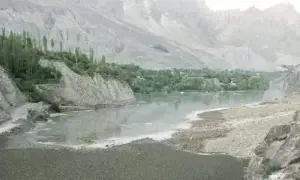
• Suparco says obstructed floodplain could trigger overbank flooding, debris flows
• Satellite imagery shows number of ‘unfrozen lakes’ increased from 24 to 40 in just two weeks
ISLAMABAD: With the monsoon season now under way, the Pakistan Space and Upper Atmosphere Research Commission (Suparco) has raised concern over the uncontrolled spread of settlements along a natural glacial lake-fed stream near Gilgit city, warning that lives, property and livestock could be at risk.
A comparison of satellite images from 2013 and 2023 clearly reveals the rapid and largely uncontrolled expansion of settlements along the natural stream near Gilgit city. The stream is fed by upstream glacial lakes within the catchment, making it highly sensitive to climate-induced hazards such as glacial lake outburst floods (Glofs).
Over the past decade, urban growth has progressively encroached into the natural flood conveyance zone and alluvial fan of the stream, significantly reducing its capacity to safely accommodate high-magnitude flows, Suparco said.
Such land-use changes have altered natural drainage patterns and increased the exposure of residential and commercial infrastructure to flood hazards.
The space agency said that in the event of a Glof or extreme precipitation-driven flow, the confined channel and obstructed floodplain could result in sudden overbank flooding, debris flows and widespread destruction.
It said the scale of potential damage had been substantially amplified by human negligence, weak enforcement of land-use regulations and the absence of risk-informed urban planning at the government level.
Despite clear evidence of hazard-prone zones identifiable through satellite imagery and geomorphological indicators, construction activities have continued unchecked, according to Suparco.
According to EM-DAT, the international disaster database, Pakistan has faced 89 flood events in the last 25 years, with impacts becoming more severe due to increasing urban expansion and development within active riverbeds and floodplains.
Unfrozen lakes
Using satellite-based monitoring, Suparco said it provided continuous assessments of river behaviour and surrounding land use, supporting informed decision-making for flood risk reduction and climate-resilient development.
Suparco is regularly monitoring the status of potentially dangerous glacial lakes using satellite imagery to support early warning and preparedness for Glof hazards. The monitoring results are shared with relevant stakeholders, including the Ministry of Climate Change’s Technical Committee on Glof Monitoring. In the last two weeks, Suparco has added one more lake to the list of potentially dangerous glacial lakes, taking the total to 131.
The locations have been provided by the Provincial Disaster Management Authorities, including the Khyber Pakhtunkhwa PDMA, Gilgit-Baltistan Disaster Management Authority and the Wapda Glacier Monitoring and Research Centre. The present assessment was based on satellite imagery acquired on June 16.
Suparco said all identified lakes had been mapped on the latest available satellite imagery to estimate their surface area and determine whether they were frozen or unfrozen. As expected with rising summer temperatures, the number of unfrozen glacial lakes is increasing.
At present, 40 lakes have been observed to be unfrozen compared to 24 lakes reported two weeks earlier, indicating accelerated seasonal melting.
However, the current assessment also indicated that most unfrozen lakes remained within their previously recorded maximum extents. Suparco said a glacial lake became a greater concern when its water extent expanded beyond its historical maximum, as this could indicate increased water storage and a higher likelihood of moraine dam instability, increasing the risk of a Glof event.
‘Evolving threat’
According to the space agency, given the ongoing rise in temperatures and the increasing number of unfrozen lakes, all authorities concerned have been advised to maintain a high level of preparedness, particularly in downstream valleys of potentially dangerous glacial lakes.
Mohammad Saleem Shaikh, spokesperson for the Ministry of Climate Change and Environmental Coordination, told Dawn that the rapid rise in temperatures across the Hindu Kush-Karakoram-Himalaya region was fundamentally altering Pakistan’s cryosphere and accelerating glacier melt, increasing the risk of Glofs and other climate-induced hazards.
He said that while glacier melt initially boosted water availability, unchecked warming was expanding unstable glacial lakes that could burst without warning, unleashing devastating floods that threatened downstream communities, public infrastructure, agricultural land and essential services.
Shaikh said scientific evidence showed that the country’s northern mountain regions were experiencing increasingly erratic weather patterns, accelerated glacier dynamics and a growing likelihood of extreme hydrological events.
“The science is unequivocally clear that rising temperatures are reshaping Pakistan’s mountain ecosystems at an unprecedented pace. Every fraction of a degree of warming increases the risk to communities living downstream. Our response must therefore be science-driven, technology-enabled and translated into timely action to protect lives, livelihoods and critical infrastructure,” Shaikh said.
He said the latest satellite-based assessment by Suparco reflected both the evolving nature of the threat and Pakistan’s strengthened scientific capacity to monitor it.
A landmark glacier inventory completed in 2024 also revealed that Pakistan was home to more than 13,000 glaciers — one of the largest concentrations outside the polar regions. “Accelerated glacier melt is increasing the exposure of mountain communities and downstream settlements to Glofs, flash floods and landslides,” he said.
The official said the Ministry of Climate Change and Environmental Coordination, in collaboration with Suparco, NDMA, provincial governments and international partners, was strengthening satellite-based monitoring, hazard mapping, early warning systems and community-based adaptation.
Published in Dawn, July 8th, 2026 ...
이 뉴스, 어떠셨어요?
한 번의 탭으로 반응을 남겨요 · 로그인 불필요