'Outrageous': Punjab's proposed law reminiscent of colonial era draws criticism
이 뉴스, 어떠셨어요?
한 번의 탭으로 반응을 남겨요 · 로그인 불필요
Seventy-eight years after Pakistan’s independence, the Punjab government is moving to introduce a law that has been criticised as being reminiscent of colonial-era laws.
The Punjab Control of Habitual Offenders and Anti-Social Behaviour Bill, 2026 has already sailed through to the Punjab Assembly Standing Committee on Law, it emerged on Sunday.
The bill proposes a regime in which the executive can freeze a person’s bank account, seize their property, remove their online presence, confiscate their phone, and place them under electronic surveillance, all on the basis of an intelligence committee’s assessment of their conduct.
It has drawn criticism from the opposition in the assembly, and from activists, lawyers, journalists and civil society outside the assembly.
Yousuf Nazar, former head of Citigroup’s emerging markets investments and author of a book on political economy, ‘The Gathering Storm’, described the bill as “one of the most dangerous pieces of legislation proposed in Pakistan in recent years”.
“It gives executive committees dominated by police and intelligence officials the power to brand citizens as ‘habitual offenders’ or ‘anti-social’ and punish them without first securing a criminal conviction,” he explained in a post on X.
Nazar went on to say: “The powers are breathtaking. Bank accounts can be frozen. Property can be attached. Electronic devices can be seized. Electronic surveillance can be imposed. Travel documents can be restricted. Social media accounts and online content can be targeted. None of this requires the state to prove guilt beyond a reasonable doubt in a court of law before these sanctions take effect.”
The “danger”, he said, “lies not only in the powers themselves but in who exercises them”.
“The committees are empowered to decide what constitutes ‘anti-social behaviour’. Alongside organised crime and drug offences, the bill includes vague offences such as spreading ‘misinformation’, using abusive language in public and causing annoyance. Worse still, it allows the executive to expand these categories through subordinate legislation. Citizens can be sanctioned on the basis of intelligence reports, police records or repeated arrests — even where no court has ever found them guilty of any offence,” he commented
“This is not the rule of law. It is rule by executive discretion. In plain, it is goonda raj by the SHO of a local police station.”
Nazar added that bill allowed the executive not merely to investigate an alleged wrongdoing but to impose severe penalties before guilt had been established by an independent court.
“Judicial oversight is reduced largely to reviewing executive action after the damage has already been done.
“No democratic government should be asking Parliament for powers of this magnitude. They undermine the presumption of innocence, weaken due process and concentrate extraordinary authority in bodies that are neither independent nor accountable in the way courts are. The inevitable result will be selective enforcement, political abuse and the chilling of dissent,” he warned.
Usama Khilji, an activist and Director of Bolo Bhi, dubbed the bill “outrageous”.
“We’re witnessing the slide down a very slippery slope of draconian measures by the current regime; this must be resisted,” he stressed.
Former Sindh governor and Awaam Pakistan leader Muhammad Zubair listed the provisions of the proposed law in an X post and commented: “This must be the most authoritarian regime in our history.”
PTI Information Secretary Sheikh Waqas Akram also condemned the proposed law in a statement shared on his party’s X account.
He called the draft law “a profound affront to constitutional guarantees of due process, presumption of innocence, security of person, freedom of expression, and the right to property”.
“In a system already plagued by delays and police overreach, it allows punitive administrative sanctions based on unproven allegations, inverting justice and enabling political victimisation of opponents, journalists, activists, and citizens,” he said.
Akram added that the legislation revived “repressive colonial instruments like the Criminal Tribes Act of 1871, which arbitrarily labelled communities as criminals and subjected them to surveillance and punishment without trial”.
“It intensifies these legacies under the guise of tackling modern challenges […] Its provisions rely on administrative fiat, surveillance, and pre-emptive punishment that contradict claims of progressive governance,” he said.
Sharing an observation and a video clip of the Punjab Assembly session from Sunday, journalist Asad Ali Toor posted on X that even Speaker Malik Ahmad Khan was “shocked to see” that the provincial government sought to bring a law “more draconian” than what could not have been implemented during the British Raj.
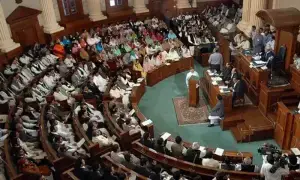
During Sunday’s Punjab Assembly session, the speaker was apparently taken aback after it emerged that the Punjab Control of Habitual Offenders and Anti-Social Behaviour Bill 2026 had sailed through the Standing Committee on Law without his knowledge. A visibly-annoyed Khan also warned the assembly secretariat of strict action, questioning why he was not informed when the legislation was first introduced on June 8.
Lawyer Taimur Malik noted in a post on X that the bill was drawing criticism as it appeared to be an attempt at the “expansion [of] executive power without providing equally strong legal safeguards”.
“Vague definitions of terms such as ‘anti-social behaviour’ can lead to misuse of power by relevant authorities and actions such as digital surveillance, biometric collection, freezing bank accounts or blocking CNICs must only be allowed under clear legal standards, judicial oversight and effective rights of appeal,” he said. ...