Any attempt to block water will have 'far-reaching consequences', warns FO after Indian minister's remarks
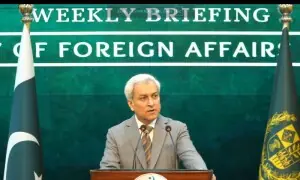
The Foreign Office on Thursday warned that any deliberate attempt to block water essential to Pakistan’s survival and development would have “far-reaching consequences”.
“Any such act would be treated with utmost seriousness and could possibly amount to an act of war under Article 51 of the UN Charter,” said FO spokesperson Tahir Andrabi during a weekly media briefing while responding to a question about recent remarks by Indian water minister.
A day ago, Indian Minister of Water CR Patil told India’s ANI news agency that “not a single drop of water will go (to Pakistan) in the coming years”.
Patil said that India was “actively working on it” after “directives” from Prime Minister Narendra Modi.
Taking note of the remarks, Andrabi said that “any attempt to block or substantially curtail water that is vital to the livelihood, agriculture and well-being of over 25o million Pakistanis would be a deeply irresponsible act”.
He added it would violate established international obligations “concerning transboundary rivers and indeed India’s own bilateral agreement with Pakistan”.
“Pakistan firmly rejects any notion that water can be treated as a political tool or instrument of coercion or a weapon,” he said, emphasising that such an action would be a threat to the regional peace and security.
He maintained that the responsibility of such a threat “to international peace and security would fall squarely on India’s shoulders”.
He held that Pakistan will “vigorously” defend its rights to water utilising all available diplomatic, political, legal, economic and other measures.
“Any deliberate attempt to block water essential to Pakistan’s survival and development would constitute an extremely grave act with far-reaching consequences, as stated at the top leadership level by Pakistan,” Andrabi warned.
He expressed that Pakistan remained ready to take “all necessary measures to safeguard its economy and its vital national interests and lives of 250m people”.
In his statement, Andrabi urged India to act responsibly, uphold its international commitments and “refrain from statements and actions that could further escalate tensions in the region”.
Andrabi stated that Pakistan remained committed to safeguarding its interests and “will closely monitor developments on the ground in India-occupied Kashmir and elsewhere from where these water resources emerge”.
Expansion of India’s nuclear arsenal ‘not surprising’
In response to a question over India expanding its nuclear arsenal, as per a recent report by the Stockholm International Peace Research Institute (SIPRI), Andrabi said the finding was not surprising to Pakistan.
“It broadly corroborates concerns that Pakistan has consistently been raising regarding India’s continued vertical proliferation,” he stated, hinting that the findings may not “fully reflect” India’s scale of nuclear arsenal.
The spokesperson noted that Pakistan also remained aware of recent developments in India’s strategic capabilities, including “cannisterisation of the missile systems, expansions of sea-based nuclear-capable submarines and pursuit of increasingly longer-range intercontinental ballistic missile systems that go beyond India’s periphery, neighbourhood or legitimate defence deals”.
Andrabi warned of “grave consequences” for international peace and security in the context of the development.
“These developments enhance operational readiness, complicate crisis stability, and carry implications that extend beyond South Asia,” he remarked.
Andrabi said while Pakistan did not seek an arms race and was “not interested in matching warheads and ammunition by number,” it also remained cognisant of the “evolving security environment”.
He said Pakistan continued to work towards the preservation of “strategic stability and deter any psosible indian aggression,” and urged the international community to “closely monitor” the situation.
“Deployment of India’s nuclear arsenal may affect strategic stability in South Asia and undermine peace and security at the regional and global level,” he cautioned.
In the given context, he said the international community, in particular the suppliers of high technology, should be cognisant of the implications of “advanced technologies and emerging capabilities being incorporated into India’s posture with grave international consequences”.
More to follow. ...
이 뉴스, 독자들은 어떻게 느꼈나요?
첫 반응을 남겨보세요로그인하면 감정 반응에 참여할 수 있어요.