Generative AI’s power sparks fears of dumbing humans down
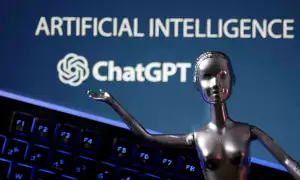
• Studies suggest memory, decision-making, critical thinking are most at risk
• Experts say artificial intelligence removes ‘learning opportunities’
• Studies suggest AI boosts short-term gains, but weakens long-term learning
• Long-term impact on human brain remains unclear
PARIS: Generative AI chatbots capable of writing emails and computer code, translating, organising a trip or coming up with gift ideas are now readily available, prompting some to ask whether human brainpower could suffer for lack of use.
A simple natural-language prompt is usually enough to draw a useable response from a service like ChatGPT or Claude, with the effects making themselves felt in schools and universities, workplaces from offices to courtrooms and our personal lives.
Recent scientific studies suggest there could be harmful consequences to farming out cognitive tasks to AI.
They highlight memory, decision-making and critical thinking as particularly at risk.
One American-British study of 1,222 people, still under peer review, found that using AI tools to solve arithmetic or reading comprehension exercises improved participants’ performance in the short term, but in the long run diminished their results and their willingness to keep trying when the tools were unavailable.
“These findings are particularly concerning because persistence is foundational to skill acquisition and is one of the strongest predictors of long-term learning,” the authors wrote.
AI’s ability to conjure up speedy responses to all kinds of questions “removes learning opportunities” from users, said Carnegie Mellon University doctoral student Grace Liu, the article’s main author.
“What makes AI particularly concerning is that it’s not a tool designated for one specific kind of activity. It’s something that can be used across pretty much any intellectual, reasoning, cognitive activity.” The technology’s adaptability to different kinds of problems sets it apart from previous waves of computerised aids.
Electronic calculators, for instance, may have helped users solve equations — but left the method and reasoning process in human hands.
Saving energy
One 2025 MIT study went viral for its finding that students using generative AI to write essays displayed less critical thinking capability.
Other research has pointed the same way, highlighting what has come to be called “cognitive offloading” — or even “cognitive surrender”.
“Human beings have a strong tendency to save energy,” said Johann Chevalere, a researcher in social and cognitive psychology at France’s publicly-funded CNRS institution.
“In daily life, we often use strategies that get us to the heart of the matter quicker, without necessarily taking the time to study in depth the information we need to process, as this can be cognitively costly,” he added.
Generative AI use could strengthen this tendency, Chevalere said.
“If there are activities you never do, the brain — which works by saving energy — won’t go to the trouble of maintaining connections that aren’t being used.”
Encouraging reflection
Under pressure from critics, generative AI developers have begun building so-called “Socratic” functions into their models, which for now remain mostly aimed at students.
In this mode, chatbots do not simply provide the answer, instead offering hints and asking questions to stimulate users’ thinking.
Examples include the “study mode” built into OpenAI’s ChatGPT, or “guided learning” in Google’s Gemini.
US software giant Microsoft told AFP it had built warnings about the risk of mistakes into its Copilot models.
The AI also reminds users to check the information it provides, just one of several measures designed to keep them actively and critically engaged with its responses.
“The risk of excessive cognitive offloading is real, especially if AI is used to automate tasks that are also valuable for developing skills,” Microsoft said, adding that users have to be trained to use the tools correctly.
For now, there is a lack of large-scale, long-term studies to judge the true impact of the new technology on human brains, researchers agreed.
Until they are available, “it’s up to us to use AI in a smart way”, Chevalere said. “We’ll adapt to this technological revolution just as we have to the previous ones”.
Published in Dawn, July 16th, 2026 ...
이 뉴스, 어떠셨어요?
탭 한 번으로 반응 · 로그인 불필요