Dar writes to UNSC president, highlights India's 'brazen violations' of Indus Waters Treaty
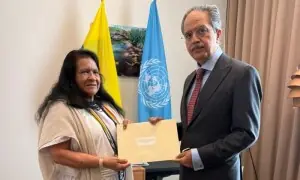
UNITED NATIONS: Deputy Prime Minister and Foreign Minister Ishaq Dar has urged the UN Security Council (UNSC) to take notice of India’s “brazen violations” of the Indus Waters Treaty (IWT), warning that New Delhi’s actions threaten Pakistan’s water security, regional stability and international peace.
Pakistan’s Permanent Representative to the UN Ambassador Asim Iftikhar Ahmad delivered a letter from DPM Dar to the president of the UNSC, Ambassador Leonor Zalabata Torres of Colombia, drawing attention to India’s violations of the IWT.
In a post on the social media platform X, the ambassador said the letter “draws urgent attention of the UNSC to two illegal Indian infrastructure projects linked to Chenab River system aimed at water diversion, which reveal India’s intention to illegally alter the treaty-governed flow and use of the Western rivers, weaponising water with dangerous implications for Pakistan’s water, food, and economic security as well as regional stability and international peace and security”.
He said that the UNSC was urged to take cognizance of this “fragile and deteriorating situation and hold India accountable for its brazen violations”.
“I also briefed the president of the UNSC on the overall situation in South Asia and India’s continued non-compliance with its obligations under UN Security Council resolutions on the Jammu and Kashmir dispute,” he said.
Dar had also written a similar letter to the UNSC president in April, to draw the council’s attention to the matter “one year after India’s illegal decision to hold the Indus Waters Treaty in abeyance” and highlighted the move’s “grave peace and security, and humanitarian consequences”.
On Thursday, DPM Dar had stated that at least 17 projects by India on waterways part of the Indus River System would give New Delhi the “tools for hydro-hegemony”.
The IWT remains a contentious issue between India and Pakistan, following New Delhi’s unilateral abeyance of the accord last year — a move that followed a brief military conflict between the two sides in May 2025.
More recently, Indian Water Minister CR Patil said his country was working to ensure “not a single drop of water” would flow into Pakistan. Meanwhile, Pakistan has maintained that any attempt to change the flow of cross-border waterways would be considered an “act of war”.
A treaty under strain
The Indus Waters Treaty, brokered by the World Bank in 1960, regulates the distribution of the Indus river system between India and Pakistan. It allocates the eastern rivers — Ravi, Beas and Sutlej — to India, while the western rivers — Indus, Jhelum and Chenab — are largely allocated to Pakistan.
The agreement has long been considered one of the most durable frameworks of cooperation between the two countries, surviving wars and repeated crises. However, it has come under strain since India announced in 2025 that it was placing its treaty obligations in abeyance.
The announcement followed an attack on tourists in occupied Kashmir’s Pahalgam that killed 26 tourists — an incident New Delhi blamed on Islamabad without evidence. For its part, Pakistan strongly denied the allegations and called for a neutral investigation.
In June 2025, the Permanent Court of Arbitration (PCA) — an organisation that provides a framework for international disputes — had issued a Supplemental Award of Competence, stating that India could not unilaterally hold the treaty in abeyance.
India has maintained that it will keep the treaty in abeyance until Pakistan ends alleged support for cross-border terrorism — an accusation that Islamabad denies.
Last month, Pakistan hailed another supplemental award by the Permanent Court of Arbitration that it said affirmed Islamabad’s position of the Indus Waters Treaty placing “substantive limits on India’s water-control capability” on Indus River system’s western rivers.
The decision pertained to maximum pondage — a technical term for the maximum volume of water that could be stored in a reservoir — in Indus Waters Treaty proceedings arising from design disputes concerning the Ratle Hydroelectric Plant and the Kishenganga Hydroelectric Project in occupied Kashmir.
While the decision was not publicly shared by the PCA, an official statement by the Pakistan government said it addressed a core treaty concern that “India cannot justify increased pondage through imagined capacity, artificial load curves, unrealistic peaking assumptions, or bare assertions of compliance with paragraph 15 release limits”.
Indian news outlet CNBC TV18 recently reported that India would begin work on a proposed “Link-3 Project”, located on Chenab in Himachal Pradesh, on August 1. The project aims to divert surplus water from the Chenab river to the Beas basin and is estimated to cost 26.2 billion Indian rupees, as per Indian news agency ANI.
When asked about these reports during a weekly briefing on June 4, Foreign Office spokesperson Tahir Andrabi denounced India’s plans to build a river-linking project to divert water from Chenab to the Beas river as a “grave violation” of the Indus Waters Treaty and other international laws.
“Yes, we have seen this report as well as the public tendered document issued by the government of India that India has invited bids for the Chenab-Beas Link Tunnel project with the intention of transferring 1.9m acre feet of water annually from Chenab into the Beas system.
“Such an inter-basin diversion of water of the Chenab into the Beas system constitutes a grave violation of not just the IWT but also of the laws of treaty, particularly the Vienna Convention on the Law of Treaties, as well as the broader framework of international water law, including the principles reflected in the 1977 UN convention on watercourses,” he said.
The FO spokesperson also highlighted India’s planned “silt flushing” of the Salal Dam in occupied Kashmir’s Reasi district.
“This is a deeply concerning development. It would provide water control capability that is not permissible under either the Indus Waters Treaty or the 1978 Salal agreement,” he pointed out. ...
이 뉴스, 독자들은 어떻게 느꼈나요?
첫 반응을 남겨보세요로그인하면 감정 반응에 참여할 수 있어요.