Truce brings no relief for displaced from Lebanon's destroyed, occupied towns
이 뉴스, 어떠셨어요?
한 번의 탭으로 반응을 남겨요 · 로그인 불필요
A long-awaited ceasefire has brought relative calm to Lebanon, but it hasn’t brought peace of mind to Hussein Merhi.
He is among tens of thousands who remain displaced because their homes were destroyed in Israeli strikes or their hometowns fall within a swathe of the south occupied by Israel’s military or, as in his case, both.
“I still can’t go back to my village. It’s still occupied. My house is gone, and my livelihood is gone,” said the former farmer, who was living in the historic Lebanese border town of Kfar Kila, which now lies destroyed.
Merhi, 39, spoke to Reuters in a university being used as a shelter in the southern Lebanese port city of Sidon, following a ceasefire that took hold on Saturday between Israel and Lebanon’s Hezbollah.
“We were displaced, and we’re going to remain displaced. There’s a ceasefire — what did I gain?”
Stray dogs walk past the rubble of flattened homes and businesses, destroyed by the Israeli military, in the southern Lebanese village of Tibnin on June 24, 2026. —AFP/File
‘There’s no house, no village’
Israel’s military began an air and ground campaign in Lebanon in early March.
As it expanded its operations, it ordered residents to leave large parts of southern Lebanon, as well as areas in the east and near the capital Beirut, some far from the front lines.
More than 1.2 million people were displaced during the fighting — about a fifth of the population. Most of the displaced fled to relatives’ homes in safer areas but tens of thousands moved to government-run displacement shelters.
The ceasefire that took hold on June 20 appeared to allow some to return to their villages: out of more than 103,000 in displacement shelters before the ceasefire, about 14,000 had left by Wednesday, according to figures from Lebanese authorities.
Local officials in some southern Lebanese towns told Reuters this week that families were returning, but numbers were hard to estimate as many found their homes in ruins.
A Lebanese woman removes broken metal railing from her damaged house following Israeli military strikes, in the southern Lebanese village of Srifa on June 24, 2026. —AFP/File
Lebanon’s National Council for Scientific Research says more than 90,000 housing units were damaged or destroyed across the country from the war’s start on March 2 until June 12.
Merhi’s mother, 64-year-old Zahra Chehadeh, told Reuters she hoped the government would provide housing as renting was too expensive for her family, who now had no income without access to their farm in Kfar Kila.
“Like everyone else, I felt like I wanted to go back to my village, go back to my home. There’s no house, no village, nothing at all. What am I supposed to feel?” she said.
Israeli troops remain deployed 10 kilometres into the south, a zone that includes dozens of Lebanese villages and which Israeli officials say remains off-limits.
Israel’s Defence Minister Israel Katz said earlier in the war that troops would destroy “all houses” in villages near the border and that residents would not be allowed to return until northern Israel was safe.
Amnesty International said earlier this month that Israel’s use of the mass displacement and “no-return” orders was a violation of international humanitarian law.
Israel’s military claims the orders are intended to protect civilians from harm.
A Lebanese child stands inside the kitchen of their family home looking at the damage caused by Israeli military strikes, in the southern Lebanese village of Srifa on June 24, 2026. —AFP/File
Long-term displacement looms
Lebanon and Israel are discussing a US-backed proposal for Israeli forces to hand some Lebanese territory to Lebanon’s military, but it remained unclear how much land Israel would withdraw from, and how quickly.
Authorities have been bracing for a long-term displacement crisis if Israeli troops remain in southern Lebanon.
Lebanese officials said they were exploring the possibility of pre-fabricated housing or cash-for-rent programs, but finding funds and open land were challenges.
In Beirut, the city council said on Wednesday it was giving people living in makeshift camps along streets time to gather their belongings “in preparation for their final removal in the coming hours”.
That has left some with nowhere to go.
Alaa Kobeissy, who hails from the southern town of Zebdine, said his extended family’s homes had been too badly damaged for them to return home. He had fled to Iraq during the 2024 war between Israel and Hezbollah and was now displaced again.
Alaa Kobeissy packs his belongings on a sidewalk in Beirut, where he and his family have been living in a tent, as he prepares to return home following an interim deal between the U.S. and Iran, in Beirut, Lebanon on June 24, 2026. —Reuters/File
“The main problem is that I don’t have a place,” the 40-year-old told Reuters on the streets of Beirut, with the tarp of his disassembled tent in a pile next to him.
Lebanon has suffered repeated rounds of conflict and economic crisis in recent decades that have prompted hundreds of thousands of people to emigrate. The latest war came as the country was still struggling to recover from the 2024 conflict.
“We in Lebanon have gone from migration to displacement, to migration, to the ground — we’ve thrown everything (to the ground): the Lebanese flag, the tents, and our belongings.”
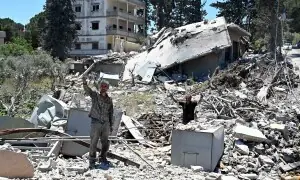
Header image: Residents flash the V-sign for Victory as they stand on the rubble of collapsed home, destroyed in Israeli military strikes, in the southern Lebanese village of Srifa on June 24, 2026. —AFP/File ...