Budgeting on hope
If ever voice mattered, it was now. The budget unveiled today shows the government heard everything that was being said about it and has moved to rectify, albeit the moves are small.
Salaried people have been extended some relief, but mostly for upper slabs. The infamous “deemed income” on capital assets (immoveable property) has been scrapped. The other bug bear of the elites, the so-called “Super Tax” has been abolished for firms with income up to Rs500 million and for those earning above this threshold the rate has been reduced from 10 per cent to 8pc, excluding banks, E&P and fertiliser sector.
Advance taxes on real estate transactions have been reduced from 2.75pc to 1.5pc, supposedly to encourage documentation of these transactions. The Capital Value Tax (CVT) on foreign movable and immovable assets of resident Pakistanis has also been abolished.
These measures were lightning rods throughout the tenure of this government and the fact that they have moved on them shows they are responsive, even if much ground remains to be covered. What is puzzling though is trying to figure out how they intend to squeeze and additional Rs 2.281 trillion FBR tax revenue for FY27.
There are revenue measures for sure, like a withholding tax on digital content creators and social media influencers, new FED imposition and increased duties on e-liquids and various additives for fuels as well as luxury electric vehicles.
There is a sweeping change in sales tax to broaden the base. The definition of a “Tier 1 retailer” has been expanded, banks and other electronic money transfers companies will be required to report high-value transactions, penalty rates on non-filers will now also apply to capital gains made from trading stocks of listed companies (which did not used to be the case) and companies will be required to file machine-readable financial statements.
As an aside, it would be helpful for the government to live up to this commitment itself as well, and make its data releases machine readable too.
On the flip side, a whole new set of administrative and enforcement power have been brought in along with what they are calling “faceless” administration to reduce human interface between tax authorities and taxpayers, to the point of creating a “National Faceless Centre”. Audits and assessments will be algorithmically managed now, and taxpayers will be able to settle tax discrepancies through a technology based system without penalties and surcharge payments, under some scenarios.
The rollout of the production monitoring system in FY26 seems to be set to expand in F27 and the FBR will be given powers to require businesses to install systems for real-time monitoring of their activity.
For income taxes, they are hoping to raise buoyancy largely from stricter enforcement measures. Sales tax collection largely tracks nominal GDP increase and it has the fewest new measures, meaning the the heavy lifting is expected to come from income tax collection.
Adjusting for nominal growth (13.2pc), the incremental revenue effort for FY27 aims to raise Rs568bn, of which a whopping Rs313bn are supposed to come from the income tax alone. The rest of the burden is going to be borne by sales tax, customs duties and federal excise.
The figures suggest a very optimistic outlook since they imply a “revenue buoyancy” that the FBR was unable to marshall up in the ongoing fiscal year. Buoyancy refers to how much revenue the state can collect from increased economic activity and increased rates. In this case, the state is aiming for its revenue growth to be one third faster than the growth of the economy.
Beyond this, the budget is empty.
The government is budgeting on a hope here. To produce revenue buoyancy of the sort they are aiming for while relying on documentation measures that have largely been tried and failed in the past inspires little confidence, especially as they are coming off a year in which they fell far behind their collection target despite aggressive pursuit.
Complicating their task is the fact that one key revenue line that shored up their fiscal health in FY26 — State Bank profits — is budgeted to shrink by almost 41pc, or Rs992 billion. This is a massive decline to be compensated for elsewhere.
But taken together, both these items will still be providing 15pc of gross federal revenue, which shows that despite the steep decline, the state’s revenue effort continues to lean heavily on these items.
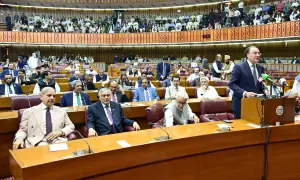
Header image: Finance Minister Muhammad Aurangzeb delivers budget speech on Friday, June 12. — White Star ...
이 뉴스, 독자들은 어떻게 느꼈나요?
첫 반응을 남겨보세요로그인하면 감정 반응에 참여할 수 있어요.