과학
기타
Hubble Glimpses Merging Galaxy Clusters
NASA Science
조회 0
Public Domain
이 매체는 공공·자유 라이선스로 본문을 직접 표시합니다.Explore HubbleHubble Home
OverviewAbout Hubble
The History of Hubble
Hubble Timeline
Why Have a Telescope in Space?
Hubble by the Numbers
At the Museum
FAQs
Impact & BenefitsHubble’s Impact & Benefits
Science Impacts
Cultural Impact
Technology Benefits
Impact on Human Spaceflight
Astro Community Impacts
ScienceHubble Science
Science Themes
Science Highlights
Science Behind Discoveries
Universe Uncovered
Hubble’s Partners in Science
Hubble & Citizen Science
AI & Hubble Science
Explore the Night Sky
ObservatoryHubble Observatory
Hubble Design
Mission Operations
Science Operations
Astronaut Missions to Hubble
Hubble vs Webb
TeamHubble Team
Career Aspirations
Hubble Astronauts
MultimediaImages
Videos
Online Activities
e-Books
Sonifications
Podcasts
3D Hubble Models
Lithographs
Fact Sheets
Posters
Hubble on the NASA App
Glossary
NewsHubble News
Social Media
Media Resources
35th Anniversary
MoreOnline Activities
2 min read
Hubble Glimpses Merging Galaxy Clusters
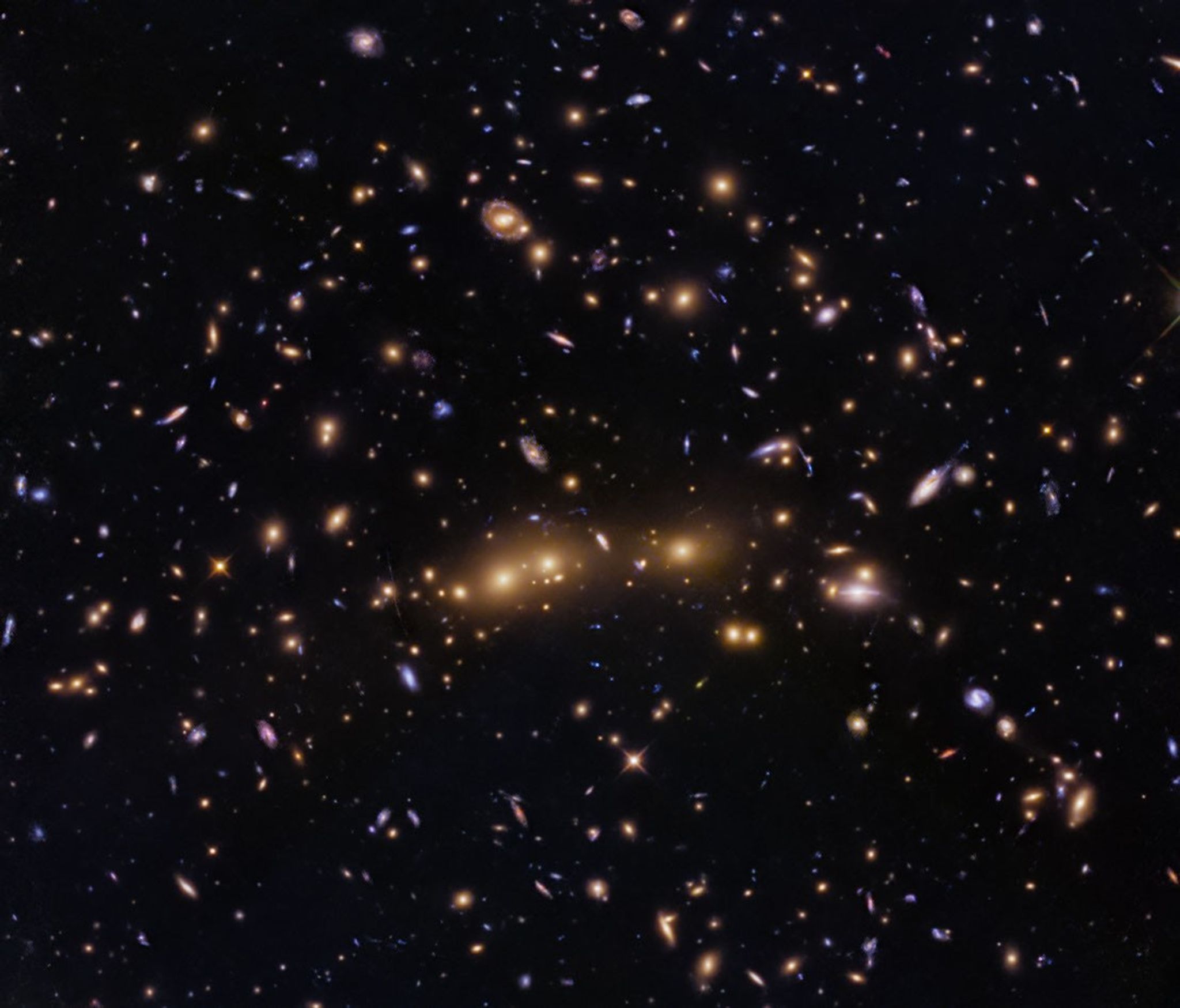
This NASA Hubble Space Telescope image features a swarm of galaxies in the galaxy cluster called CL0016+1609 or MACS J0018.5+1626.
NASA, ESA, H. Ebeling (University of Hawaii), D. Coe (STScI, ESA, JWST); Image Processing: G. Kober (NASA/Catholic University of America)
This NASA Hubble Space Telescope image features a galaxy cluster, called CL0016+1609 or MACS J0018.5+1626, that is very bright at X-ray wavelengths and is one of the most extensively studied clusters at X-ray and radio wavelengths. The X-ray observations of this cluster revealed that it is two clusters merging along our line of sight.
Researchers requested time to observe CL0016+1609 with Hubble’s Advanced Camera for Surveys because that data would help them accurately measure the cluster’s dark-matter distribution, which helps them study the merger and the role of CL0016+1609 in the large-scale structure of the universe. Hubble can’t directly see dark matter, but its infrared and visible light observations can detect dark matter’s gravitational lensing effects on the normal matter Hubble observes.
The data in this image also includes observations with Hubble’s Wide Field Camera 3 taken as part of an observing program that obtained the first Hubble infrared images of 46 massive galaxy clusters and looked for distant galaxies gravitationally lensed by these clusters. Called RELICS (Reionization Lensing Cluster Survey), this survey found some 300 high-redshift candidate galaxies lensed by these clusters.
You can see the faint vertical arc of one of these distant galaxies in the image above. Look for it just to the left of the large elliptical galaxies in the center of the image. Another brighter, though shorter arc is visible just above and to the right of the large elliptical galaxies in the center of the image.
Facebook logo
@NASAHubble
@NASAHubble
Instagram logo
@NASAHubble
Media Contact:
Claire Andreoli
NASA’s Goddard Space Flight Center, Greenbelt, MD
claire.andreoli@nasa.gov
Share
Details
Last Updated
Jun 18, 2026
Editor
Andrea Gianopoulos
Location
NASA Goddard Space Flight Center
Related Terms
Hubble Space Telescope
Astrophysics
Astrophysics Division
Galaxies
Galaxy clusters
Goddard Space Flight Center
The Universe
Keep Exploring
Discover More Topics From Hubble
Hubble Space Telescope
Since its 1990 launch, the Hubble Space Telescope has changed our fundamental understanding of the universe.
Hubble’s Galaxies
Hubble Science Highlights
Hubble Images
The post Hubble Glimpses Merging Galaxy Clusters appeared first on NASA Science.
이 뉴스, 독자들은 어떻게 느꼈나요?
첫 반응을 남겨보세요로그인하면 감정 반응에 참여할 수 있어요.
관련 뉴스
관련 뉴스 제보는 로그인 후 가능합니다.