Turns Out France Has an Oligarch Problem Too
As recently as 1957, it was news when an American, the oil man H.L. Hunt, ranked among the five richest people on earth. In those days, the only path to that kind of wealth was oil, and the other four richest people were all Mideast monarchs: King Saud of Saudi Arabia; Sheikh Abdullah Al-Salim Al-Sabah of Kuwait; Sheikh Ali Bin Abdullah Al Thani of Qatar; and the last Nizam of Hyderabad, Mir Osman Ali Khan (who’d lost his royal title in 1948 when Hyderabad was absorbed into India with the end of the British Raj).
Today it’s quite different. The five richest people on earth, according to Forbes, are all tech bros—Elon Musk, Larry Page, Sergey Brin, Jeff Bezos, and Michael Dell—and they’re all American. Royalty no longer figures. The world’s richest monarch, King Maha Vajiralongkorn of Thailand (net worth: $45 billion), would just barely make the top 50 if Forbes bothered to include royals in its billionaire tally, which it doesn’t. Too small-time! In the 1990s the Sultan of Brunei (since 1967, Hassanal Bolkiah Muiz’zaddin Wad’daulah) was the world’s richest person. Today he’s the world’s second-richest monarch after Thailand’s, with a net worth of $30 billion, an amount that would rank him a pitiful 79th in the Forbes tally, right after the ex-wives of Bezos and Bill Gates. (It was Gates who displaced Brunei’s Sultan.)
If we tend today to speak of the American oligarchy and the global oligarchy as one and the same, that’s because mostly they are. Great political power no longer propels you to the top of the Forbes billionaire rankings (though President Donald Trump is giving it the old college try). Did I say the five richest people in earth are all American tech tycoons? You might almost say the same of the top 10. But there’s one exception—a foreigner who is not in tech, not in oil, and not of royal blood. He is the ninth-richest person in the world (net worth: $142.7 billion), and a couple of years ago he was the richest. Now he’s just the richest person in Europe, leaving its crowned heads in the dust. Most Americans have never heard of him.
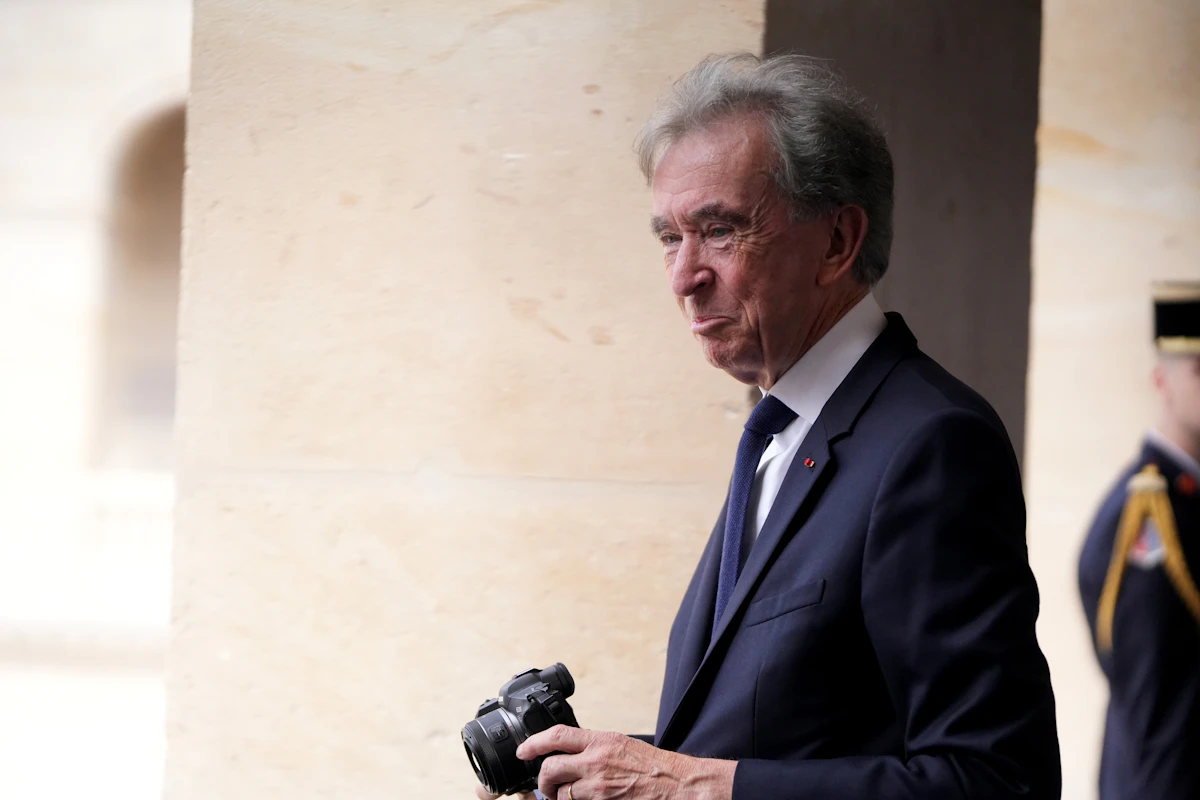
I’m speaking of the Frenchman Bernard Arnault, founder and CEO of LVMH. Arnault got rich selling expensive stuff to rich people. LVMH owns the luxury brands Louis Vuitton, Tiffany & Co., Christian Dior, Givenchy, Bulgari, Guerlain, and Sephora. It also owns the makers of Moët & Chandon and Dom Pérignon and Veuve Cliquot. If there’s something your wife or girlfriend would like that you can’t afford to buy, odds are Arnault sells it. And according to a six-part newspaper series published last week in Le Monde by Raphaëlle Bacqué and Vanessa Schneider (English translation here), l’État, c’est lui. Arnault wields too much power in France.
This comes as a terrible disappointment, as I’m a bit of a Francophile. On a trip to France last year, my wife and I rhapsodized about the more plentiful public squares, the safer roadways, the more beautiful urban vistas, and—of course—the food. France also has one of the better single-payer health care systems in the world, though, happily, we didn’t need to use it. I published a history 14 years ago of America’s post-1979 growth in income inequality in which I used France as Exhibit A for my argument that, since incomes were growing more equal there, expanding economic inequality is a political choice, not an inevitability. I still believe that, but in France, alas, that trend has reversed.
Let’s take Le Monde’s tour of l’oligarchie en français.
Inside the company, almost everybody refers to Arnault as Monsieur; a handful will call him “BA” (which doesn’t carry the vulgar associations we Americans give it). Arnault’s children are addressed as Monsieur or Madame as well, only with them it’s attached to a first name (e.g., “Monsieur Alexandre”). This is the same locution that foreign-born American housekeepers apply to subvert their employer’s insistence on addressing one another on a first-name basis. At LVMH, it is used to address even Arnault’s grandchildren after they reach the age of 7, making even high-ranking LVMH executives sound like a stiff-backed butler in a drawing-room play. Arnault himself shuns physical contact and, according to his wife, “has no friends.”
Arnault does have five children from two wives, and all of them work for the company, which should make these Le Monde pieces catnip to anyone who followed Succession, the TV series about a thinly-veiled Murdoch family. Arnault is 77 and, yes, he hasn’t settled who among his five children will inherit his luxury empire. We learn that “tensions and rivalries tear at his clan” and “it’s now difficult to get everyone around the same table.” The very existence of these six articles both reflects and intensifies family tensions because Arnault’s son-in-law, Xavier Niel, is effectively Le Monde’s principal shareholder. (It’s a little complicated. Niel transferred his majority shares two years ago to a nonprofit to preserve the paper’s independence, and Le Monde’s disclaimer calls him merely “an individual shareholder.”) Arnault’ s wife Hélène says of Niel: “He is not the kind of person we want in the family.” Niel is no longer invited to family occasions. Hélène’s also got chilly relations with her stepson Antoine, Arnault’s son from an earlier marriage. Antoine hasn’t spoken to Hélène for two years.
Proceeding now to Arnault’s role as oligarch: France will have a presidential election next year. At the funeral last month for former president Jacques Chirac’s widow (who Arnault had placed on LVMH’s board), three candidates walked to the front of the basilica, where Arnault was seated among the country’s past and present political elite, to pay homage. Arnault isn’t sure he likes any of them. In April he agreed to meet, for the first time in his life, the far-right candidate Marine LePen, who, like Trump, kicked off a presidential run with a felony conviction (in LePen’s case, for embezzling public funds, a ruling upheld earlier this month by an appeals court). Arnault told LePen that “On security and illegal immigration, you have real credibility, but on the economy, it feels like you’re close to” France’s political left in wanting to “over tax” businesses. Two of Arnault’s sons met recently with Jordan Bardella, president of LePen’s repellant National Rally party. This is a moment for France’s financial leaders to unite in opposition to incipient fascism. It didn’t happen in the United States in 2024, and it isn’t happening in France today.
Arnault wields remarkable influence over France’s current president, Emmanuel Macron. In 2020, Macron directed his finance minister to permit Arnault to renegotiate LVMH’s contract to purchase Tiffany, which had already been signed. Arnault felt he’d paid too much because after he agreed to a price Covid reduced Tiffanys’ sales. This was, Le Monde observes, a matter in which the government had no legitimate reason to interfere. In 2021, Macron appeared for the opening of a department store, something he’d never done before; it was LVMH’s Paris flagship, La Samaritaine. In 2024, Macron awarded Arnault the Légion d’Honneur, France’s highest honor. “During Macron’s time in office,” writes Le Monde, “the Elysée has never refused anything for Arnault.”
The United States government, at least in the person of French Ambassador Charles Kushner (Trump-pardoned ex-con father to Jared) treats Arnault better than it treats Macron. Kushner has twice refused Macron summonses to the Elysée Palace, but he celebrated America’s semiquincentennial by throwing a party for Arnault, who Kushner calls not Monsieur but “Beurrernarte.” Arnault and Trump have been friends since the 1980s. In 2019, Arnault and his son Alexandre travelled with President Trump on Air Force One so they could attend the opening of a Louis Vuitton factory outside Dallas. “You are an artist and a visionary,” Trump said in his speech. Arnault got Trump to exempt LVMH’s champagnes from European tariffs; later, Louis Vuitton rented space from the Trump Organization in midtown Manhattan. Alas, Arnault had less luck in Trump’s second term fighting Trump’s 20 percent tariff on European imports, which cost LVMG tens of billions of euros.
Arnault was so angered by the Le Monde series that he took to social media for the first time in his life and posted a lengthy response on X. It’s mostly a series of sarcastic ripostes (“I haven’t received such treatment since the takeover of Boussac in 1984. Back then, they called me ‘The Terminator.’ I prefer ‘the last royal family’ – it’s more elegant”). The family soap opera should end once Arnault chooses a successor. L’oligarchie, however, seems settled in for a long run, especially if, God forbid, LePen wins. Please somebody make France stop aping the United States. ...
이 뉴스, 어떠셨어요?
탭 한 번으로 반응 · 로그인 불필요