Trump’s Latest Plan to Sell Your History Out From Under You
Last week, in an update about efforts to save the Wilbur J. Cohen Federal Building—a.k.a. “the Sistine Chapel of the New Deal” —I mentioned in passing the Advisory Council on Historic Preservation, or ACHP. The ACHP administers an important regulation, known as Section 106, that enforces the 1966 National Historic Preservation Act. Back in February the ACHP launched a comprehensive review of Section 106 with the avowed purpose of “streamlining” it, which is to say weakening it.
That review process turns out to be further along than I realized (hat tip to Janay Kingsberry of the Atlantic for filling me in). Now the ACHP, which is under the firm control of President Donald Trump, has produced a draft notice of proposed rulemaking (text here and here) that would make it significantly easier for Trump “to fast-track projects that destroy, or cause irreversible damage to, our historic places, with virtually no public oversight,” according to Sara Bronin, who chaired the ACHP under President Joe Biden. The ACHP is expected to publish the notice of proposed rulemaking by the end of this week.
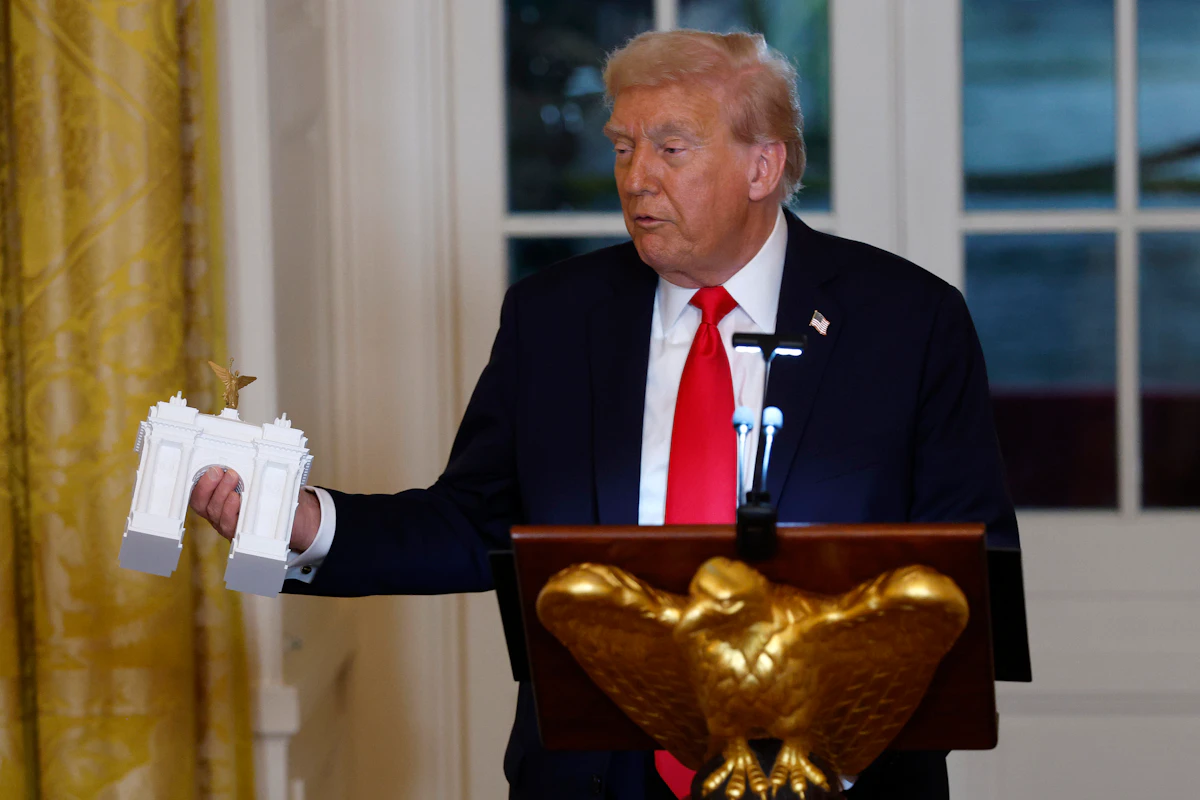
Given Trump’s demolition of the East Wing; his plans to build a White House ballroom that dwarfs the executive mansion; his efforts to erect an Arc de Trump in the traffic circle leading to Arlington Cemetery, and a National Garden of American Heroes in West Potomac Park; and, given further, the Trump White House’s previous plans, now set aside, to demolish the Wilbur J. Cohen building and three other federal office buildings in Southwest Washington that it’s been trying to unload—these regulatory changes would be like handing a box of matches to an arsonist.
The main thrust of the proposed revisions is to reduce opportunities for public input into preservation decisions and to reduce preservation’s scope. “We’ve never seen a proposal that would do this much damage to this much of the country’s history in one stroke,” said Greg Werkheiser, founding partner of Cultural Heritage Partners, which is currently litigating against Trump’s Kennedy Center alterations and his planned whitewashing of the Old (now Eisenhower) Executive Office building. Cultural Heritage Partners has set up an online war room to fight against the proposed Section 106 changes.
But in a telephone conversation late Monday, Bronin warned me not to think solely of Trump’s Mad King Ludwig-like desire to reshape the nation’s capital according to his whims. (My analogy, not hers.) “I would encourage people not to get distracted by the types of projects that have been in the news,” Bronin said, “because these changes are geared toward a more systematic overhaul of the process” to “benefit some of the most destructive projects that are in the federal pipeline,” including lucrative mining and oil exploration on federal lands previously protected by the National Trust for Historic Preservation.
Bronin cited as an example an area of Arizona’s Tonto National Forest, known to the local indigenous community as Chi’chil Biłdagoteel and to everyone else as Oak Flat. To these Native Americans, it’s a sacred site, and as such it’s listed as a Traditional Cultural Property in the National Register for Historic Places. In 2014, then-Senators John McCain and Jeff Flake, Republicans of Arizona, inserted into a defense bill a provision requiring transfer of Oak Flat to an Australian mining company called Resolution Copper. The mining would obliterate Chi’chil Biłdagoteel, and thus far Section 106 has been a useful tool to block this activity in court.
But the proposed revisions to Section 106 require (on page 47) that to qualify for protection, a physical location must be “geographically compact,” which Oak Flat is not. It also states that “noncompact, unimproved natural features such as mountains, valleys, bodies of water, or landscapes, including ethnographic landscapes, do not qualify as property for the purposes of section 106.” If this change is adopted, Resolution Copper, which has already taken title to the land from the U.S. Forest Service, will likely soon dismantle Chi’chil Biłdagoteel.
The “geographically compact” restriction has an urban application as well, Bronin said. It could be used to remove existing protections under the National Historic Preservation Act for historically significant neighborhoods such as New York’s Greenwich Village and Washington’s Georgetown. “These two words,” Bronin said, “would greenlight a wave of destruction of our historic and culturally significant properties that we’ve never seen before.”
The Cohen building would be affected because Section 106 determines how the General Services Administration assesses the fate of the murals and sculptures inside and outside the building as it prepares to sell the Cohen. Passage of Rep. Dina Titus’s bill putting those protections, and more, into statutory language would help, but, as I noted last week, at the moment greater protection for the Cohen comes from GSA’s recent revelation that selling it would incur large expenses to separate its heating and electrical equipment from an adjacent structure, the Mary E. Switzer Memorial Federal Building, which is used by the Department of Health and Human Services.
The proposed Section 106 revision is expected to be approved by the end of this week and published in the Federal Register soon thereafter. The public comment period will be limited to 30 days. After that, the ACHP will likely ignore public comment and finalize the regulation, because that’s now routine practice in the Trump administration. But posting a comment wouldn’t hurt—and you might also want to call your member of Congress about this latest scheme to sell cherished pieces of the United States to the highest bidder. ...
이 뉴스, 어떠셨어요?
탭 한 번으로 반응 · 로그인 불필요