Crew Works Eye Exams, DNA Sequencing, and Spacesuit Preps
이 뉴스, 어떠셨어요?
한 번의 탭으로 반응을 남겨요 · 로그인 불필요
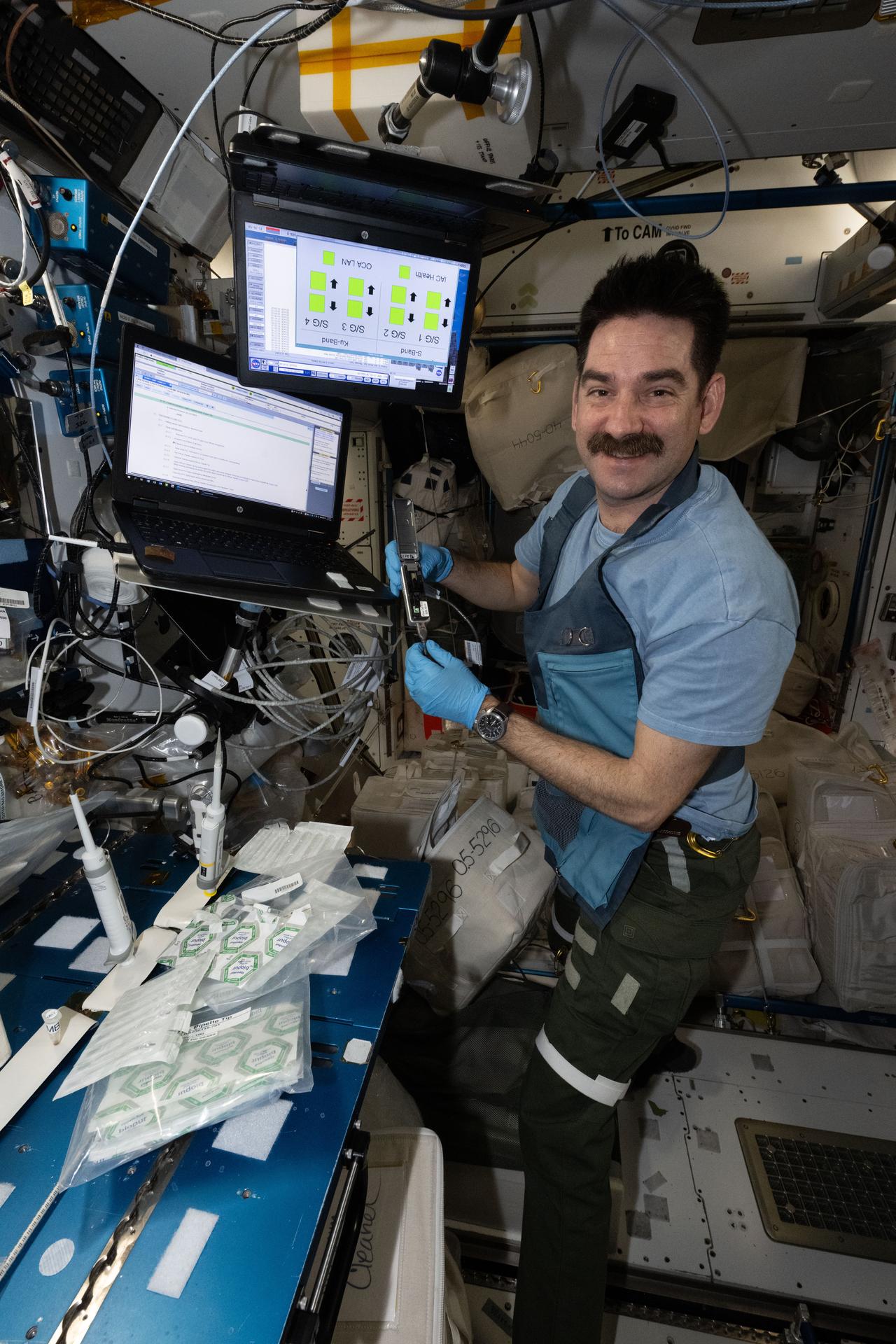
NASA astronaut Jack Hathaway loads bacterial samples into a portable DNA sequencer to read their genetic code inside the International Space Station’s Harmony module. The GEARS biotechnology investigation may help scientists understand how bacteria become resistant to antibiotics in the space environment, which could affect an astronaut’s ability to fight infections.
NASA/Jessica Meir
Life science topped the research schedule on Thursday as the Expedition 74 crew studied how space affects vision and sequenced DNA collected from microbes. More spacesuit preparations, a virtual reality investigation, and exercise gear maintenance rounded out the day aboard the International Space Station.
Eye exams were once again underway as NASA flight engineers Jessica Meir and Chris Williams joined each other in the Columbus laboratory module for the vision portion of the CIPHER suite of 14 human research investigations. Meir took charge first attaching electrodes around Williams’ eyes then sending flashing light signals to measure his retina’s electrical response. Next, she operated medical imaging hardware that Williams peered into providing doctors on the ground a real time view of his retina, cornea, and lens. The biomedical data will help researchers detect potential space-caused changes to eye structure and function.
Meir and Williams also partnered together preparing the components they will install on their spacesuits on June 30 when they go on a spacewalk to repair the Canadarm2 robotic arm’s malfunctioning wrist joint. Meir wore virtual reality goggles and trained to maneuver the Simplified Aid for EVA Rescue (SAFER) that would return a spacewalker to safe haven in the unlikely event they became untethered from the orbital outpost. Williams checked out the SAFER he will wear on his spacesuit next week ensuring its latches, sensors, and controls are in operating condition.
NASA flight engineer Jack Hathaway focused on sequencing microbial DNA using a handheld reader in the Harmony module’s maintenance work area. Scientists are exploring how bacteria become resistant to antibiotics in microgravity and seek to characterize the microbes’ genomic identity possibly revealing their adaptive mechanisms to weightlessness. Insights from the biotechnology investigation may reduce the risk of crew infections during a spaceflight and improve patient health care on Earth.
A new spaceflight workout system has recently been installed and is being tested inside the Columbus lab module. Flight engineer Sophie Adenot ESA (European Space Agency) powered on and configured the advanced gear—known as the European Enhanced Exploration Exercise Device (E4D) from ESA—returning it to normal workout mode. The E4D is being evaluated for its ability to maintain astronaut bone, muscle, and cardiovascular health on future missions to the Moon, Mars, and beyond.
Station commander Sergey Kud-Sverchkov strapped on a virtual reality headset and responded to computerized stimuli as electrodes tracked his brain signals and eye movement documenting his sense of direction and motion in space. Next, Kud-Sverchkov installed automated photography gear in the Zvezda service module to capture imagery of Asian and Pacific Ocean landmarks during the crew’s sleep shift.
Roscosmos flight engineer Sergei Mikaev disconnected computerized docking hardware then reorganized cargo stowed inside the Nauka science module making more room for crew activities. Roscosmos flight engineer Andrey Fedyaev tested the communications and network systems of the European robotic arm.
Learn more about station activities by following the space station blog, @space_stationon X, as well as the ISS Facebook and ISS Instagram accounts.
Get the latest from NASA delivered every week. Subscribe here.