NASA at the Ion: Orion Lessons from Artemis II Shape NASA’s Moon to Mars Path
이 뉴스, 어떠셨어요?
한 번의 탭으로 반응을 남겨요 · 로그인 불필요
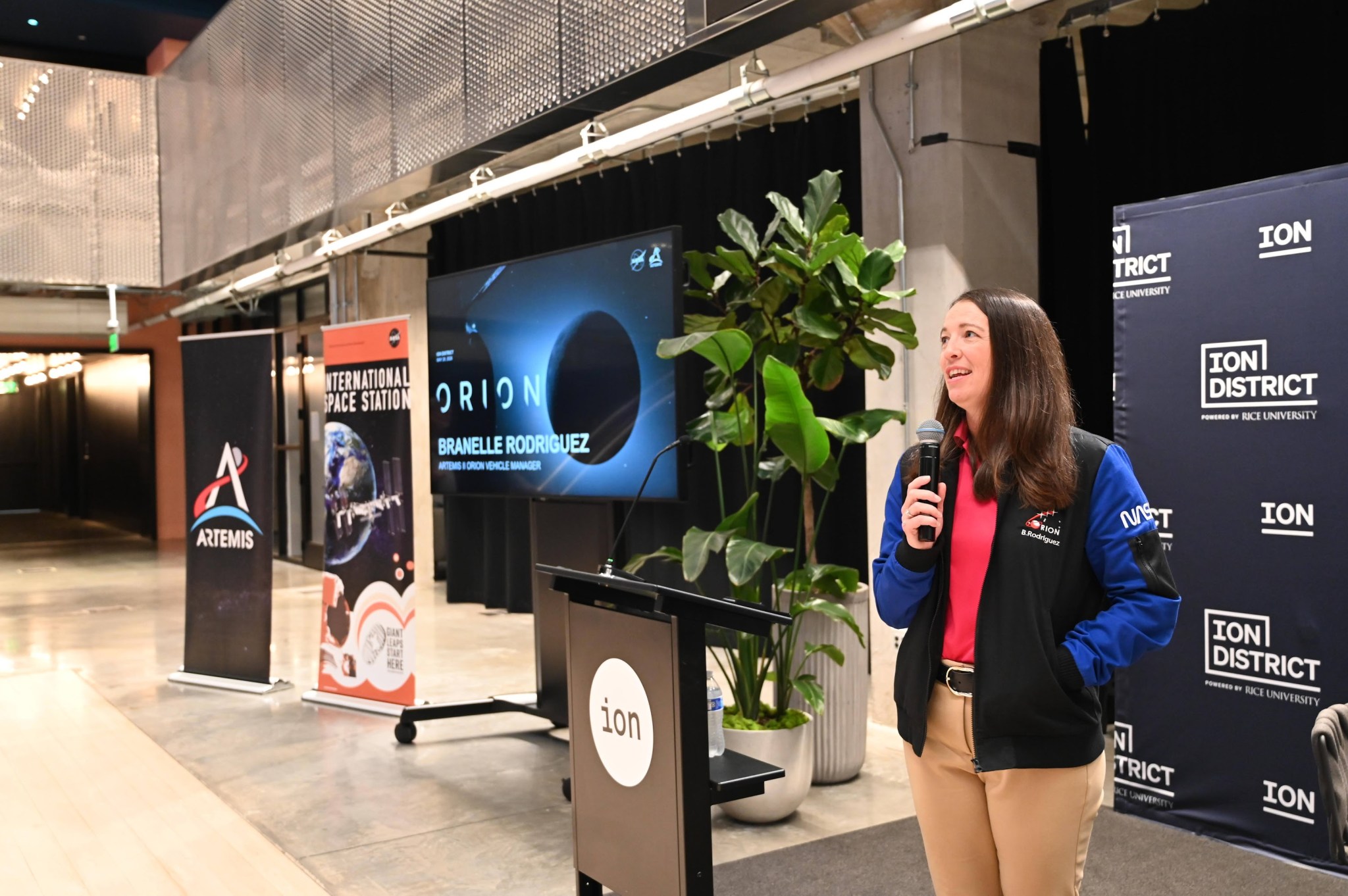
Artemis II Orion Vehicle Manager Branelle Rodriguez speaks at the Ion in Houston on May 28, 2026.
Seven weeks after the Orion spacecraft returned four astronauts from humanity’s first crewed journey around the Moon since Apollo, Artemis II Orion Vehicle Manager Branelle Rodriguez reflected on the mission’s achievements and how it is shaping NASA’s return to the lunar surface and future missions to Mars.
Introduced by NASA’s Johnson Space Center Acting Director of Business Development and Technology Integration Monte Goforth, Rodriguez spoke at the Ion in Houston on May 28 as part of the NASA Stories at the Ion speaker series. Located in Houston’s Ion District, the innovation hub serves as a gathering place for entrepreneurs, researchers, and industry leaders working to advance technology and shape the future of industries ranging from aerospace to energy.
She shared an inside look at the mission she helped guide — as the Orion vehicle manager for Artemis II, Rodriguez has overseen the life of the spacecraft from end-to-end, through its development, production, execution of the mission, and currently, the post-mission work underway now that Orion is back at NASA’s Kennedy Space Center in Florida.
“This mission was very near and dear to my heart,” Rodriguez said. “It has not sunk in what this mission and what this accomplishment all means to us and humanity.”
From left: NASA’s Johnson Space Center Acting Director of Business Development and Technology Integration Monte Goforth, Artemis II Orion Vehicle Manager Branelle Rodriguez, and Director of the Rice Space Institute David Alexander.
Launched April 1, Artemis II carried NASA astronauts Reid Wiseman, Victor Glover, and Christina Koch, along with CSA (Canadian Space Agency) astronaut Jeremy Hansen, on a 10-day voyage around the Moon inside the Orion spacecraft.
Using mission imagery and video, Rodriguez walked attendees through key milestones, including launch aboard NASA’s SLS (Space Launch System) rocket, operations in high-Earth orbit, a lunar flyby, and Orion’s return to Earth. She also shared views from Orion captured by the crew, including Earthrise, detailed images of the lunar surface, and a solar eclipse observed from deep space.
Artemis II successfully demonstrated Orion’s performance during its first crewed deep space mission. The mission tested Orion’s life support systems, crew interfaces, navigation, and reentry systems, providing data that will help teams prepare for upcoming Artemis missions. The crew also completed a manual piloting demonstration, evaluating Orion handling and proximity operations that will inform future rendezvous and docking activities.
“I think it really hit me at T-minus 10 seconds,” Rodriguez said. “That’s when we go into ‘terminal count,’ meaning there’s just no turning back.”
Rodriguez emphasized that Orion’s success on Artemis II was the result of global teamwork across NASA centers, industry partners, and international agencies. She highlighted the European Service Module, provided by ESA (European Space Agency), which supplies Orion with power, propulsion, oxygen, water, and other resources needed during flight. In the Orion Mission Evaluation Room at Johnson, more than 300 people supported the mission, monitoring spacecraft systems and standing ready to respond in real time. Among the mission’s more personal touches was Rise, Orion’s zero-gravity indicator. The plushie, created by a student through an Artemis II design competition, carried a memory card containing over 5.6 million names of space fans who signed up through NASA’s “Send Your Name with Artemis” effort.
“It is what the crew wanted – to bring all of us with them on this mission,” Rodriguez said.
The crew also designed the mission patch with a hidden detail: viewed from a distance, the artwork reads “all” – a deliberate tribute to everyone who made the mission a success.
“It is a village that makes this possible, absolutely,” she said. Looking ahead, Rodriguez discussed preparations underway for upcoming Artemis missions. Artemis III will test critical rendezvous and docking capabilities between Orion and commercial human landing systems in low Earth orbit and advance plans to return astronauts to the lunar surface. On June 9, NASA announced the Artemis III crew at Johnson Space Center in Houston, while hardware for future missions is already in production at Kennedy Space Center in Florida.
For Rodriguez, Artemis II demonstrated what is possible when thousands of people work toward a common goal, supporting NASA’s vision of a sustained presence at the Moon and, ultimately, human missions to Mars.
“It’s going to take time to build this all up,” Rodriguez said. “But we are off and running.”
Explore More
4 min read
I Am Artemis: Jason Peterson
Jason Peterson’s responsibilities for NASA’s Artemis II mission went beyond his usual role as the…
Article
1 day ago
3 min read
I Am Artemis: Elkin Norena
Article
2 weeks ago
4 min read
How NASA Science and Artemis Are Shaping the 2026 FIFA World Cup
Article
2 weeks ago