Examining Algal Blooms in Blue Mesa
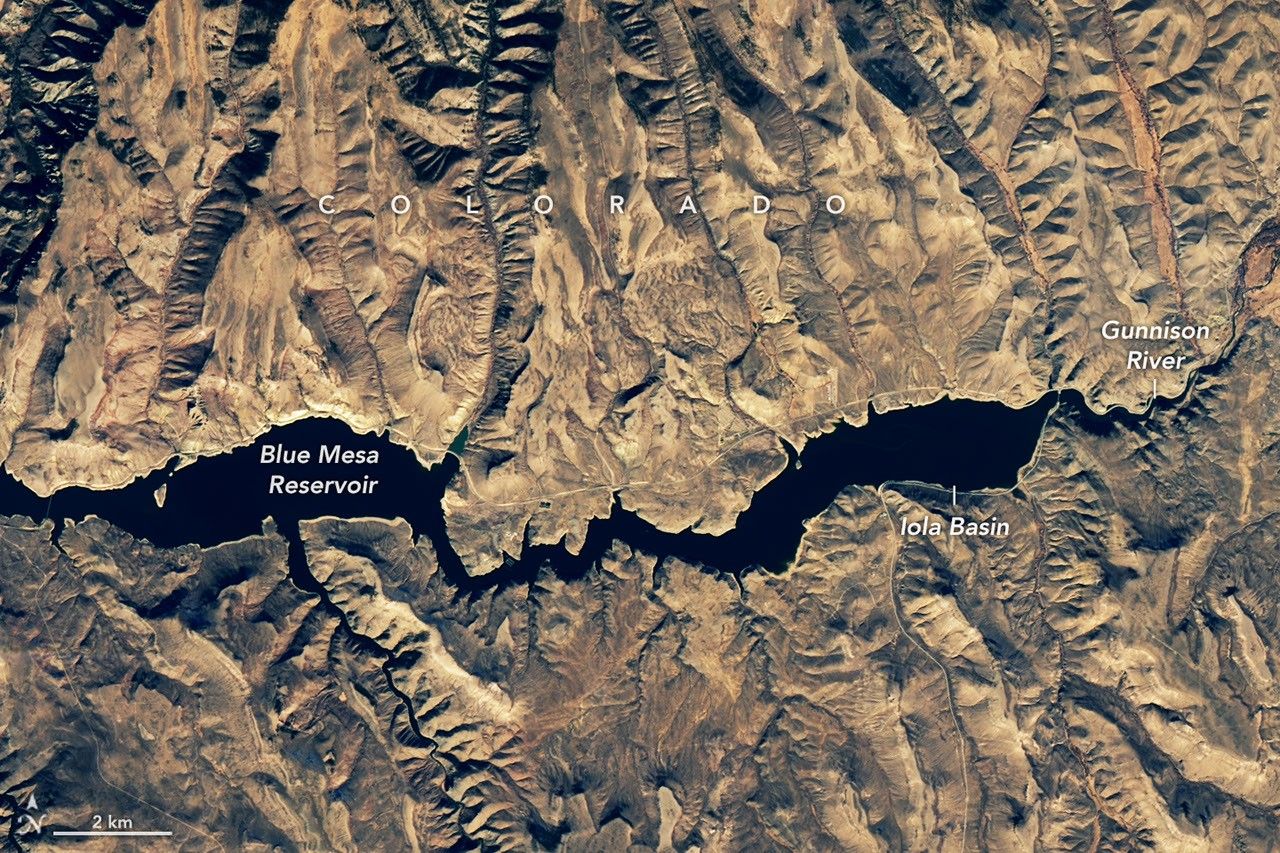
The summers of 2021 and 2022 were tough seasons for Colorado's Blue Mesa Reservoir. A severe drought gripped much of the western U.S., prompting emergency water releases that brought the reservoir to its lowest level since 1984. Marinas and boat ramps closed, remnants of a ghost town emerged from the muck, and parts of the reservoir turned greenish and swirled with toxic cyanobacteria blooms.
Research conducted by scientists at the U.S. Geological Survey and the National Park Service analyzed decades of Blue Mesa Reservoir data and found a connection between low water levels, warm water temperatures, and harmful blooms.
"Algal blooms were more common when water levels were below 7,470 feet and water temperatures were above approximately 19.5 degrees Celsius (67.1 degrees Fahrenheit)," said Tyler King, a research hydrologist with U.S. Geological Survey. Water levels that low are relatively common and have occurred every few years in recent decades.
While some cyanobacteria, also called blue-green algae, are always present in the reservoir in small numbers, problems occur when certain types proliferate. Aphanizomenon, Dolichospermum, and Woronichinia, for instance, thrive when the reservoir's waters become warm and stagnant, releasing a toxin called microcystin that can cause skin and eye irritation, respiratory problems, and liver damage. Children and pets are particularly vulnerable to microcystin poisoning because of their size and tendency to ingest more water than adults.
King and colleagues analyzed in situ water samples and satellite observations from the European Space Agency's Sentinel-2 mission and the NASA/U.S. Geological Survey Landsat satellites. A Sentinel-2 sensor that detects the light-harvesting pigment chlorophyll was particularly useful for mapping the blooms, while Landsat sensors were used to map water temperatures over time.
The National Park Service and U.S. Geological Survey launched the project in 2021 after anecdotal reports and water sampling suggested elevated cyanobacteria concentrations, King said. The scientists collected water samples but also turned to historical records and satellite data—"like a time machine," he said—to examine conditions before regular water sampling had begun. Their analysis included satellite records of chlorophyll levels that extended back to 2016 and temperature records that reached back to 2000. The research team also studied in situ data on water levels dating to the 1970s.
The satellite data showed that blooms typically start in the eastern end of the reservoir, an area known as Iola Basin. The basin, where the Gunnison River flows into the reservoir, is the shallowest part of the reservoir. Occasionally, the satellite data showed, blooms spread westward into other parts of the reservoir, sometimes moving about two-thirds of the way across. However, concentrations of toxins rarely reached levels that posed health concerns beyond Iola Basin.
The same dynamics that caused challenges for Blue Mesa in 2021 and 2022 are present in 2026, said King. Drought again plagues much of the western U.S., the mountains hold little snow, and water levels in Blue Mesa are low. On June 27, 2026, the reservoir stored about 43 percent of the water it typically does on that date, the lowest value observed for that day in the past 30 years. Water levels are expected to continue dropping until October, according to U.S. Bureau of Reclamation projections.
If cyanobacteria blooms emerge in 2026, the researchers expect that satellites will help scientists track them. The researchers use the U.S. Geological Survey's WaterMAP (Water Monitoring Above the Planet) tool to monitor for potential bloom conditions within hours of satellite overpasses. NASA's STREAM (Satellite-based Tool for Rapid Evaluation of Aquatic Environments) project also uses data from Landsat and Sentinel-2 to map potential blooms within hours of a satellite overpass, and the multi-agency CyAN (Cyanobacteria Assessment Network) project collects daily data from other satellites to map blooms in larger water bodies.
"It's amazing that we can use satellites to map the impacts of microscopic organisms from almost 500 miles away," King said. Yet it will still be crucial to get people out on the water taking samples and directly testing for toxins, he emphasized. "The satellites aren't definitive," he added. "They can tell us where there might be a problem, but toxins often aren't present until the later stages of a bloom."
NASA Earth Observatory images by Michala Garrison, using Landsat data from the U.S. Geological Survey. Photos by Katie Walton-Day (USGS) and Nicole Gibney (NPS). Story by Adam Voiland.
References & Resources
- Aspen Journalism (2026, January 9) Low reservoir levels main cause of toxic algae in Blue Mesa. Accessed July 1, 2026.
- Aspen Journalism (2021, September 4) Blue Mesa Reservoir releases to prop up Lake Powell impacting recreation. Accessed July 1, 2026.
- CPR News (2021, September 3) Drought-Hit Blue Mesa Reservoir Losing 8 Feet Of Water To Save Lake Powell. Accessed July 1, 2026.
- The Colorado Sun (2023, June 16) Side-by-side photos show how much Blue Mesa Reservoir’s water levels have risen thanks to this winter’s snow. Accessed July 1, 2026.
- The Colorado Sun (2022, September 22) At Colorado’s largest reservoir, one national park scientist shifts her focus to toxic algae. Accessed July 1, 2026.
- Environmental Protection Agency (2026, January 5) Cyanotoxins (microcystin). Accessed May 28, 2026.
- King, T. V., et al. (2025) Remote Sensing of Chlorophyll a and Temperature to Support Algal Bloom Monitoring in Blue Mesa Reservoir, Colorado. JAWRA Journal of the American Water Resources Association, 61(4), e70038.
- National Park Service (2026) Reservoir Levels. Accessed July 1, 2026.
- U.S. Bureau of Reclamation (2026) Blue Mesa Reservoir. Accessed July 1, 2026.
- U.S. Bureau of Reclamation (2026) Reservoir Storage Dashboard. Accessed July 1, 2026.
- University of Colorado Boulder (2026, January 26) Low reservoir levels main cause of toxic algae in Blue Mesa. Accessed May 28, 2026.
- U.S. Drought Monitor (2026, May 28) Colorado. Accessed July 1, 2026.
- Walton-Day, K., et al. (2025) Environmental Characterization of Blue Mesa Reservoir and Potential Causes of and Management Strategies for Harmful Algal Blooms, 1970 through 2023, Curecanti National Recreation Area, Colorado. U.S. Geological Survey Scientific Investigations Report, 2025–5109.
이 뉴스, 어떠셨어요?
한 번의 탭으로 반응을 남겨요 · 로그인 불필요