Moving beyond cane prices
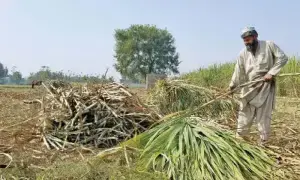
Every year, as the sugarcane crushing season approaches, Pakistan finds itself trapped in the same debate. Farmers demand higher cane prices to offset rising production costs. Sugar mills argue that increased procurement prices make sugar commercially unviable. Governments intervene to broker settlements, while consumers brace for higher retail prices.
By the end of the season, all of them have negotiated a price. Yet almost no one asks the most important question: why does Pakistan continue to treat sugarcane as a pricing problem rather than a productivity challenge? This difference matters because prices merely redistribute value within the supply chain; productivity creates new value for everyone. A grower harvesting more cane from the same land earns higher income without depending entirely on a single factor of price increases. Millers process more efficiently, consumers benefit from a more stable supply, and the economy becomes more competitive. Unfortunately, public policy has rarely been designed around this principle.
Sugarcane occupies a unique place in Pakistan’s economy. It supports millions of rural livelihoods and supplies raw material to the country’s second-largest agro-based industry after textiles. According to the Pakistan Economic Survey 2025-26, agriculture contributes 23.4 per cent to Pakistan’s GDP and employs about 33pc of the national workforce. However, the sugarcane crop contributes merely 0.8pc to GDP. Sugarcane was the best-performing major crop during the last fiscal year, with production rising by 6.2pc to 89.45 million tonnes.
One favourable season does not guarantee long-term competitiveness. Pakistan’s sugar economy continues to face deep-rooted challenges: stagnant-to-declining farm productivity in many regions, rising cultivation costs, deteriorating water availability, climate variability, labour shortages and inconsistent technology adoption.
The real measure of success is whether farmers are producing more from the same investments
These are not seasonal problems, but structural ones. Yet policy attention remains disproportionately focused on annual price notifications.
Every year, provincial governments devote considerable administrative effort to fixing support prices and resolving disputes between the millers and growers’ bodies.
While fair prices are essential for protecting farmers’ economy, they have gradually become the dominant measure of policy success.
Productivity, innovation and resource efficiency receive far less attention.
Pakistan’s future agricultural growth cannot depend on expanding cultivated area.
Land is finite, water is becoming increasingly scarce, and climate risks (high temperatures and untimely rains) are intensifying. The next generation of agricultural growth must come from producing more output with fewer resources.
The first priority should be rebuilding agricultural extension. Pakistan has invested heavily in agricultural research over several decades. Research institutions and universities have developed improved crop varieties such as CPF-246, HSF-240 and YTFG-236, better nutrient management practices and more sustainable pest-control strategies. Yet scientific knowledge too often remains confined to experimental stations instead of reaching farmers’ fields.
The country’s extension system has gradually weakened, leaving many farmers dependent on inherited practices or commercial input dealers for technical advice. Modern agriculture requires something different: research-based professional extension services that combine field demonstrations with digital advisory systems, satellite imagery, weather-based recommendations and artificial intelligence (AI) to deliver timely, locationspecific guidance.
The second priority is accelerating technological adoption.
Mechanisation should no longer be viewed as a luxury reserved for large landholders.
Precision planters, laser land levellers, stubble shavers, residue-management machines and precision irrigation technologies can significantly improve productivity while managing resources more efficiently and reducing production costs. Public policy should therefore focus not only on subsidising machinery procurement but also on promoting customer facilitation centres, machinery cooperatives, and affordable financing to enable small and medium-sized farmers to access modern technologies.
Water productivity deserves equal attention.
Pakistan is among the world’s most waterstressed countries, yet agricultural policy still tends to measure success by harvested weight rather than by output per unit of water consumed. Indus River System Authority (IR SA) has predicted 15pc and 5pc shortfall of water for Kharif and Rabi seasons in 2026- 27.
Sugarcane becomes a hot debate because of its water requirements (300 m³/tonne of cane in semi-arid regions). The more relevant policy question, however, is not whether the country should grow sugarcane, but whether it can produce the crop more efficiently through better soil management, laser land levelling, improved irrigation scheduling, and varieties with higher water-use efficiency.
The same logic applies to pest management.
Heavy dependence on chemical pesticides has increased production costs while creating environmental and ecological concerns.
Integrated Pest Management (IPM) and biological control should no longer be viewed simply as environmental projects; they are sound economic policies. Reducing unjust pesticide use lowers input costs, slows the development of pest resistance and preserves farmer-friendly beneficial insects.
Profitability and sustainability are increasingly becoming complementary rather than challenging objectives.
None of these reforms diminishes the importance of fair cane prices. Farmers deserve returns that reflect rising input costs and reward efficient production. But price alone cannot become the centrepiece of agricultural policy.
Higher procurement prices without corresponding productivity reforms simply shift costs along the value chain. Farmers continue to struggle with rising costs of fertiliser, diesel and labour. Millers face higher production costs. Consumers ultimately pay more.
Governments become trapped in another cycle of intervention.
Productivity improvement offers a longlasting solution because it expands economic value instead of merely redistributing it.
Pakistan already holds many of the ingredients necessary for transformation: experienced farmers, capable researchers, an established sugar industry (working in variety development, technology introduction, biological control of pests and financial support) and growing access to digital technologies.
What has been missing is a clear national approach that rewards innovation as consistently as it regulates prices.
The frequent debate over cane prices is unlikely to disappear, nor should it. Pricing will always remain an important part of agricultural policy, but it should no longer dominate it.
The real measure of success is not the price announced before the crushing season.
It is whether, year after year, farmers are producing more from every hectare, every drop of water and every rupee they invest.
The writer is senior manager R&D at Mehran Sugar Mills
Published in Dawn, The Business and Finance Weekly, July 20th, 2026 ...
이 뉴스, 어떠셨어요?
탭 한 번으로 반응 · 로그인 불필요