Investors want a bigger reward for lending money
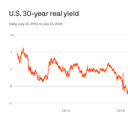
Data: Federal Reserve Bank of St. Louis, U.S. Treasury Department; Chart: Courtenay Brown/Axios
The relentless run-up in Treasury yields reflects the globe's new economic reality: It takes a much richer reward to persuade investors to lend their money, especially for the longer run.
Why it matters: Unlike previous bond sell-offs driven by inflation fears, this one reflects a world in which governments and companies are scrambling for enormous amounts of capital to finance wide fiscal deficits, the AI infrastructure buildout and more.
The competition is forcing borrowers to pay more.
The good news is that inflation expectations appear to be in check, so the moves don't necessarily compel any immediate reaction from the Federal Reserve. But it does imply that policy rates will need to remain higher, year in and year out, to keep the economy in balance.
It also makes Washington's fiscal math considerably more painful by raising the cost of financing an already swelling national debt. For homebuyers, that means mortgage rates are less likely to fall anytime soon.
By the numbers: The bond market's long-run inflation pricing has barely changed even as Treasury yields have climbed.
The 10-year breakeven inflation rate — a market-based gauge of expected inflation — has edged higher to 2.28% since late June as conflict in the Middle East flared again. Yet it remains below its 2.5% peak in early May and in a zone consistent with the Fed achieving its 2% inflation target over time.
Despite that relatively steady inflation outlook, Treasury yields have continued to surge, with the 10-year yield topping 4.7% Thursday morning for the first time since last January.
Of note: The surge in real yields is even more startling at the longest time horizons. Thirty-year Treasury Inflation-Protected Securities are now yielding 2.97%, the highest since the security was reintroduced in 2010.
State of play: It all suggests that investors are largely demanding a bigger reward to lend money for the long haul, not just pricing in higher inflation.
For much of the last two decades, bond market moves were primarily downstream of inflationary trends and central bank actions.
Now, the rate environment is being shaped by the supply of loanable funds (finite) and demand (seemingly limitless).
Flashback: In the 2010s, the world had too much money chasing too few productive investments, keeping the cost of capital historically cheap.
Today, the opposite looks true: Governments are running larger deficits just as companies embark on the biggest investment boom in decades — competing for the same pool of money.
Consider what Alphabet told investors Wednesday night: The company raised its capital expenditure plans by another $15 billion this year, with chief financial officer Anat Ashkenazi saying that demand for computing capacity "still outpaces that investment."
The intrigue: If sustained, the higher rates will make the U.S. government's debt service costs even more unwieldy than currently projected.
Congressional Budget Office projections issued in February assumed the 10-year Treasury yield would average 4.1% this year and 4.3% the next few years.
CBO estimates that every 0.1 percentage point rise in rates, sustained over the coming decade, would increase government interest expense by $379 billion over that span.
Back-of-the-envelope math implies that if the recent rate move is sustained, it will cost taxpayers something like $1.8 trillion in additional interest over the coming decade.
The bottom line: There is a chance this is but a summer hiccup in the multitrillion-dollar global bond market. But these surges in yields keep happening, suggesting something bigger is shifting in the global capital markets. ...
이 뉴스, 어떠셨어요?
탭 한 번으로 반응 · 로그인 불필요